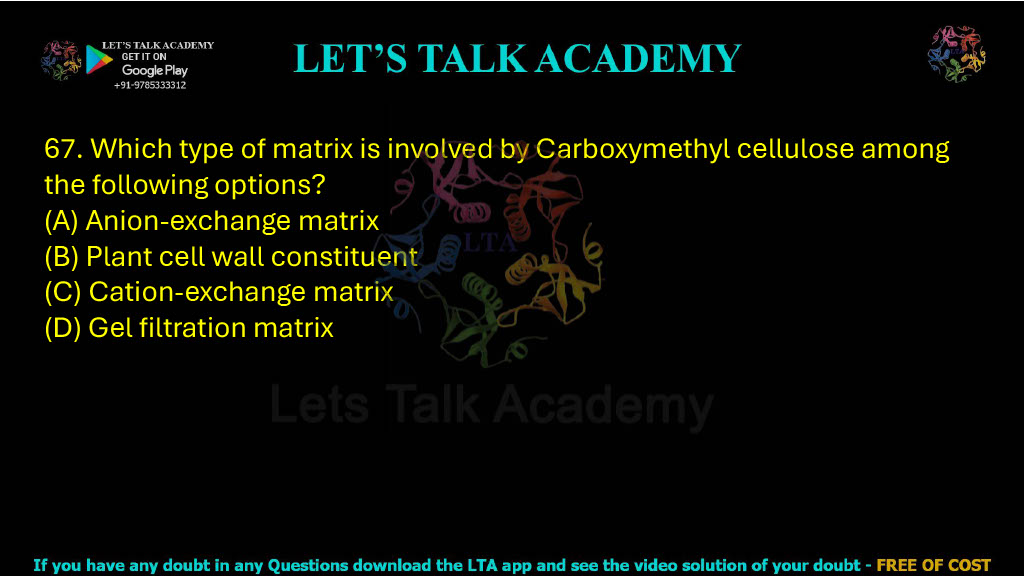
67. Which type of matrix is involved by Carboxymethyl cellulose among the following options:
A. Anion-exchange matrix
B. Plant cell wall constituent
C. Cation-exchange matrix
D. Gel filtration matrix
Carboxymethyl cellulose (CMC) is a cation-exchange matrix due to its negatively charged carboxymethyl groups (-CH₂COOH), which bind positively charged molecules like proteins at appropriate pH levels.
Correct Answer
The right option is C. Cation-exchange matrix. This is commonly tested in exams like GATE Life Sciences for chromatography concepts in biochemistry.
Option Breakdown
-
A. Anion-exchange matrix: Incorrect. Anion exchangers have positive charges (e.g., DEAE-cellulose with diethylaminoethyl groups) to bind anions. CMC’s negative charges repel anions.
-
B. Plant cell wall constituent: Incorrect. Cellulose forms plant cell walls, but CMC is a modified derivative with carboxymethyl groups added chemically, not found naturally in plants.
-
C. Cation-exchange matrix: Correct. At neutral pH, CMC’s carboxymethyl groups ionize to -CH₂COO⁻, attracting cations for protein purification.
-
D. Gel filtration matrix: Incorrect. Gel filtration (size-exclusion) uses porous beads like Sephadex for separation by molecular size, not charge. CMC relies on ion-exchange.
CMC, or carboxymethyl cellulose, serves as a key tool in biochemistry labs for protein separation. Its structure features cellulose modified with carboxymethyl groups, making it water-soluble and charged.
In ion-exchange chromatography, the matrix type determines what it binds. CMC’s -CH₂COOH groups deprotonate at pH above ~4.5, forming negative sites that capture cations while anions pass through.
Why Cation-Exchange?
Cation exchangers like CMC (CM-cellulose) are favorites for purifying basic proteins. Elution uses salt gradients or pH shifts to release bound molecules. This contrasts with anion exchangers like Q-Sepharose.
| Matrix Type | Charge | Example | Binds | GATE Relevance |
|---|---|---|---|---|
| Cation-Exchange | Negative | CM-Cellulose | Positive ions/proteins | Protein purification |
| Anion-Exchange | Positive | DEAE-Cellulose | Negative ions/proteins | DNA/RNA separation |
| Gel Filtration | Neutral | Sephadex | By size | Molecular weight check |
| Plant Cell Wall | Neutral polymer | Cellulose | N/A | Structural role |
This table clarifies distinctions for quick revision. For GATE, remember: negative matrix = cation binder.
Exam Applications
In competitive exams, questions test matrix selection for purification. CMC suits cation-exchange due to its weak acid nature (pKa ~4), ideal for physiological pH. Practice with past papers to master.


1 Comment
Kanica Sunwalka
June 26, 2026CATION EXCHANGE MATRIX