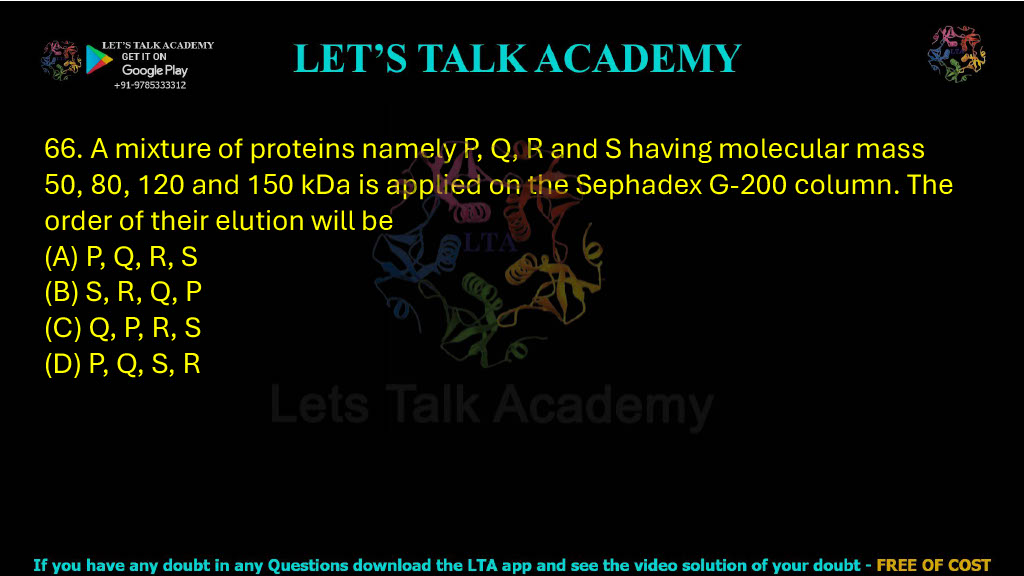
66. A mixture of proteins namely P, Q, R and S having molecular mass 50, 80, 120 and 150 kDa is applied on the Sephadex G-200 column.
The order of their elution will be:
A. P, Q, R, S
B. S, R, Q, P
C. Q, P, R, S
D. P, Q, S, R
The correct answer is B. S, R, Q, P.
Sephadex G-200 is a size exclusion chromatography matrix where larger proteins elute first as they cannot enter the bead pores, while smaller ones take longer paths and elute later.
Option Explanations
A. P, Q, R, S (50→80→120→150 kDa) reverses the elution order; smaller proteins elute last in size exclusion, not first.
B. S, R, Q, P (150→120→80→50 kDa) matches the principle—largest (S, 150 kDa) excluded first, smallest (P, 50 kDa) last within G-200’s 5-8000 kDa range.
C. Q, P, R, S lacks logical size progression; elution strictly follows decreasing molecular mass.
D. P, Q, S, R incorrectly prioritizes small proteins early and disrupts size order.
Sephadex G-200 in Protein Separation
Sephadex G-200 elution order proteins 50 80 120 150 kDa follows size exclusion chromatography principles, crucial for GATE Life Sciences preparation. Larger proteins like 150 kDa (S) elute first, smaller 50 kDa (P) last.
Size Exclusion Mechanism
Porous Sephadex G-200 beads (exclusion limit ~800 kDa) allow small proteins to enter pores, increasing their path length and elution time. Order: S (150 kDa), R (120 kDa), Q (80 kDa), P (50 kDa).
Elution Order Comparison
| Option | Predicted Order (kDa) | Correct? | Reason |
|---|---|---|---|
| A | P-Q-R-S (50-150) | No | Small first—inverse of SEC |
| B | S-R-Q-P (150-50) | Yes | Large first—SEC principle |
| C | Q-P-R-S | No | No size correlation |
| D | P-Q-S-R | No | Irregular pattern |
GATE Life Sciences Application
This PYQ tests SEC fundamentals over ion exchange or affinity methods. G-200 suits 5-800 kDa globular proteins; remember inverse elution for exams.


2 Comments
Nisha Choudhary
February 8, 2026Ans S,R,Q,P
Kanica Sunwalka
June 26, 2026larger will elute first in SEC