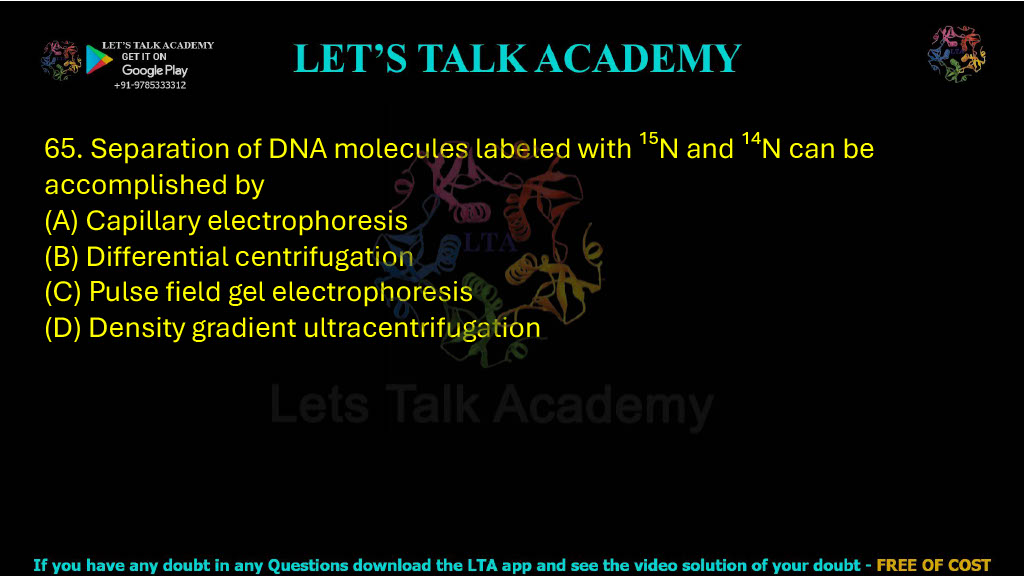
65. Separation of DNA molecules labelled with 15N and 14N can be accomplished by:
A. Capillary electrophoresis
B. Differential centrifugation
C. Pulse field gel electrophoresis
D. Density gradient ultracentrifugation
The correct answer is D. Density gradient ultracentrifugation.
This method separates DNA based on buoyant density differences between 15N-labeled (heavier) and 14N-labeled (lighter) molecules, as proven in the Meselson-Stahl experiment.
Option Explanations
Capillary Electrophoresis (A) separates DNA primarily by size and charge using an electric field in a capillary tube, not density. It lacks the resolution for isotopic density differences.
Differential Centrifugation (B) pellets cells or large organelles by varying speeds but cannot resolve subtle DNA isotope density variations.
Pulse Field Gel Electrophoresis (C) handles large DNA fragments (>50 kb) by alternating electric fields to avoid tangling, focusing on size rather than density.
Density Gradient Ultracentrifugation (D) uses cesium chloride (CsCl) gradients spun at high speeds; DNA bands at its buoyant density. 15N-DNA (1.725 g/ml) separates from 14N-DNA (1.710 g/ml).
Introduction to DNA Isotope Separation
Density gradient ultracentrifugation DNA separation 15N 14N is a cornerstone technique in molecular biology, famously used in the 1958 Meselson-Stahl experiment to prove semi-conservative DNA replication. Bacteria grown in 15N medium produce heavy DNA, which shifts to hybrid density after switching to 14N. This method’s precision makes it ideal for competitive exams like GATE Life Sciences.
How Density Gradient Ultracentrifugation Works
In CsCl density gradient ultracentrifugation, DNA equilibrates at its buoyant density during ultracentrifugation (e.g., 55,000 rpm for 66 hours). 15N incorporation increases density by ~1.5%, creating distinct bands visible under UV after staining. This directly resolves heavy (15N/15N), hybrid (15N/14N), and light (14N/14N) DNA.
Comparing Separation Techniques
| Technique | Basis of Separation | Suitable for 15N/14N DNA? | Key Limitation |
|---|---|---|---|
| Capillary Electrophoresis | Size/charge in electric field | No | Ignores density differences |
| Differential Centrifugation | Sedimentation rate | No | For cells, not isotopes |
| Pulse Field Gel Electrophoresis | Size of large fragments | No | Size-based, not density |
| Density Gradient Ultracentrifugation | Buoyant density | Yes | Gold standard for isotopes |
Relevance for GATE Life Sciences
This question tests understanding of Meselson-Stahl’s legacy in replication studies. Options A-C mislead by confusing electrophoresis (size/charge) with centrifugation (density). Master this for PYQs on molecular biology.


2 Comments
Nisha Choudhary
February 9, 2026Ans density gradient ultracentrifugation
Kanica Sunwalka
June 26, 2026density gradient ultracentrifugation