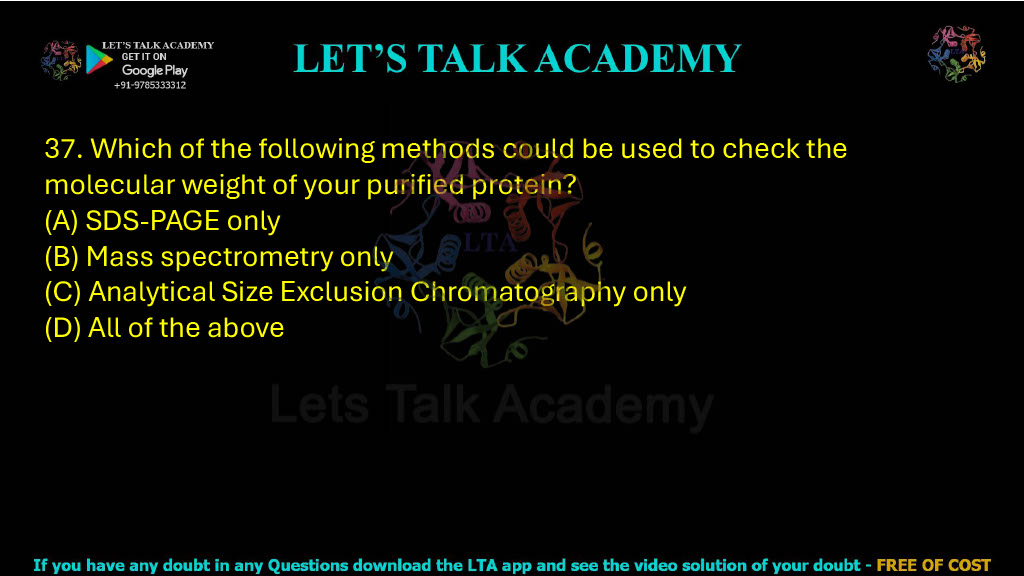
37. Which of the following methods could be used to check the molecular weight of your purified protein?
A. SDS-PAGE only
B. Mass spectrometry only
C. Analytical size exclusion chromatography only
D. All of the above
All three methods—SDS-PAGE, mass spectrometry, and analytical size exclusion chromatography—can determine the molecular weight of purified proteins, though each varies in precision and application.
Option Analysis
-
A. SDS-PAGE only: SDS-PAGE denatures proteins and separates them by size in a polyacrylamide gel under an electric field. Molecular weight is estimated by comparing migration distance to standards, offering ~5-10% accuracy for routine checks.
-
B. Mass spectrometry only: MS ionizes proteins and measures mass-to-charge ratio (e.g., MALDI-TOF), providing exact molecular weights down to daltons. It’s highly accurate for intact proteins or peptides but requires specialized equipment.
-
C. Analytical size exclusion chromatography only: SEC (gel filtration) separates proteins by hydrodynamic volume as they pass through porous beads. Elution volume correlates to molecular weight via calibration curves, ideal for native conditions.
-
D. All of the above: Correct, as each method independently assesses molecular weight, complementing each other for validation in protein purification workflows.
Correct Answer: D
Introduction to Checking Molecular Weight of Purified Protein
Checking molecular weight of purified protein is essential in biochemistry for verifying purity and identity post-purification, especially for GATE Life Sciences aspirants tackling protein analysis questions. Common techniques include SDS-PAGE for gel-based estimation, mass spectrometry for precise mass, and analytical size exclusion chromatography for native sizing.
Principles of Protein Molecular Weight Methods
Proteins’ molecular weight reflects polypeptide chain mass, influenced by sequence and modifications. SDS-PAGE uses size-based migration; mass spectrometry measures ionized mass; SEC relies on size exclusion in columns. Each suits different needs—routine vs. high-precision.
Comparison of Methods
| Method | Principle | Accuracy | Best For |
|---|---|---|---|
| SDS-PAGE | Denatured size separation in gel | ~5-10% | Purity & quick estimates |
| Mass Spectrometry | Mass-to-charge ratio of ions | <1 Da | Exact mass, modifications |
| Analytical SEC | Hydrodynamic volume exclusion | 5-15% | Native oligomers, stability |
| All Above | Combined validation | Comprehensive | Full characterization |
All options work, making “all of the above” ideal for versatile lab use.


2 Comments
Vanshika Sharma
February 3, 2026All three methods can determine the mol. Weight of purified protein
Kanica Sunwalka
June 26, 2026all of the above