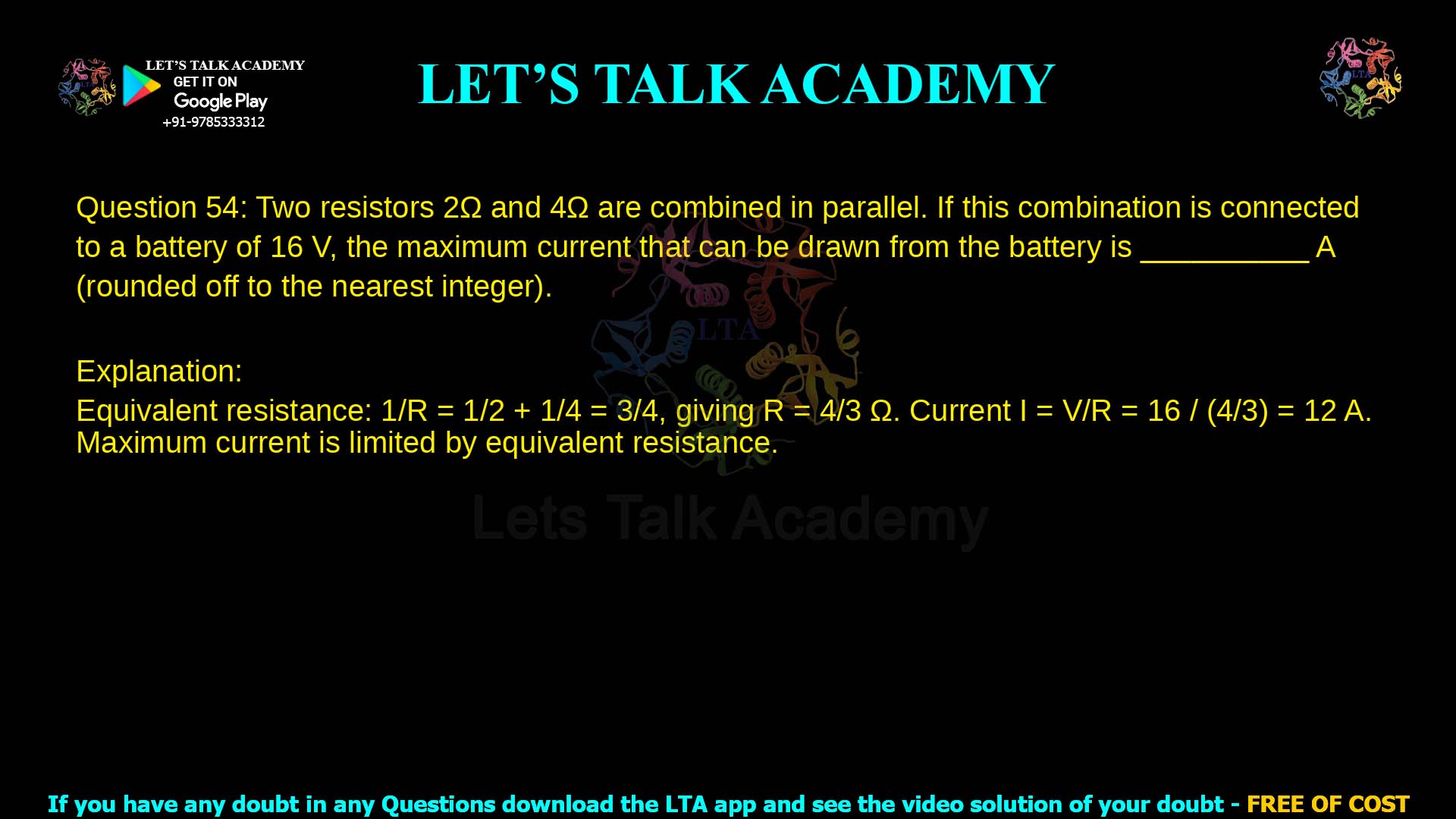
Q.54 Two resistors 2ohm and 4ohm are combined in parallel. If this combination is
connected to a battery of 16 𝑉, the maximum current that can be drawn from
the battery is __________ 𝐴 (rounded off to the nearest integer).
Maximum Current from 2 Ohm and 4 Ohm Resistors in Parallel with 16V Battery
Two 2Ω and 4Ω resistors in parallel connected to a 16V battery draw a maximum current of 12A, rounded to the nearest integer.
Problem Analysis
The query specifies a parallel combination of 2Ω and 4Ω resistors across a 16V battery, asking for maximum current in amperes. “Maximum current” refers to total current from the battery under ideal conditions (no internal resistance), determined by Ohm’s Law after finding equivalent resistance.
Equivalent Resistance Calculation
For parallel resistors, use the formula \( \frac{1}{R_{eq}} = \frac{1}{R_1} + \frac{1}{R_2} \). Substituting values: \( \frac{1}{R_{eq}} = \frac{1}{2} + \frac{1}{4} = \frac{2}{4} + \frac{1}{4} = \frac{3}{4} \), so \( R_{eq} = \frac{4}{3} \approx 1.33 \, \Omega \).
Total Current Determination
Apply Ohm’s Law: \( I = \frac{V}{R_{eq}} = \frac{16}{\frac{4}{3}} = 16 \times \frac{3}{4} = 12 \, \text{A} \). This exact value rounds to 12A as required.
Individual Branch Currents
Current divides inversely with resistance: through 2Ω branch, \( I_1 = \frac{16}{2} = 8 \, \text{A} \); through 4Ω branch, \( I_2 = \frac{16}{4} = 4 \, \text{A} \). Total confirms: \( 8 + 4 = 12 \, \text{A} \).
Why No Options Provided
The question lacks explicit choices (A, B, C, D), typical for numerical fill-in formats like CSIR NET or JEE. Common distractors include series equivalent (6Ω, yielding ~2.7A) or misapplied formulas; parallel always gives lower \( R_{eq} \) and higher current than series.


