The two phylogenetic trees given below represent evolutionary patterns in species or population. The differently colored or dashed lines represent a single or gene genealogy. Select the option that correctly […]

CSIR NET Life Science Previous Year Questions and Solution on Molecular Evolution
No posts found.
The two phylogenetic trees given below represent evolutionary patterns in species or population. The differently colored or dashed lines represent a single or gene genealogy. Select the option that correctly […]

The following statements were made describing the properties of a UPGMA tree (Unweighted Pair Group Method with Arithmetic Mean): A. It describes species relationships and is therefore the best method […]

Given are some statements with reference to the use of genes in plant molecular systematics. A. mtDNA are not preferred over cpDNA or rDNA because they generally show slow rate […]

In the cladograms given below each nucleotide change is indicated by a black bar Which one of the following options represents two equally most parsimonious trees? (1) A and B […]

When James R Brown and W Ford Doolittle (1997) reconstructed the tree of life using a variety of different genes, they found that different genes gave fundamentally different phylogenies as […]

In the phylogenetic tree above, branch-lengths are drawn proportional to the number of changes along a lineage. The following inferences were made from this tree. (A) Bacteria are more closely […]
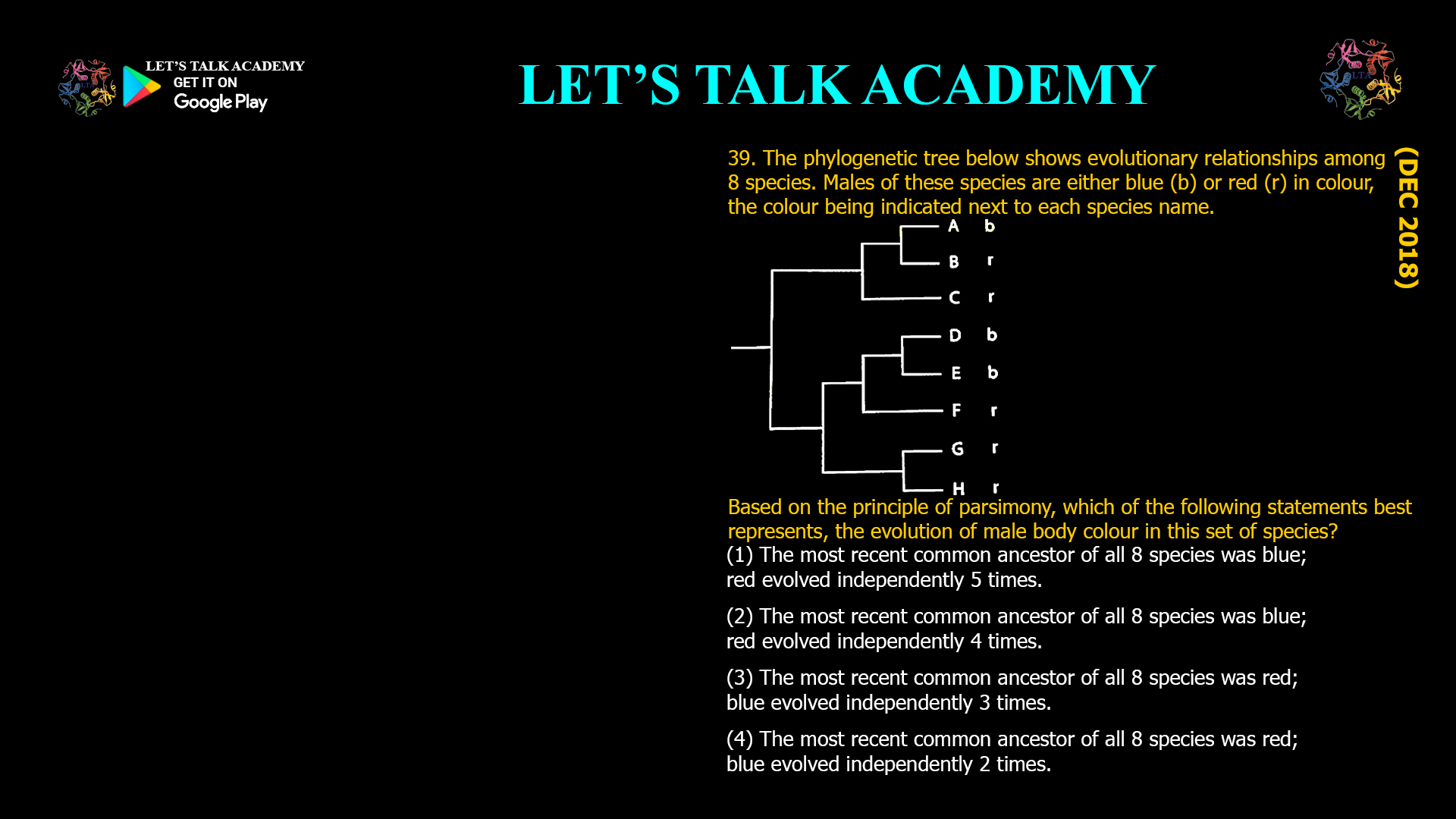
The phylogenetic tree below shows evolutionary relationships among 8 species. Males of these species are either blue (b) or red (r) in colour, the colour being indicated next to each […]

The phylogeny below shows evolutionary relationships between 9 extant bird species and whether they display red or blue plumage. Based on the above phylogeny and the distribution of red and […]
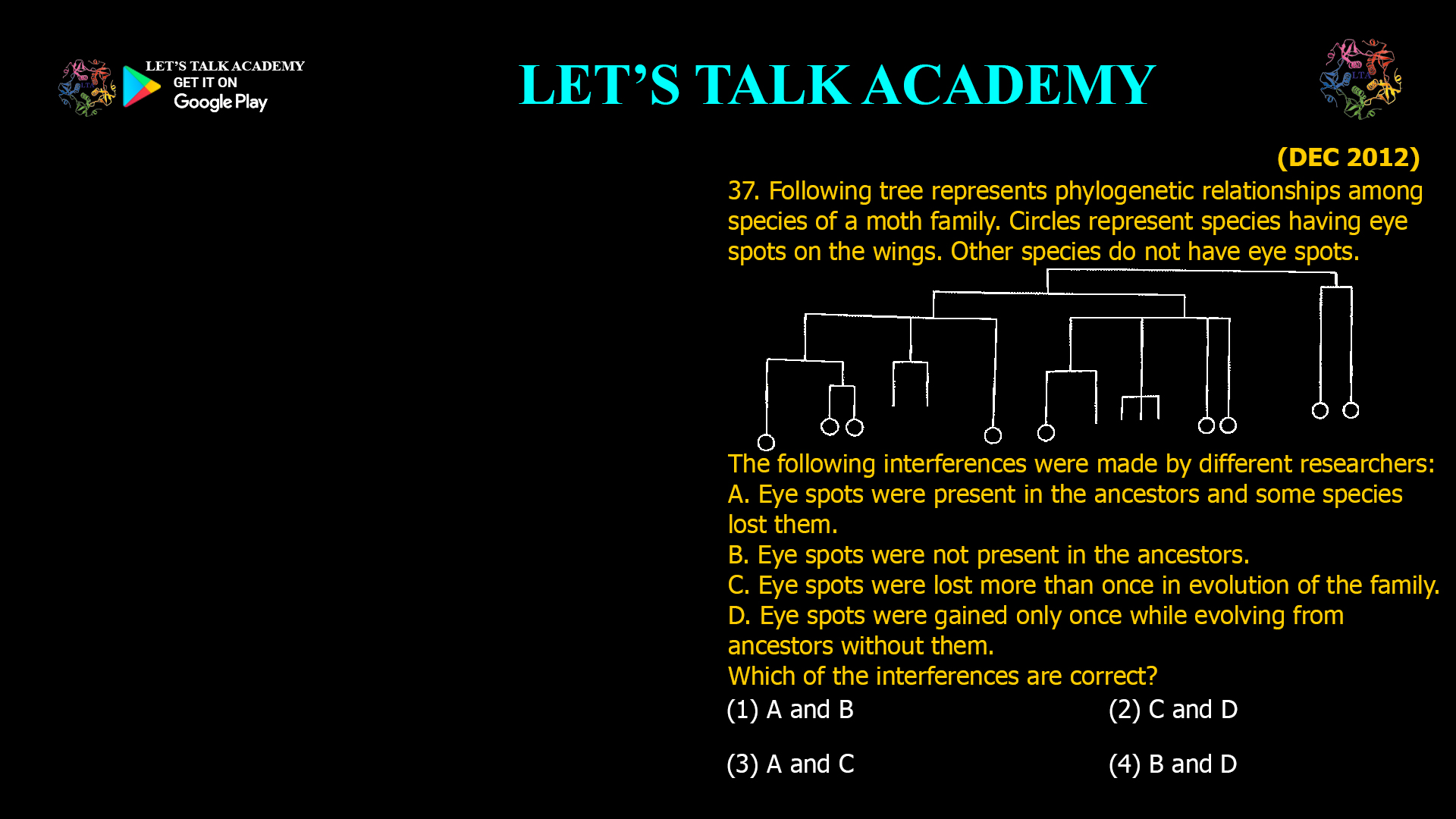
Following tree represents phylogenetic relationships among species of a moth family. Circles represent species having eye spots on the wings. Other species do not have eye spots. The following interferences […]

Which one of the following genomes is most appropriate to determine hybrids in plants and animals? (1) Nuclear (2) Mitochondrial (3) Chloroplast (4) Mitochondria and chloroplast Nuclear Genome: The […]


