- When James R Brown and W Ford Doolittle (1997) reconstructed the tree of life using a variety of different genes, they found that different genes gave fundamentally different phylogenies as shown below.
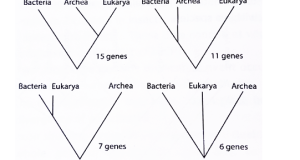
Note that the genes are unique to the specific trees.From the given options select the process that best explains the observed discrepancies between the trees.
(1) polyploidization
(2) horizontal gene transfer
(3) allopatric speciation
(4) localized extinctionsHorizontal Gene Transfer: The Key to Conflicting Phylogenetic Trees in the Tree of Life
The quest to reconstruct the universal tree of life has long fascinated evolutionary biologists. James R. Brown and W. Ford Doolittle’s 1997 study highlighted a perplexing issue: when using different genes to build phylogenetic trees, the resulting evolutionary relationships often conflict. Why do these discrepancies arise, and what do they reveal about the history of life on Earth?
The Challenge: Conflicting Phylogenetic Trees
When Brown and Doolittle reconstructed the tree of life using a variety of genes, they found that each gene often produced a fundamentally different tree. This means that the evolutionary relationships suggested by one gene might not match those suggested by another. Such conflicts are especially pronounced among prokaryotes (bacteria and archaea), but can also affect eukaryotic lineages.
The Underlying Process: Horizontal Gene Transfer
The process that best explains these discrepancies is horizontal gene transfer (HGT). Unlike vertical gene transfer, where genetic material is passed from parent to offspring, HGT involves the movement of genes between unrelated organisms. This can happen through various mechanisms such as transformation, transduction, and conjugation.
Why HGT Disrupts Phylogenetic Trees
-
Gene Mixing Across Lineages: HGT allows genes to jump between distant species, creating a network of genetic relationships rather than a simple, branching tree.
-
Unique Gene Histories: Each gene may have its own evolutionary path, independent of the organism’s overall lineage, leading to conflicting phylogenetic signals when different genes are analyzed.
-
Prokaryotic Complexity: HGT is especially common in bacteria and archaea, making it difficult to represent their evolutionary history as a single, coherent tree.
The Impact on the Tree of Life
The prevalence of HGT has led some scientists, including Doolittle, to propose that the history of life is better represented as a “web” or “network” rather than a strictly bifurcating tree. This network model acknowledges the reality that gene flow between lineages can blur the boundaries of evolutionary history.
Alternative Explanations: Why They Fall Short
-
Polyploidization primarily affects eukaryotes and results in genome doubling, not the widespread gene tree conflicts seen in all domains of life.
-
Allopatric speciation and localized extinctions are important evolutionary processes but do not explain why different genes produce different phylogenetic trees.
Conclusion
The observed discrepancies between phylogenetic trees constructed from different genes are best explained by horizontal gene transfer. This process has profoundly shaped the genomes of prokaryotes and challenges the traditional view of a single, universal tree of life. Instead, the evolutionary history of life is more accurately depicted as a complex network of genetic exchanges.
Correct answer: (2) horizontal gene transfer
-


