- A study tested the importance of learning mechanisms in the development of antipredator escape responses in tadpoles of a frog species. Tadpoles hatched from eggs in the lab were kept individually either with predator chemical cues (PRIOR EXPOSURE) or without predator
chemical cues (NAIVE) for 1 week. These individuals were tested for their escape response when exposed to a live predator. They were tested either alone or together with 3 older experienced tadpoles. The graph below shows the escape response of the test individuals
in the four different treatments.
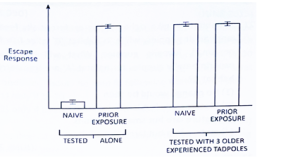
Some of the inferences drawn are given below:
A. Prior exposure to predator cues is necessary for the development of escape response.
B. Prior exposure to predator cues positively influences the development of escape response.
C. The presence of older experienced individuals is necessary for the development of escape response.
D. The presence of older experienced individuals positively influences the development of escape response.
E. An individual with prior exposure and with older and experienced individuals showed the strongest escape response.
Which one of the following combination of statements represents the correct inference from the experiment?
(1) A and C (2) B and D
(3) A and D (4) A, C and EKey Experimental Findings
The experiment involved four groups:
-
Naive tadpoles (no prior predator cue exposure), tested alone
-
Naive tadpoles, tested with older experienced tadpoles
-
Tadpoles with prior predator cue exposure, tested alone
-
Tadpoles with prior predator cue exposure, tested with older experienced tadpoles
The escape responses were measured and compared across these groups.
Interpreting the Results
Let’s evaluate the inferences:
A. Prior exposure to predator cues is necessary for the development of escape response.
Incorrect.
While prior exposure enhances the escape response, it is not strictly necessary—tadpoles can still show some response without it, especially when social cues are present.B. Prior exposure to predator cues positively influences the development of escape response.
Correct.
Tadpoles exposed to predator cues before testing showed a stronger escape response than naive individuals, indicating that learning from prior experience enhances antipredator behavior.C. The presence of older experienced individuals is necessary for the development of escape response.
Incorrect.
While the presence of experienced conspecifics boosts the escape response, it is not absolutely necessary; individuals can develop responses through their own experience.D. The presence of older experienced individuals positively influences the development of escape response.
Correct.
Tadpoles tested with older, experienced individuals showed enhanced escape responses, demonstrating the positive influence of social learning and group cues.E. An individual with prior exposure and with older and experienced individuals showed the strongest escape response.
Supported by the data but not a direct inference option in the question.
Correct Combination
The best-supported inferences from the experiment are:
-
B. Prior exposure to predator cues positively influences the development of escape response.
-
D. The presence of older experienced individuals positively influences the development of escape response.
Conclusion
Both individual learning through prior predator exposure and social cues from experienced conspecifics independently and additively enhance the development of effective antipredator escape responses in tadpoles. This highlights the importance of both learning mechanisms and social environment in shaping survival strategies.
Correct answer: (2) B and D
-


1 Comment
Kajal
November 26, 2025B and D