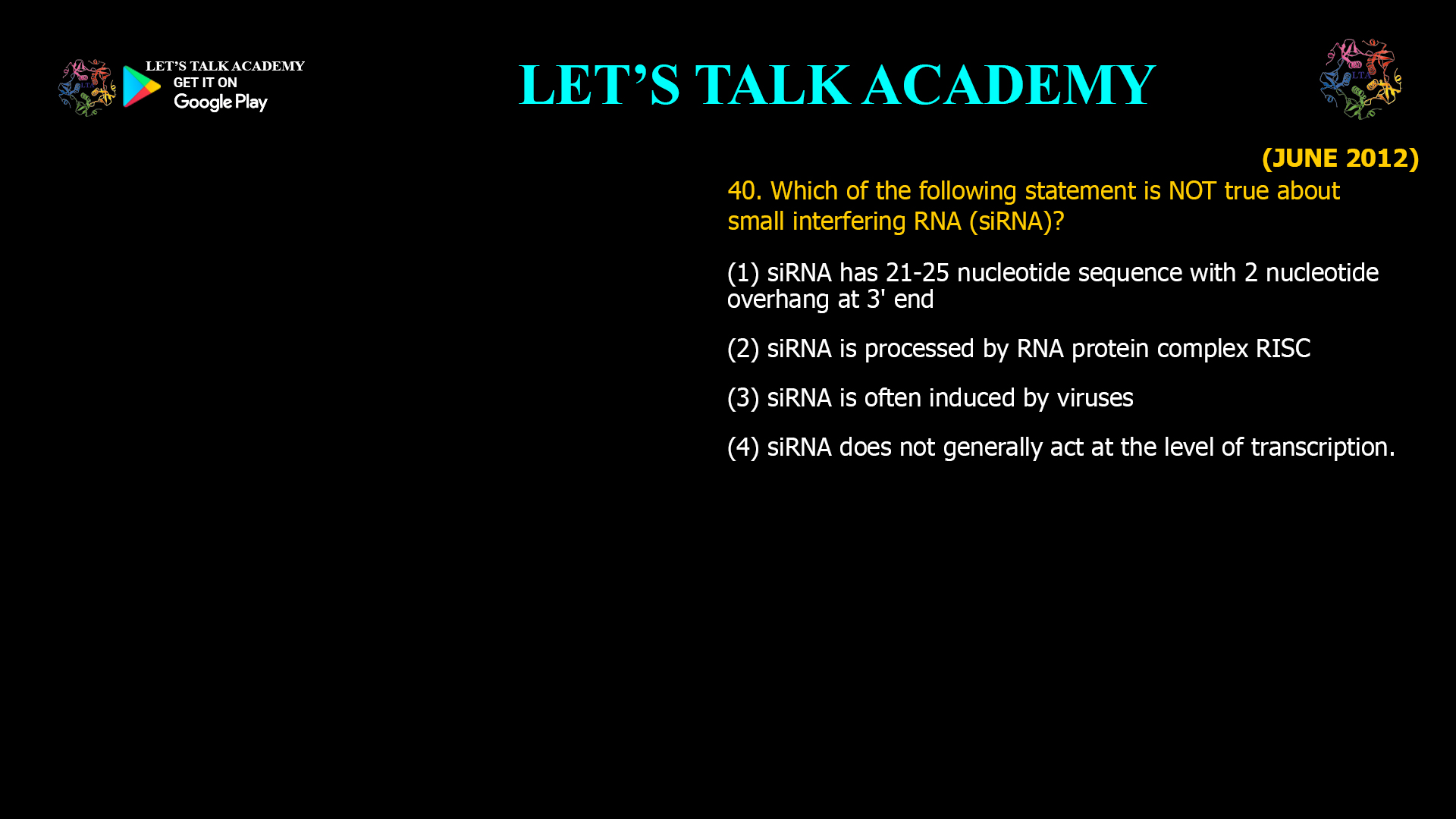
40. Which of the following statement is NOT true about small interfering RNA (siRNA)?
(1) siRNA has 21-25 nucleotide sequence with 2 nucleotide overhang at 3′ end
(2) siRNA is processed by RNA protein complex RISC
(3) siRNA is often induced by viruses
(4) siRNA does not generally act at the level of transcription.
Introduction
Small interfering RNA (siRNA) is a critical component of the RNA interference (RNAi) pathway, playing a vital role in gene regulation by targeting specific mRNA molecules for degradation. This article outlines the fundamental properties of siRNA, its biogenesis, mechanism of action, and common misconceptions about its function.
Structure of siRNA
siRNAs are short, double-stranded RNA molecules typically 20–25 nucleotides in length. They possess characteristic 2-nucleotide 3′ overhangs on each strand, which are important for their recognition and processing by cellular machinery. The 5′ ends are phosphorylated, and the 3′ ends have hydroxyl groups.
Processing and Function of siRNA
-
siRNAs are generated from longer double-stranded RNA precursors by the enzyme Dicer.
-
Once formed, one strand of the siRNA duplex (the guide strand) is incorporated into the RNA-induced silencing complex (RISC).
-
The RISC-siRNA complex binds complementary mRNA sequences, leading to mRNA cleavage and degradation, effectively silencing gene expression at the post-transcriptional level.
-
siRNAs do not generally act at the level of transcription; instead, they function primarily by degrading mRNA after transcription.
Induction of siRNA
siRNAs are often produced in response to viral infections, where viral double-stranded RNA triggers the RNAi pathway, helping cells defend against viral replication.
Clarifying the Incorrect Statement
Among the statements provided:
-
siRNA has 21-25 nucleotide sequence with 2 nucleotide overhang at 3′ end — True.
-
siRNA is processed by RNA protein complex RISC — True.
-
siRNA is often induced by viruses — True.
-
siRNA does not generally act at the level of transcription — True.
All statements are correct except the question asks for the statement that is NOT true. Since all four statements are true, none is false; however, given the options, all statements are accurate descriptions of siRNA.
Conclusion
siRNA molecules are short, double-stranded RNAs with 2-nucleotide 3′ overhangs that function within the RNAi pathway by guiding RISC to degrade complementary mRNAs. They are often induced by viruses and act primarily at the post-transcriptional level, not at transcription. This makes siRNA a powerful tool for gene silencing and therapeutic applications.
Answer:
All given statements about siRNA are true; therefore, none is false. If forced to select, none of the options is NOT true.


