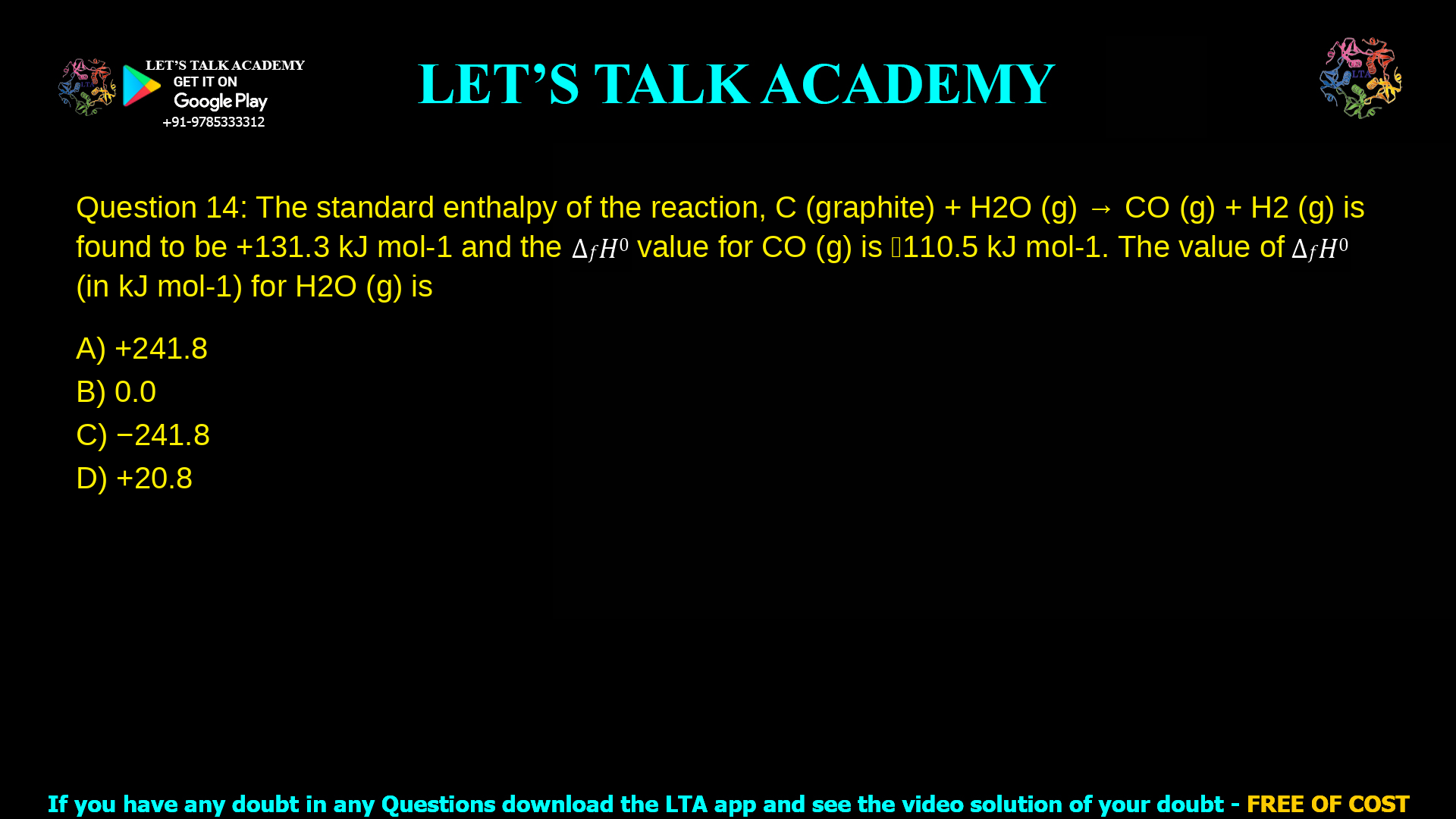
Q. 14 The standard enthalpy of the reaction,
C (graphite) + H2O (g) → CO (g) + H2 (g) is found to be +131.3 kJ mol–1
and the ∆𝑓𝐻0 value for CO (g) is ‒110.5 kJ mol–1.
The value of ∆𝑓𝐻0 (in kJ mol–1) for H2O (g) is
(The standard enthalpies of formation of elements in their reference states are zero
at all temperatures)
(A) +241.8
(B) 0.0
(C) −241.8
(D) +20.8
The standard enthalpy of formation (∆fH⁰) for H₂O(g) is -241.8 kJ/mol, calculated using the given reaction enthalpy and known values. This matches option (C) in the CSIR NET Life Sciences/Biochemistry question.
Reaction Analysis
The given reaction is C(graphite) + H₂O(g) → CO(g) + H₂(g) with ∆rH⁰ = +131.3 kJ/mol. Standard enthalpy of formation equals the reaction enthalpy for forming 1 mol of compound from elements in standard states, and elements like C(graphite) and H₂(g) have ∆fH⁰ = 0 kJ/mol.
The reaction enthalpy equation becomes: ∆rH⁰ = [∆fH⁰(CO) + ∆fH⁰(H₂)] – [∆fH⁰(C(graphite)) + ∆fH⁰(H₂O(g))]. Substituting known values: +131.3 = [-110.5 + 0] – [0 + ∆fH⁰(H₂O(g))].
Rearranging gives ∆fH⁰(H₂O(g)) = -110.5 – 131.3 = -241.8 kJ/mol.
Option Breakdown
-
(A) +241.8: Incorrect; positive value implies endothermic formation, but water formation is exothermic (negative ∆fH⁰).
-
(B) 0.0: Incorrect; only elements in standard states have zero ∆fH⁰—compounds like H₂O(g) do not.
-
(C) −241.8: Correct, as derived from Hess’s law application above.
-
(D) +20.8: Incorrect; no logical derivation yields this—possibly from misadding values.
Introduction to Standard Enthalpy of Formation H2O(g)
In thermochemistry for CSIR NET preparation, the standard enthalpy of formation H2O(g) (∆fH⁰) measures heat change when 1 mol H₂O(g) forms from elements under standard conditions. For the water-gas shift reaction C(graphite) + H₂O(g) → CO(g) + H₂(g) with ∆rH⁰ = +131.3 kJ/mol and ∆fH⁰(CO(g)) = -110.5 kJ/mol, calculate ∆fH⁰(H₂O(g)). Elements C(graphite) and H₂(g) have ∆fH⁰ = 0.
Step-by-Step Calculation
Apply Hess’s law: ∆rH⁰ = Σ∆fH⁰(products) – Σ∆fH⁰(reactants).
+131.3 = [-110.5 + 0] – [0 + ∆fH⁰(H₂O(g))].
∆fH⁰(H₂O(g)) = -110.5 – 131.3 = -241.8 kJ/mol.
This endothermic reaction (+∆H) occurs because breaking H₂O(g) bonds requires more energy than forming CO(g) and H₂(g) bonds releases.
Why -241.8 kJ/mol Matches Literature
Standard value for H₂O(g) is consistently -241.8 kJ/mol (vs. -285.8 for H₂O(l)), confirming the calculation.
CSIR NET Exam Tips
Practice similar problems using formation enthalpies for biochemistry reactions. Memorize: H₂O(g) ≈ -242 kJ/mol, CO(g) ≈ -110 kJ/mol.


