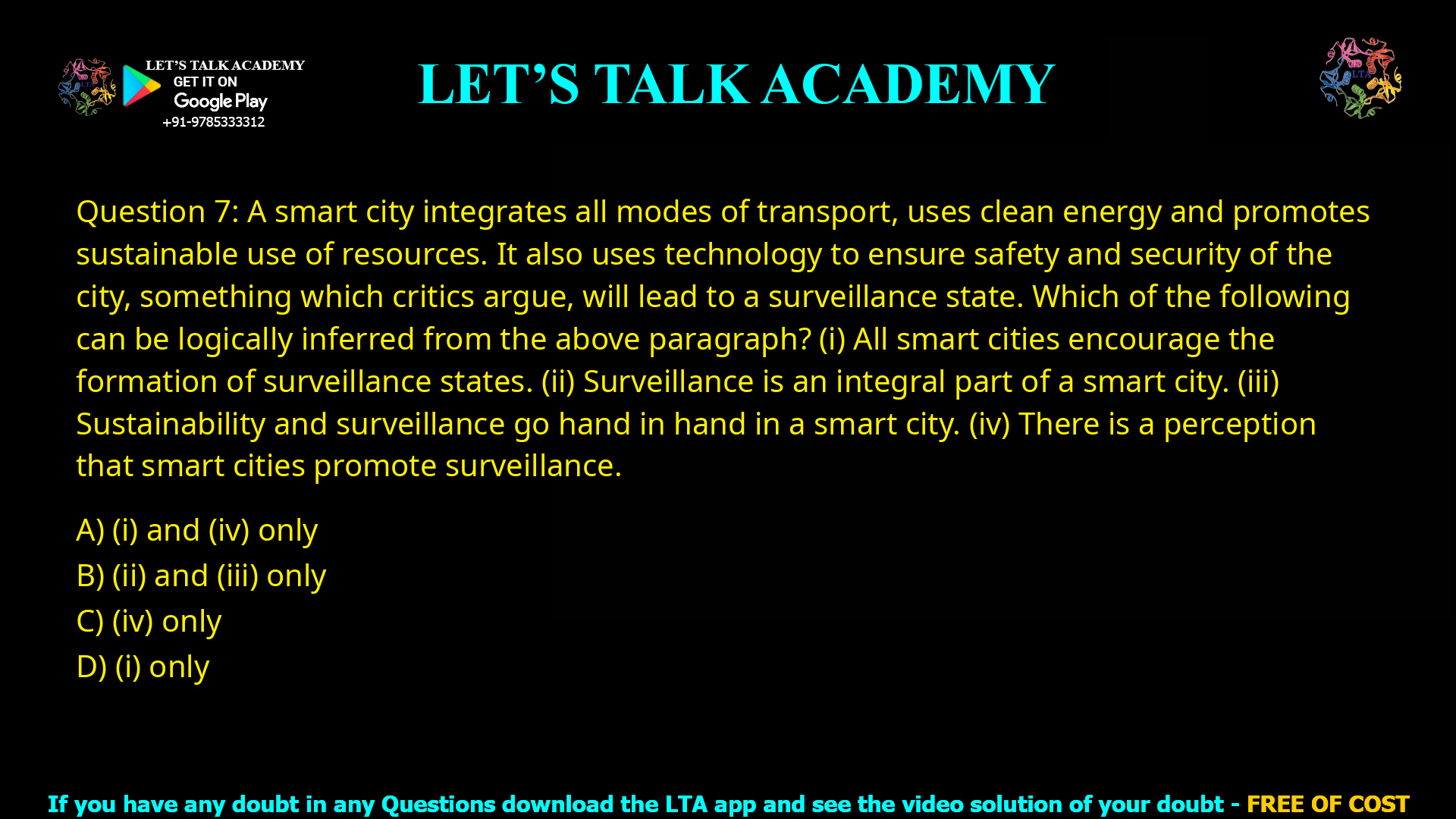
Q.7 A smart city integrates all modes of transport, uses clean energy and promotes sustainable use of
resources. It also uses technology to ensure safety and security of the city, something which critics
argue, will lead to a surveillance state.
Which of the following can be logically inferred from the above paragraph?
(i) All smart cities encourage the formation of surveillance states.
(ii) Surveillance is an integral part of a smart city.
(iii) Sustainability and surveillance go hand in hand in a smart city.
(iv) There is a perception that smart cities promote surveillance.
(A) (i) and (iv) only (B) (ii) and (iii) only
(C) (iv) only (D) (i) only
Answer: (C) (iv) only
The paragraph describes smart city features like integrated transport, clean energy, sustainable resources, and technology for safety/security, noting critics’ argument that this leads to a surveillance state. Only option (iv) logically follows as an inference.
Option Analysis
-
(i) All smart cities encourage the formation of surveillance states: This overgeneralizes; the paragraph mentions critics’ argument but does not state all smart cities actively encourage surveillance states.
-
(ii) Surveillance is an integral part of a smart city: Technology ensures safety but the paragraph does not define surveillance as integral; it presents it as a critic’s concern, not a core feature.
-
(iii) Sustainability and surveillance go hand in hand in a smart city: Sustainability is listed separately from security tech; no direct link to surveillance is made.
-
(iv) There is a perception that smart cities promote surveillance: Directly inferable from “critics argue,” indicating a held view among critics.
Smart cities integrate transport modes, clean energy, and sustainable resources while using technology for safety, sparking debate on surveillance state risks. This passage-based question tests inference skills: Which statement logically follows from critics’ argument that security tech leads to surveillance?
Passage Key Elements
The paragraph highlights:
-
Multi-modal transport integration.
-
Clean energy and resource sustainability.
-
Technology-driven safety/security.
-
Critics’ view: This creates a surveillance state.
Such critiques reflect real-world privacy worries in sensor-heavy urban tech.
Why Only (iv) is Inferable
Inference means directly deducible from text without adding assumptions. Critics’ “argue” signals perception, not fact—making (iv) “There is a perception that smart cities promote surveillance” the sole valid choice. Others require unsupported leaps, like claiming “all” cities or “integral” roles.
| Option | Why Not Inferable | Passage Basis |
|---|---|---|
| (i) All smart cities encourage surveillance states | Absolute claim; ignores variation | Critics argue, not “all encourage” |
| (ii) Surveillance is integral | Not stated as core; tech is for safety | No explicit link |
| (iii) Sustainability + surveillance hand-in-hand | Separate concepts; no connection | Sustainability listed independently |
| (iv) Perception of promotion | Direct from critics’ argument | Valid inference |
Broader Smart Cities Context
Smart cities use ICT for efficiency but face “electronic panopticon” fears via CCTV, sensors, and data analytics. Predictive policing aids safety yet erodes anonymity. Balancing sustainability with privacy remains key.


