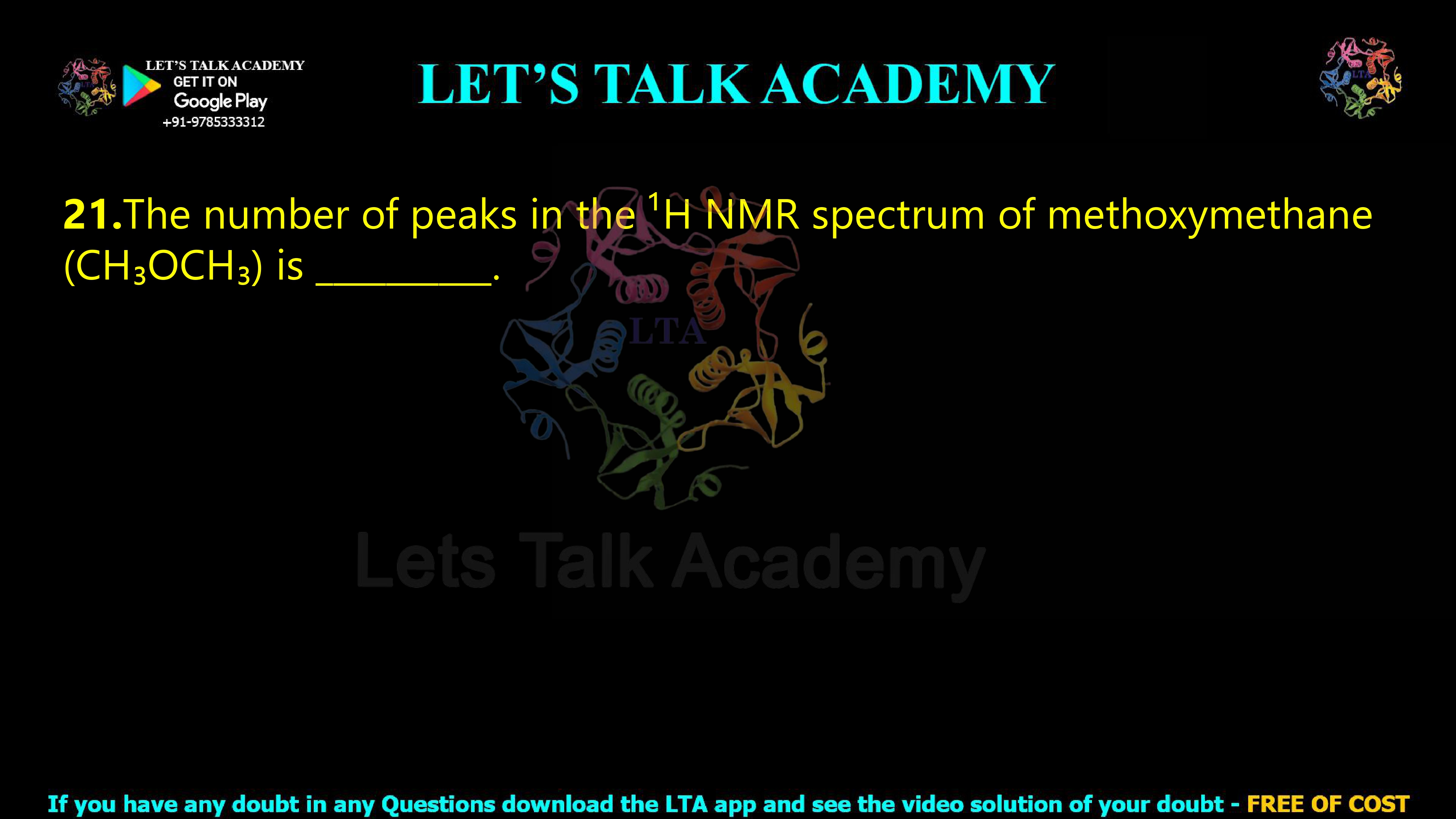
20.The number of peaks in the ¹H NMR spectrum of methoxymethane (CH₃OCH₃) is __________.
Number of Peaks in the ¹H NMR Spectrum of Methoxymethane (CH₃OCH₃)
Correct Answer
Correct Answer: 1 peak
Methoxymethane, also known as dimethyl ether, has the molecular structure:
CH₃–O–CH₃
The molecule contains a total of six hydrogen atoms. However, the number of peaks in a ¹H NMR spectrum is not determined simply by counting the total number of hydrogen atoms. Instead, it is determined by counting the number of chemically distinct proton environments present in the molecule.
In methoxymethane, the two methyl groups are identical and related by molecular symmetry. The three hydrogen atoms within each methyl group are equivalent, and the two methyl groups are also equivalent to each other. Consequently, all six hydrogen atoms experience the same chemical environment.
Since all six protons are chemically equivalent, they produce only one ¹H NMR signal.
Therefore:
Number of chemically distinct proton environments = 1
Hence:
Number of peaks in the ¹H NMR spectrum = 1
Understanding the Structure of Methoxymethane
Molecular Structure of CH₃OCH₃
Methoxymethane has the simple ether structure:
CH₃–O–CH₃
An oxygen atom is bonded to two methyl groups. Both sides of the molecule are identical. If the molecule is viewed from either side, the same CH₃–O environment is observed.
The molecule contains:
First methyl group: 3 hydrogen atoms
Second methyl group: 3 hydrogen atoms
Thus, methoxymethane contains a total of:
3 + 3 = 6 hydrogen atoms
However, all six hydrogens are chemically equivalent because of the symmetry of the molecule. Therefore, the ¹H NMR spectrometer does not distinguish them as separate sets of protons.
All six protons contribute to a single resonance.
Why Does Methoxymethane Show Only One ¹H NMR Peak?
The Number of NMR Signals Depends on Chemical Environments
In proton NMR spectroscopy, chemically equivalent protons resonate at the same chemical shift and therefore produce the same signal.
The central rule is:
Number of ¹H NMR signals = Number of chemically non-equivalent sets of protons
This means that a molecule containing many hydrogen atoms can still produce only one peak if all of those hydrogen atoms occupy equivalent chemical environments.
Methoxymethane is a perfect example. Although it contains six protons, all six belong to one chemically equivalent set.
Therefore:
6 hydrogen atoms ≠ 6 NMR peaks
Instead:
6 equivalent hydrogen atoms = 1 NMR peak
Role of Molecular Symmetry in the ¹H NMR Spectrum
The Two Methyl Groups Are Chemically Equivalent
Molecular symmetry is the key reason why methoxymethane gives only one proton NMR signal.
Consider the two methyl groups:
CH₃–O–CH₃
The methyl group on the left is attached to oxygen. The methyl group on the right is also attached to the same oxygen atom in an identical molecular environment.
There is no structural feature that makes one methyl group different from the other. Therefore, both methyl groups have the same electronic surroundings and the same chemical shift.
The six protons can be represented as one equivalent proton set:
(CH₃)₂O → 6 equivalent H
As a result, all six protons absorb radiofrequency energy at the same resonance position and produce a single signal.
Why Are the Three Protons Within Each CH₃ Group Equivalent?
Rapid Rotation Around the Carbon-Oxygen Bond
Within each methyl group, the three hydrogen atoms are equivalent under normal ¹H NMR conditions. Rapid molecular rotation averages their environments over the NMR timescale.
Therefore, the three hydrogens of one methyl group do not produce three different signals. Instead, they behave as one set of equivalent protons.
Since the second methyl group is identical to the first, its three hydrogens also belong to the same proton environment.
Thus:
3 H on the first CH₃ + 3 H on the second CH₃ = 6 equivalent H
Therefore, only one proton environment is present.
Step-by-Step Method to Count the ¹H NMR Peaks
Step 1: Draw the Complete Molecular Structure
The first step is to write the correct structure of methoxymethane:
CH₃–O–CH₃
This immediately reveals that the molecule contains two methyl groups connected through an oxygen atom.
Step 2: Identify All Hydrogen-Containing Groups
There are two groups containing hydrogen:
Left CH₃ group
Right CH₃ group
At first glance, these may appear to be two possible proton environments. However, structural symmetry must be examined before counting them separately.
Step 3: Check Whether the Two Groups Are Equivalent
Both methyl groups are attached to the same oxygen atom and have identical surroundings.
Interchanging the left and right methyl groups does not produce a different molecule. Therefore, the two groups are chemically equivalent.
Step 4: Combine Equivalent Proton Sets
Since the two methyl groups are equivalent, all six protons belong to the same set.
Therefore:
Number of proton environments = 1
Step 5: Predict the Number of Signals
Each chemically distinct proton environment gives one ¹H NMR signal.
Therefore:
1 proton environment → 1 signal
Hence, the ¹H NMR spectrum of methoxymethane contains one peak.
What Would the ¹H NMR Signal of Methoxymethane Look Like?
One Signal Representing Six Protons
The single resonance in the ¹H NMR spectrum represents all six hydrogen atoms of methoxymethane.
Therefore, the integration of the signal corresponds to:
6H
The NMR signal can be summarized as:
Number of signals: 1
Number of protons represented: 6H
Type of protons: Two equivalent O–CH₃ groups
This single resonance reflects the high symmetry of the molecule.
Will the Single Signal Be a Singlet?
Equivalent Protons Do Not Split One Another
The one ¹H NMR signal of methoxymethane appears as a singlet.
According to the basic n + 1 splitting rule, signal splitting is caused by non-equivalent neighboring protons. In methoxymethane, the methyl protons do not have ordinary vicinal hydrogen atoms on an adjacent carbon atom.
The structure is:
CH₃–O–CH₃
The oxygen atom separates the two methyl groups. In routine introductory ¹H NMR interpretation, the protons of the two equivalent methyl groups do not split one another.
Therefore, the spectrum contains:
One singlet integrating to 6H
Thus, both the number of signals and the multiplicity are simple:
1 signal → singlet → integration of 6H
Chemical Equivalence and Magnetic Equivalence in Methoxymethane
All Six Protons Have the Same Chemical Environment
Chemically equivalent protons experience the same average electronic shielding and resonate at the same chemical shift.
In methoxymethane, all six hydrogens are associated with equivalent methyl groups attached to the same oxygen atom. They therefore experience the same average electronic environment.
Because they have the same chemical shift, the NMR instrument records them as a single resonance rather than separate peaks.
For this question, the important relationship is:
Molecular symmetry → Proton equivalence → Same chemical shift → One NMR signal
Why Oxygen Does Not Create Two Different Proton Environments
Both Methyl Groups Are Attached to the Same Oxygen Atom
Oxygen is highly electronegative and influences the chemical shift of nearby protons. The protons in an O–CH₃ group are generally more deshielded than protons in a simple hydrocarbon methyl group.
However, this effect does not create two different signals in methoxymethane because oxygen affects both methyl groups equally.
The left methyl group has the environment:
CH₃–O
The right methyl group has an equivalent environment:
O–CH₃
Since both groups are structurally identical, their protons resonate at the same chemical shift.
Therefore, oxygen changes the position of the resonance but not the number of resonances.
Comparison with an Unsymmetrical Ether
Methoxymethane Has One Proton Environment
Methoxymethane has the structure:
CH₃–O–CH₃
Because both groups attached to oxygen are identical, the molecule is symmetrical and gives one ¹H NMR signal.
Methoxyethane Has More Than One Proton Environment
Consider an unsymmetrical ether such as:
CH₃–O–CH₂–CH₃
Here, the groups on the two sides of oxygen are different. The methoxy protons, methylene protons and terminal methyl protons occupy different chemical environments.
Therefore, unlike methoxymethane, an unsymmetrical ether produces multiple ¹H NMR signals.
This comparison demonstrates why molecular symmetry is so important when predicting the number of peaks in a proton NMR spectrum.
Important NMR Concept Behind the Question
Count Proton Environments, Not Individual Hydrogen Atoms
The most important principle for solving ¹H NMR signal-counting questions is that individual hydrogen atoms should not automatically be counted as separate peaks.
Instead, protons must first be classified according to their chemical environments.
For methoxymethane:
Total hydrogen atoms = 6
Chemically distinct sets of hydrogen atoms = 1
Number of ¹H NMR signals = 1
This is the central reasoning required to solve the question correctly.
Final Answer
Methoxymethane has the symmetrical structure:
CH₃–O–CH₃
The two methyl groups are chemically equivalent, and all six hydrogen atoms experience the same chemical environment. Therefore, all six protons resonate at the same chemical shift and produce a single signal in the proton NMR spectrum.
The signal appears as one resonance representing six equivalent protons.
Therefore:
Number of peaks in the ¹H NMR spectrum of methoxymethane = 1
Correct Answer: 1 peak


