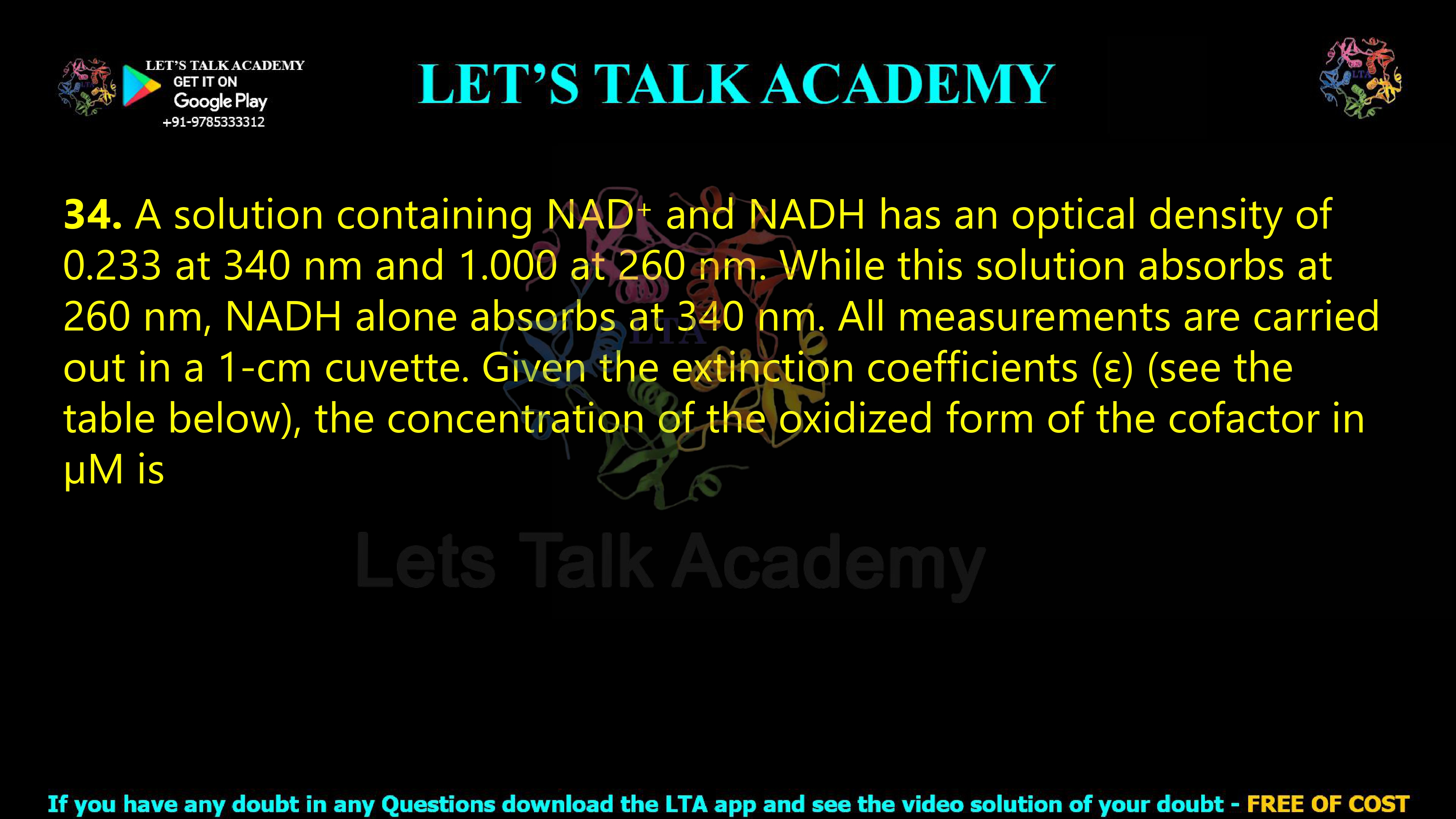
33. A solution containing NAD+ and NADH has an optical density of 0.233 at 340 nm and 1.000 at 260 nm. While this solution absorbs at 260 nm, NADH alone absorbs at 340 nm. All measurements are carried out in a 1-cm cuvette. Given the extinction coefficients (ε) (see the table below), the concentration of the oxidized form of the cofactor in µM is
Calculation of NAD⁺ Concentration from Optical Density at 260 nm and 340 nm
Correct Answer
Correct Answer: Approximately 23.5 µM NAD⁺
The problem is solved by analyzing the absorbance at the two wavelengths separately. At 340 nm, only NADH contributes significantly to the absorbance. Therefore, the absorbance at 340 nm can first be used to calculate the concentration of NADH.
At 260 nm, both NAD⁺ and NADH absorb light. Once the concentration of NADH is known, its contribution to the total absorbance at 260 nm can be calculated and subtracted. The remaining absorbance is due to oxidized NAD⁺.
Using the standard extinction coefficients commonly used for this calculation:
ε340 for NADH = 6.22 mM−1 cm−1
ε260 for NADH = 15.4 mM−1 cm−1
ε260 for NAD⁺ = 18.0 mM−1 cm−1
the concentration of oxidized NAD⁺ is calculated to be approximately:
[NAD⁺] = 0.0235 mM = 23.5 µM
Note: The extinction-coefficient table is not visible in the question provided here. This solution uses the standard values listed above. If the original table contains slightly different extinction coefficients, the final numerical answer will change accordingly.
Understanding the Basic Principle of the Question
NAD⁺ and NADH Have Different Absorption Properties
Nicotinamide adenine dinucleotide exists mainly in two important forms. The oxidized form is written as NAD⁺, while the reduced form is written as NADH. These two forms have different ultraviolet absorption properties, and this difference makes it possible to determine their concentrations spectrophotometrically.
At 340 nm, NADH shows strong characteristic absorption, whereas NAD⁺ has essentially negligible absorbance. Therefore, an absorbance measurement at 340 nm provides a selective method for determining the concentration of NADH.
At 260 nm, both NAD⁺ and NADH absorb light because both molecules contain the adenine nucleotide portion of the cofactor. Therefore, the total absorbance at 260 nm is the sum of the absorbance produced by NAD⁺ and the absorbance produced by NADH.
The key relationships are:
At 340 nm: Absorbance is due to NADH only
At 260 nm: Absorbance is due to NAD⁺ + NADH
This allows the two concentrations to be determined in two stages.
Beer-Lambert Law Used in the Calculation
Relationship Between Absorbance and Concentration
The Beer-Lambert law relates the absorbance of a solution to the concentration of the absorbing substance:
A = εcl
where:
A = absorbance or optical density
ε = molar extinction coefficient
c = concentration of the absorbing species
l = optical path length of the cuvette
In this question, all measurements are carried out using a 1-cm cuvette. Therefore:
l = 1 cm
This simplifies the Beer-Lambert equation to:
A = εc
when the extinction coefficient and concentration are expressed in compatible units.
Step 1: Calculate the Concentration of NADH at 340 nm
Only NADH Absorbs at 340 nm
The absorbance of the solution at 340 nm is:
A340 = 0.233
The extinction coefficient of NADH at 340 nm is:
ε340,NADH = 6.22 mM−1 cm−1
The path length is:
l = 1 cm
Using the Beer-Lambert law:
A = εcl
Therefore:
0.233 = 6.22 × [NADH] × 1
Rearranging:
[NADH] = 0.233 / 6.22
Therefore:
[NADH] = 0.03746 mM
Converting millimolar to micromolar:
0.03746 mM × 1000 = 37.46 µM
Thus:
[NADH] = 37.46 µM
Step 2: Calculate the Contribution of NADH to Absorbance at 260 nm
NADH Also Absorbs at 260 nm
Although the 340 nm measurement selectively identifies NADH, the reduced cofactor also absorbs at 260 nm. Therefore, the total absorbance of 1.000 at 260 nm cannot be assigned entirely to NAD⁺.
The concentration of NADH has already been calculated as:
[NADH] = 0.03746 mM
The extinction coefficient of NADH at 260 nm is:
ε260,NADH = 15.4 mM−1 cm−1
Using:
A = εcl
the absorbance contributed by NADH at 260 nm is:
A260,NADH = 15.4 × 0.03746 × 1
Therefore:
A260,NADH = 0.5769
Thus, out of the total absorbance of 1.000 at 260 nm, approximately 0.577 is contributed by NADH.
Step 3: Calculate the Absorbance Due to NAD⁺ at 260 nm
Subtract the NADH Contribution from the Total Absorbance
The total absorbance at 260 nm is:
A260,total = 1.000
This total absorbance contains contributions from both forms of the cofactor:
A260,total = A260,NAD⁺ + A260,NADH
Therefore:
A260,NAD⁺ = A260,total − A260,NADH
Substituting the values:
A260,NAD⁺ = 1.000 − 0.5769
Therefore:
A260,NAD⁺ = 0.4231
This remaining absorbance is attributed to the oxidized form, NAD⁺.
Step 4: Calculate the Concentration of NAD⁺
Apply the Beer-Lambert Law to the Oxidized Cofactor
The absorbance due to NAD⁺ at 260 nm is:
A260,NAD⁺ = 0.4231
The extinction coefficient of NAD⁺ at 260 nm is:
ε260,NAD⁺ = 18.0 mM−1 cm−1
Using the Beer-Lambert law:
A = εcl
Therefore:
0.4231 = 18.0 × [NAD⁺] × 1
Rearranging:
[NAD⁺] = 0.4231 / 18.0
Therefore:
[NAD⁺] = 0.02351 mM
Since:
1 mM = 1000 µM
we obtain:
[NAD⁺] = 0.02351 × 1000
Therefore:
[NAD⁺] = 23.51 µM
Hence, the concentration of the oxidized form of the cofactor is approximately:
23.5 µM
Solving the Question Using Simultaneous Absorbance Equations
Equation at 340 nm
Because only NADH contributes significantly at 340 nm:
0.233 = 6.22[NADH]
Therefore:
[NADH] = 0.03746 mM
Equation at 260 nm
At 260 nm, both NAD⁺ and NADH contribute to the measured absorbance:
1.000 = 18.0[NAD⁺] + 15.4[NADH]
Substituting:
[NADH] = 0.03746 mM
gives:
1.000 = 18.0[NAD⁺] + (15.4 × 0.03746)
Therefore:
1.000 = 18.0[NAD⁺] + 0.5769
Hence:
18.0[NAD⁺] = 1.000 − 0.5769
18.0[NAD⁺] = 0.4231
Therefore:
[NAD⁺] = 0.02351 mM
or:
[NAD⁺] = 23.51 µM
Why the 340 nm Measurement Is Calculated First
340 nm Selectively Measures NADH
The sequence of calculation is extremely important. The 260 nm absorbance cannot be used first to calculate NAD⁺ directly because both NAD⁺ and NADH contribute to the measured optical density at this wavelength.
In contrast, the absorbance at 340 nm is selective for NADH in this problem. Therefore, the NADH concentration can be determined independently.
The correct analytical sequence is:
Step 1: Use A340 to calculate NADH
Step 2: Calculate the NADH contribution to A260
Step 3: Subtract this contribution from total A260
Step 4: Use the remaining absorbance to calculate NAD⁺
This approach separates the contributions of the oxidized and reduced forms of the cofactor.
Why NADH Absorbs at 340 nm but NAD⁺ Does Not
The Reduced Nicotinamide Ring Creates Characteristic Absorption
The difference between NAD⁺ and NADH at 340 nm arises from the electronic structure of the nicotinamide portion of the molecules. Reduction of NAD⁺ to NADH changes the electronic arrangement of the nicotinamide ring and creates a characteristic absorption band near 340 nm.
This property is widely used in biochemistry because reactions involving NADH can be followed by monitoring changes in absorbance at 340 nm.
If NADH is consumed during an enzymatic reaction, the absorbance at 340 nm decreases. If NADH is produced, the absorbance at 340 nm increases.
Therefore, the 340 nm wavelength provides a powerful method for monitoring NAD-dependent biochemical reactions.
Complete Calculation at a Glance
| Calculation Step | Expression | Result |
|---|---|---|
| NADH concentration from 340 nm | 0.233 / 6.22 | 0.03746 mM |
| NADH concentration in µM | 0.03746 × 1000 | 37.46 µM |
| NADH absorbance at 260 nm | 15.4 × 0.03746 | 0.5769 |
| NAD⁺ absorbance at 260 nm | 1.000 − 0.5769 | 0.4231 |
| NAD⁺ concentration | 0.4231 / 18.0 | 0.02351 mM |
| NAD⁺ concentration in µM | 0.02351 × 1000 | 23.51 µM |
Final Answer
At 340 nm, only NADH contributes significantly to the absorbance. Therefore:
[NADH] = 0.233 / 6.22 = 0.03746 mM
The contribution of NADH to the absorbance at 260 nm is:
A260,NADH = 15.4 × 0.03746 = 0.5769
The remaining absorbance due to NAD⁺ is:
A260,NAD⁺ = 1.000 − 0.5769 = 0.4231
Therefore:
[NAD⁺] = 0.4231 / 18.0
[NAD⁺] = 0.02351 mM
Converting to micromolar:
[NAD⁺] = 23.51 µM
Correct Answer: Approximately 23.5 µM


