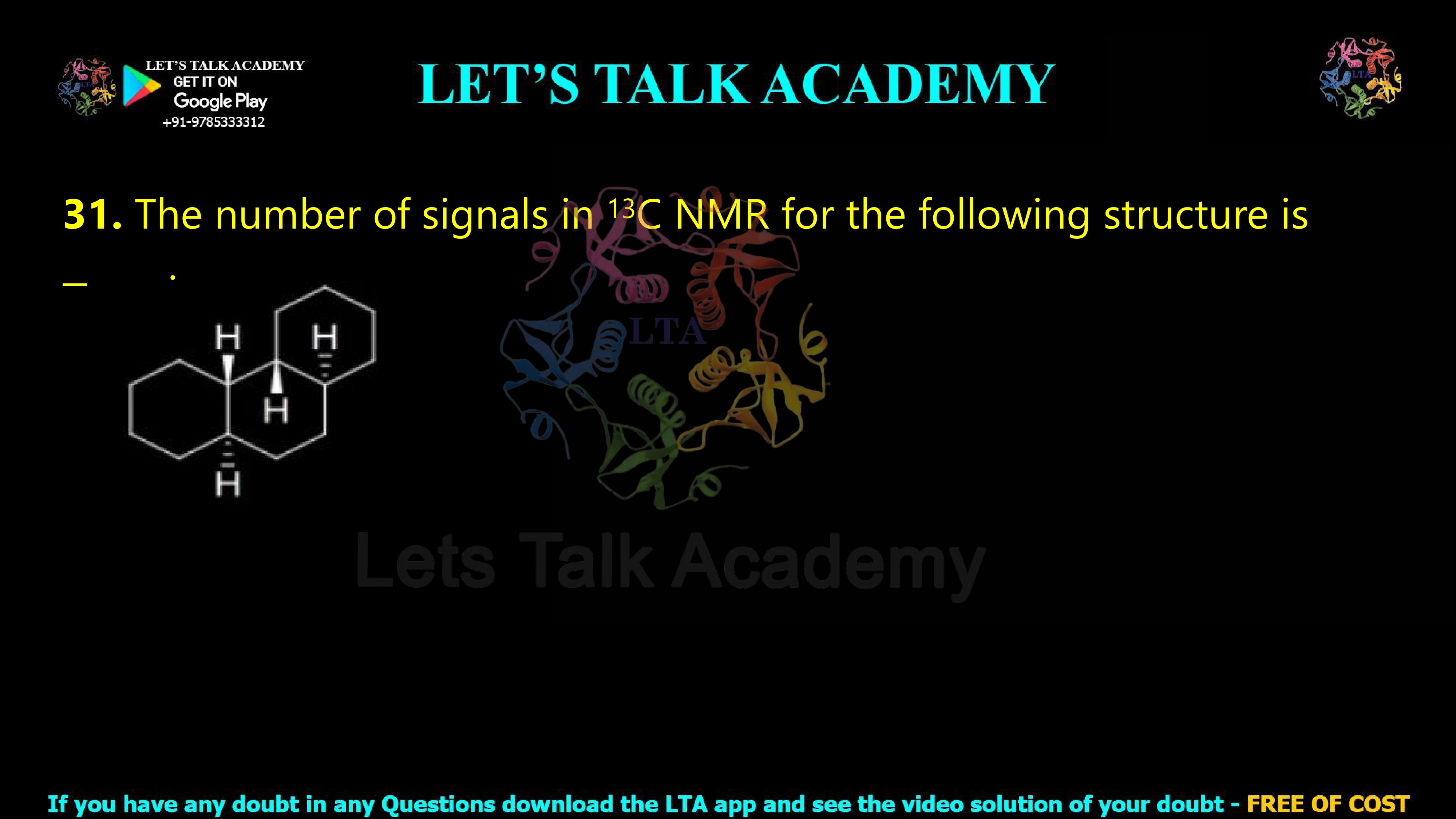
30. The number of signals in 13C NMR for the following structure is ______.
Number of Signals in ¹³C NMR for the Given Fused Tricyclic Structure
The correct answer is 7 signals.
The given question asks us to determine the number of distinct signals observed in the ¹³C NMR spectrum of the shown fused tricyclic compound. At first glance, the structure appears complicated because it contains three fused cyclohexane rings and several stereochemical bonds. However, the problem becomes much easier when we analyze the molecule in terms of molecular symmetry and chemically equivalent carbon atoms.
Understanding the Basic Principle of ¹³C NMR Spectroscopy
In ¹³C NMR spectroscopy, every chemically non-equivalent carbon environment generally produces a separate resonance signal. Therefore, the number of signals does not necessarily equal the total number of carbon atoms present in a molecule.
If two or more carbon atoms are related by a genuine symmetry operation and experience identical chemical environments, they are chemically equivalent and produce the same ¹³C NMR signal. On the other hand, carbon atoms that are not symmetry-related normally produce different signals.
Thus, the main question is not simply, “How many carbon atoms are present?” Instead, we must ask, “How many different carbon environments are present?”
Counting the Total Number of Carbon Atoms
The molecule contains three fused six-membered carbon rings. If the rings were completely separate, the total number of carbon atoms would be:
3 × 6 = 18 carbon atoms
However, the rings are fused. Every ring fusion shares two carbon atoms between adjacent rings. Since there are two ring fusions, four carbon atoms have been counted twice.
Therefore:
Total number of carbon atoms = 18 − 4 = 14
So, the given compound contains 14 carbon atoms. If all 14 carbon atoms were chemically different, we would observe 14 separate ¹³C NMR signals. However, that is not the case because the molecule possesses symmetry.
Role of Molecular Symmetry in Determining the Number of ¹³C NMR Signals
The most important feature of the given structure is its two-fold rotational symmetry. The molecule can be related to itself through a 180° rotation.
The stereochemical arrangement shown by the solid wedge and dashed wedge bonds must also be considered. The symmetry operation is valid because the three-dimensional stereochemical pattern is preserved during the rotation.
For example, the upper ring-junction carbon on one side corresponds to the lower ring-junction carbon on the opposite side. Similarly, the lower junction carbon on one side corresponds to the upper junction carbon on the other side. The solid-wedge and dashed-wedge relationships are preserved under the symmetry operation.
Therefore, the molecule can be divided into seven symmetry-related pairs of carbon atoms.
How the 14 Carbon Atoms Form Seven Equivalent Pairs
The 14 carbon atoms do not produce 14 independent signals because every carbon atom has one symmetry-related partner.
The relationship can be expressed as:
14 carbon atoms ÷ 2 carbon atoms per equivalent pair = 7 different carbon environments
Therefore, the carbon atoms occur as seven sets of chemically equivalent pairs. Each pair produces only one resonance in the ¹³C NMR spectrum.
Hence:
Number of distinct carbon environments = 7
Therefore:
Number of ¹³C NMR signals = 7
Why the Stereochemistry Does Not Destroy the Symmetry
The wedge and dash bonds are especially important in this question. A solid wedge represents a bond projecting toward the observer, whereas a dashed wedge represents a bond projecting behind the plane. For a symmetry operation to make two carbon atoms equivalent, the complete three-dimensional structure must remain equivalent.
In the given molecule, a 180° rotation maps the stereochemical arrangement on one side onto the corresponding stereochemical arrangement on the other side. Therefore, the symmetry remains valid even after the wedge and dash bonds are considered.
This is why the carbon atoms are paired rather than all being chemically independent.
Why the Answer Is Not 14 Signals
The compound contains 14 carbon atoms, but the number of carbon atoms and the number of ¹³C NMR signals are not always the same.
Fourteen signals would be expected only if all 14 carbon atoms experienced different chemical environments. Because the molecule has a valid two-fold rotational symmetry, each carbon has an equivalent partner.
Thus, 14 carbon atoms are reduced to seven chemically distinct carbon environments.
Why the Answer Is Not Based Only on the Number of Rings
The molecule contains three rings, but the number of rings does not directly determine the number of ¹³C NMR signals. NMR signals depend on the number of chemically distinct carbon environments.
A molecule with many rings may produce only a few signals if it is highly symmetrical, while a less symmetrical molecule with fewer rings may produce many signals. Therefore, symmetry analysis is always more important than simply counting rings.
Step-by-Step Method for Solving Similar ¹³C NMR Questions
For similar questions, first count the total number of carbon atoms in the molecule. Next, identify possible symmetry elements such as a plane of symmetry, a center of symmetry, or a rotational axis. Then check whether the stereochemistry shown by wedges and dashes preserves or destroys that symmetry.
After confirming the symmetry, group the symmetry-related carbon atoms into equivalent sets. Finally, count the number of distinct sets. Each distinct set corresponds to one ¹³C NMR signal.
Calculation for the Given Compound
Total carbon atoms = 14
Each carbon has one symmetry-related partner
Number of equivalent carbon pairs = 14 ÷ 2 = 7
Final Answer
The given fused tricyclic compound contains 14 carbon atoms, but because of its two-fold rotational symmetry, the carbon atoms form seven pairs of chemically equivalent carbon atoms.
Therefore, the number of distinct signals in the ¹³C NMR spectrum is:
7 signals
Correct Answer: 7


