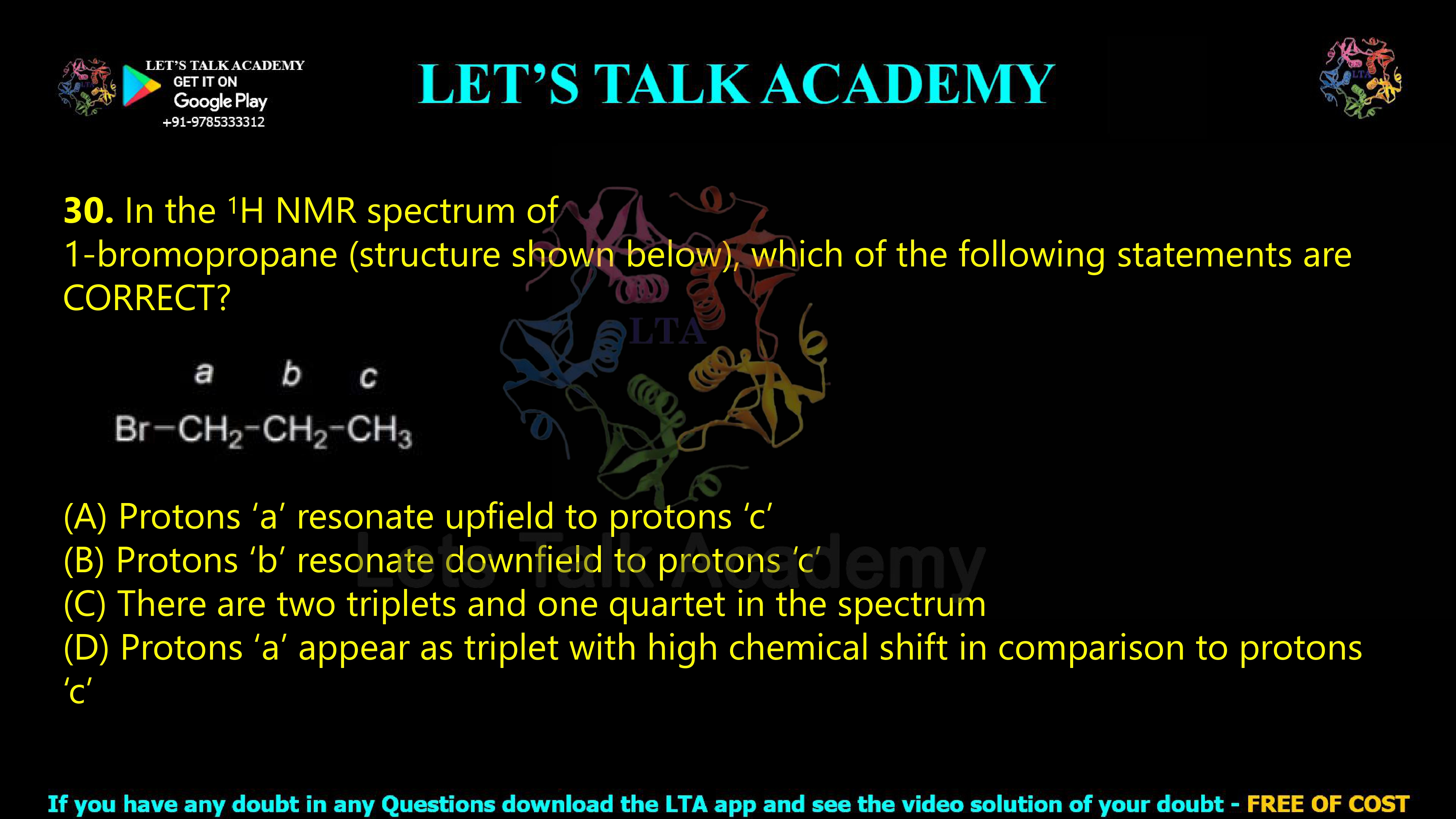
29. In the 1H NMR spectrum of
1-bromopropane (structure shown below), which of the following statements are CORRECT?
(A) Protons ‘a’ resonate upfield to protons ‘c’
(B) Protons ‘b’ resonate downfield to protons ‘c’
(C) There are two triplets and one quartet in the spectrum
(D) Protons ‘a’ appear as triplet with high chemical shift in comparison to protons ‘c’
¹H NMR Spectrum of 1-Bromopropane: Chemical Shift and Splitting Pattern Explained
Correct Answer
Correct Statements: (B) and (D)
In 1-bromopropane, the protons labelled ‘a’ are directly attached to the carbon bonded to bromine. Because bromine is electronegative, it withdraws electron density and strongly deshields these protons. Therefore, protons ‘a’ have the highest chemical shift and appear farthest downfield among the three proton environments.
The middle methylene protons labelled ‘b’ are farther from bromine than protons ‘a’, but they are still influenced by the electron-withdrawing effect of bromine. Therefore, they resonate downfield relative to the terminal methyl protons ‘c’.
The chemical shift order is:
δa > δb > δc
or, in terms of position in the spectrum:
a = most downfield > b > c = most upfield
The ‘a’ protons have two neighboring equivalent protons on carbon ‘b’. According to the n + 1 rule, they are split into:
2 + 1 = 3 peaks
Therefore, protons ‘a’ appear as a triplet. Since they are directly adjacent to bromine, this triplet occurs at a higher chemical shift than the signal of protons ‘c’.
Hence, statements (B) and (D) are correct.
Understanding the Structure of 1-Bromopropane
Identification of the Three Proton Environments
Before predicting a proton NMR spectrum, the first step is to identify the chemically different sets of hydrogen atoms. The structure of 1-bromopropane is:
Br–CH2–CH2–CH3
The molecule contains three chemically distinct proton environments. The first methylene group is directly bonded to the carbon bearing bromine and is labelled ‘a’. The second methylene group is located in the middle of the carbon chain and is labelled ‘b’. The terminal methyl group is farthest from bromine and is labelled ‘c’.
These proton environments can be summarized as:
| Proton Set | Position | Number of Protons | Relative Chemical Shift |
|---|---|---|---|
| a | Br–CH2– | 2H | Highest |
| b | –CH2– | 2H | Intermediate |
| c | –CH3 | 3H | Lowest |
Therefore, 1-bromopropane gives three main proton environments in its ¹H NMR spectrum.
Why Bromine Changes the Chemical Shift
Electronegativity of Bromine Causes Deshielding
Bromine is an electronegative atom. When it is bonded to carbon, it withdraws electron density through the sigma bonds by an inductive effect. As a result, the electron density surrounding nearby hydrogen nuclei decreases.
Electrons normally generate a small induced magnetic field that partially protects, or shields, a proton from the external magnetic field. When electron density is reduced, this protective effect becomes weaker. The proton is then described as deshielded.
Deshielded protons resonate at a higher chemical shift and appear farther downfield in the ¹H NMR spectrum.
Therefore:
Greater influence of Br → Greater deshielding → Higher δ value → More downfield signal
This relationship explains the chemical shift order of the three proton sets in 1-bromopropane.
Chemical Shift Order in 1-Bromopropane
Protons ‘a’ Have the Highest Chemical Shift
The protons labelled ‘a’ belong to the CH2Br group. These protons are located closest to the electronegative bromine atom and therefore experience the strongest electron-withdrawing effect.
As a result, protons ‘a’ are the most strongly deshielded protons in the molecule and resonate at the highest chemical shift.
Therefore:
δa is the highest
Protons ‘b’ Have an Intermediate Chemical Shift
The protons labelled ‘b’ belong to the central methylene group. They are not directly attached to the carbon bearing bromine in the same way as protons ‘a’, but they still experience the inductive effect of the electronegative bromine atom.
The influence of an electronegative substituent decreases with increasing distance. Therefore, protons ‘b’ are less deshielded than protons ‘a’ but more deshielded than protons ‘c’.
Thus:
δa > δb
and:
δb > δc
Protons ‘c’ Have the Lowest Chemical Shift
The protons labelled ‘c’ belong to the terminal methyl group. These protons are farthest from the electronegative bromine atom and therefore experience the weakest deshielding effect.
Consequently, the ‘c’ protons are the most shielded and appear at the lowest chemical shift among the three proton environments.
The complete chemical shift order is therefore:
δa > δb > δc
Understanding Upfield and Downfield Positions
What Does Downfield Mean in ¹H NMR?
A proton that resonates at a higher chemical shift is said to appear downfield. Downfield protons are generally more deshielded and experience a stronger effective magnetic field.
In 1-bromopropane, the order from most downfield to most upfield is:
a → b → c
Therefore, protons ‘a’ are downfield relative to both ‘b’ and ‘c’, while protons ‘b’ are downfield relative to protons ‘c’.
What Does Upfield Mean in ¹H NMR?
A proton that resonates at a lower chemical shift is described as appearing upfield. Upfield protons are generally more shielded by surrounding electron density.
The terminal methyl protons ‘c’ are farthest from bromine and are therefore the most shielded proton set in the molecule.
Thus, protons ‘c’ appear upfield relative to both ‘a’ and ‘b’.
Splitting Pattern of Protons ‘a’
Why the CH₂Br Protons Appear as a Triplet
The protons labelled ‘a’ belong to the CH2Br group. The adjacent carbon contains two equivalent ‘b’ protons.
According to the basic n + 1 rule, a proton signal is split by n equivalent neighboring protons into n + 1 lines.
For proton set ‘a’:
Number of neighboring protons = 2
Therefore:
Multiplicity = n + 1 = 2 + 1 = 3
A three-line signal is called a triplet.
Therefore:
Protons ‘a’ → Triplet
Because these protons are also closest to bromine, their triplet appears at the highest chemical shift among the three signals.
Splitting Pattern of Protons ‘c’
Why the Terminal CH₃ Protons Also Appear as a Triplet
The protons labelled ‘c’ belong to the terminal methyl group. The adjacent carbon contains two ‘b’ protons.
Applying the n + 1 rule:
n = 2
Therefore:
n + 1 = 3
Thus, the terminal methyl protons ‘c’ also produce a triplet.
However, the ‘c’ triplet occurs at a much lower chemical shift than the ‘a’ triplet because the ‘c’ protons are much farther from the electron-withdrawing bromine atom.
Therefore, the molecule contains two triplet-type signals:
‘a’ protons → Downfield triplet
‘c’ protons → Upfield triplet
Splitting Pattern of the Middle Protons ‘b’
Why the Central CH₂ Signal Is Not Simply a Quartet
The central methylene protons ‘b’ are located between two different proton groups:
Br–CH2a–CH2b–CH3c
On one side, the ‘b’ protons have two neighboring ‘a’ protons. On the other side, they have three neighboring ‘c’ protons.
Therefore, the ‘b’ protons are influenced by two different sets of neighboring protons. The simple n + 1 rule should not be applied by treating the entire molecule as if ‘b’ had only three equivalent neighboring protons.
Because the two adjacent proton sets are chemically different, the middle CH2 signal shows a more complex splitting pattern. In a simplified description, it is often reported as a multiplet. Under ideal first-order conditions, if the coupling constants to the two neighboring groups are similar, the pattern may resemble a sextet, but it is not correctly described as a simple quartet.
Therefore, the statement that the spectrum contains two triplets and one quartet is incorrect.
Detailed Explanation of Every Option
Option (A): Protons ‘a’ Resonate Upfield to Protons ‘c’
Option (A) is incorrect. Protons ‘a’ are directly adjacent to the electron-withdrawing bromine atom. Bromine decreases the electron density around these protons and strongly deshields them.
Protons ‘c’, in contrast, are located farthest from bromine and are relatively shielded.
Therefore, the actual relationship is:
δa > δc
This means that protons ‘a’ resonate downfield, not upfield, relative to protons ‘c’.
Therefore, Statement (A) is incorrect.
Option (B): Protons ‘b’ Resonate Downfield to Protons ‘c’
Option (B) is correct. The middle methylene protons ‘b’ are closer to bromine than the terminal methyl protons ‘c’.
Although the electron-withdrawing effect of bromine becomes weaker with increasing distance, it still affects the ‘b’ protons more strongly than the ‘c’ protons.
Therefore:
δb > δc
Hence, protons ‘b’ resonate downfield relative to protons ‘c’.
Therefore, Statement (B) is correct.
Option (C): There Are Two Triplets and One Quartet in the Spectrum
Option (C) is incorrect. The ‘a’ protons are split by two neighboring ‘b’ protons and therefore appear as a triplet. Similarly, the ‘c’ protons are split by two neighboring ‘b’ protons and also appear as a triplet.
However, the central ‘b’ protons are coupled to two different neighboring proton sets: two ‘a’ protons on one side and three ‘c’ protons on the other side.
Therefore, the central signal is not correctly described as a simple quartet. It generally appears as a more complex multiplet or, under simplified first-order conditions, may resemble a sextet.
Hence, the description two triplets and one quartet is not correct.
Therefore, Statement (C) is incorrect.
Option (D): Protons ‘a’ Appear as a Triplet with High Chemical Shift in Comparison to Protons ‘c’
Option (D) is correct. The ‘a’ protons have two neighboring ‘b’ protons. According to the n + 1 rule:
2 + 1 = 3
Therefore, the ‘a’ signal appears as a triplet.
At the same time, the ‘a’ protons are directly adjacent to the electron-withdrawing bromine atom and are therefore more deshielded than the terminal ‘c’ protons.
Consequently:
δa > δc
Thus, protons ‘a’ appear as a triplet at a higher chemical shift than protons ‘c’.
Therefore, Statement (D) is correct.
Complete ¹H NMR Analysis of 1-Bromopropane
| Proton Set | Group | Relative Chemical Shift | Major Splitting Pattern | Reason |
|---|---|---|---|---|
| a | CH2Br | Highest | Triplet | Strongly deshielded by Br; split by two neighboring b protons |
| b | Middle CH2 | Intermediate | Multiplet | Coupled to two different neighboring proton sets |
| c | Terminal CH3 | Lowest | Triplet | Split by two neighboring b protons |
Relationship Between Distance from Bromine and Chemical Shift
The Inductive Effect Decreases with Distance
The chemical shift pattern in 1-bromopropane provides a clear example of how the effect of an electronegative atom decreases with increasing bond distance.
The ‘a’ protons are closest to bromine and therefore experience the greatest deshielding. The ‘b’ protons are farther away and experience a weaker effect. The ‘c’ protons are farthest from bromine and are therefore the most shielded.
This produces the order:
Br–CH2a > CH2b > CH3c
in terms of decreasing chemical shift.
Therefore:
δa > δb > δc
Final Answer
In 1-bromopropane, the protons labelled ‘a’ are directly adjacent to the electronegative bromine atom and therefore experience the strongest deshielding. They appear at the highest chemical shift and are split by the two neighboring ‘b’ protons into a triplet.
The middle ‘b’ protons experience a greater electron-withdrawing effect than the terminal ‘c’ protons. Therefore, protons ‘b’ resonate downfield relative to protons ‘c’.
The correct chemical shift order is:
δa > δb > δc
Therefore:
(A) Incorrect
(B) Correct
(C) Incorrect
(D) Correct
Correct Answer: Statements (B) and (D)


