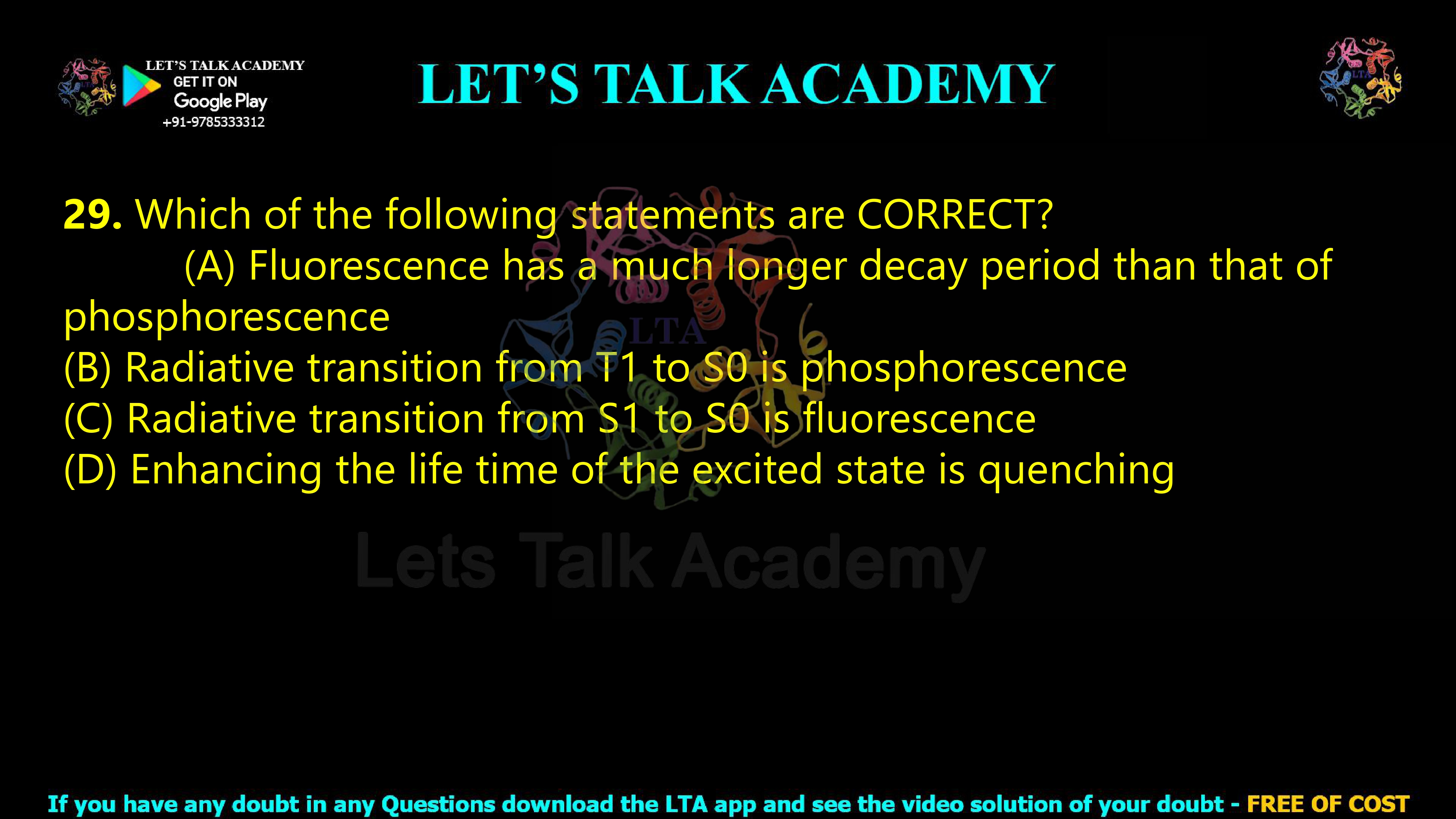
28. Which of the following statements are CORRECT?
(A) Fluorescence has a much longer decay period than that of phosphorescence
(B) Radiative transition from T1 to S0 is phosphorescence
(C) Radiative transition from S1 to S0 is fluorescence
(D) Enhancing the life time of the excited state is quenching
Which Statements About Fluorescence, Phosphorescence, and Quenching Are Correct?
Understanding Fluorescence and Phosphorescence
This question examines the fundamental principles of photochemistry and photophysics, particularly the nature of fluorescence, phosphorescence, excited electronic states, radiative transitions, and quenching. To identify the correct statements, it is necessary to understand how a molecule behaves after absorbing light.
When a molecule absorbs a photon of suitable energy, it is promoted from its electronic ground state to an excited electronic state. The ground singlet state is represented as S₀, while the first excited singlet state is represented as S₁. A molecule may also reach the first excited triplet state, represented as T₁, through a non-radiative process known as intersystem crossing.
The excited molecule can return to the ground state through several pathways. If the transition from S₁ to S₀ occurs with the emission of light, the process is called fluorescence. If the molecule first enters the triplet state and then undergoes a radiative transition from T₁ to S₀, the process is called phosphorescence.
The different spin properties of singlet and triplet states explain why fluorescence is usually rapid, whereas phosphorescence is generally much slower and can persist for a considerably longer time.
Detailed Explanation of Statement (A)
Statement (A): Fluorescence has a much longer decay period than that of phosphorescence.
Statement (A) is incorrect.
The statement reverses the actual relationship between the decay periods of fluorescence and phosphorescence. In reality, fluorescence generally has a much shorter decay period than phosphorescence.
Fluorescence commonly occurs on a timescale of approximately:
10⁻⁹ to 10⁻⁷ seconds
Phosphorescence generally occurs over a much longer timescale, which may range approximately from:
10⁻⁶ seconds to seconds, minutes, or even longer
The exact lifetime depends on the molecular structure and surrounding environment, but the fundamental relationship remains the same: fluorescence is normally much faster than phosphorescence.
Why Fluorescence Has a Short Decay Period
Fluorescence usually involves the radiative transition:
S₁ → S₀ + hν
Both the initial excited state S₁ and the final ground state S₀ are singlet states. Because the spin multiplicity does not change during this transition, it is considered spin-allowed.
Spin-allowed transitions have relatively high probabilities and therefore occur rapidly. As a result, the excited singlet state usually has a short lifetime, and fluorescence emission disappears rapidly after the excitation source is removed.
Why Phosphorescence Has a Longer Decay Period
Phosphorescence involves the radiative transition:
T₁ → S₀ + hν
The initial state T₁ is a triplet state, whereas the final state S₀ is a singlet state. This transition involves a change in spin multiplicity and is therefore considered spin-forbidden according to the spin selection rule.
Because the transition is formally forbidden, its probability is much lower than that of fluorescence. The molecule may remain trapped in the triplet excited state for a relatively long time before returning to the singlet ground state by emitting a photon.
This is why some phosphorescent materials continue to glow after the excitation source has been removed.
Therefore, fluorescence does not have a longer decay period than phosphorescence.
Conclusion for Statement (A): Incorrect
Detailed Explanation of Statement (B)
Statement (B): Radiative transition from T₁ to S₀ is phosphorescence.
Statement (B) is correct.
Phosphorescence is defined as the radiative transition from the lowest excited triplet state T₁ to the singlet ground state S₀.
The process can be represented as:
T₁ → S₀ + hν
where hν represents the emitted photon.
Before phosphorescence occurs, a molecule usually follows a sequence of photophysical processes. First, it absorbs a photon and moves from the singlet ground state S₀ to an excited singlet state such as S₁ or a higher singlet state. The molecule may then undergo vibrational relaxation and internal conversion before reaching the lowest excited singlet state.
From S₁, the molecule may undergo intersystem crossing to the triplet state T₁. Once present in T₁, the molecule may return radiatively to S₀. This emitted radiation is phosphorescence.
Why the T₁ to S₀ Transition Is Slow
The transition from T₁ to S₀ changes the spin multiplicity of the molecule. A triplet state contains two electrons with parallel spins, whereas the singlet ground state contains paired electrons with opposite spins.
According to the spin selection rule:
ΔS = 0
is the condition for a spin-allowed electronic transition.
The transition:
T₁ → S₀
involves a change in total spin and is therefore formally spin-forbidden. A spin-forbidden transition is less probable and occurs more slowly than a spin-allowed transition.
This low transition probability gives the T₁ state a relatively long lifetime and explains the long-lived nature of phosphorescence.
Therefore, Statement (B) correctly defines phosphorescence.
Conclusion for Statement (B): Correct
Detailed Explanation of Statement (C)
Statement (C): Radiative transition from S₁ to S₀ is fluorescence.
Statement (C) is correct.
Fluorescence is the emission of light associated with a radiative transition from an excited singlet state to the singlet ground state. In most cases, fluorescence occurs from the lowest excited singlet state S₁ to the ground singlet state S₀.
The process can be represented as:
S₁ → S₀ + hν
The emitted photon carries away the energy difference between the excited and ground electronic states.
Why Fluorescence Usually Occurs from S₁
After absorbing light, a molecule may initially reach a higher excited singlet state such as S₂ or an upper vibrational level of S₁. However, it rapidly loses some energy through vibrational relaxation and internal conversion.
The molecule generally reaches the lowest vibrational level of the first excited singlet state S₁ before fluorescence emission occurs. It then returns radiatively to one of the vibrational levels of S₀.
This behavior is consistent with Kasha’s rule, according to which fluorescence emission usually occurs from the lowest excited state of a given multiplicity.
Why the S₁ to S₀ Transition Is Fast
Both S₁ and S₀ are singlet states. Therefore, the transition does not require a change in spin multiplicity and is spin-allowed.
Because the transition is allowed, it has a relatively high probability and normally occurs within nanoseconds.
This is why fluorescence stops almost immediately after the excitation source is removed.
Therefore, Statement (C) correctly identifies the radiative S₁ → S₀ transition as fluorescence.
Conclusion for Statement (C): Correct
Detailed Explanation of Statement (D)
Statement (D): Enhancing the lifetime of the excited state is quenching.
Statement (D) is incorrect.
Quenching generally refers to any process that decreases the intensity of fluorescence or another form of luminescence by providing an additional pathway for deactivation of the excited state.
In many important forms of quenching, especially dynamic or collisional quenching, the presence of a quencher introduces an additional non-radiative decay pathway. This increases the total rate of excited-state deactivation and consequently shortens, rather than enhances, the observed excited-state lifetime.
The excited-state lifetime can be represented as:
τ = 1/(kf + knr)
where kf is the fluorescence rate constant and knr represents the total non-radiative decay rate constant.
If a quencher introduces an additional quenching rate:
kq[Q]
then the lifetime becomes:
τ = 1/(kf + knr + kq[Q])
Since the denominator becomes larger, the excited-state lifetime becomes shorter.
Therefore, enhancing or increasing the lifetime of the excited state is not the general definition of quenching.
What Actually Happens During Quenching?
Suppose a fluorescent molecule is in its excited state. Under normal conditions, it may return to the ground state by emitting fluorescence.
If a quencher is present, the excited molecule may interact with the quencher and lose its excitation energy through a non-radiative process. This reduces the probability of fluorescence emission.
As a result, the observed fluorescence intensity decreases. In dynamic quenching, the observed fluorescence lifetime also decreases.
Common quenching mechanisms include collisional quenching, energy transfer, electron transfer, oxygen quenching, and complex formation.
Thus, the statement that quenching enhances the lifetime of the excited state is incorrect.
Conclusion for Statement (D): Incorrect
Understanding Singlet and Triplet Electronic States
The terms singlet and triplet describe the spin multiplicity of an electronic state. Spin multiplicity is given by:
Spin multiplicity = 2S + 1
where S is the total electron spin quantum number.
In a singlet state, the relevant electron spins are paired, giving:
S = 0
Therefore:
2(0) + 1 = 1
This is why the state is called a singlet state.
In a triplet state, two electrons have parallel spins, giving:
S = 1
Therefore:
2(1) + 1 = 3
This is why the state is called a triplet state.
The difference in spin multiplicity is central to understanding why fluorescence and phosphorescence have very different lifetimes.
Complete Photophysical Pathway of an Excited Molecule
The photophysical behavior of a molecule begins with absorption. When a molecule absorbs a photon, it may undergo the transition:
S₀ → S₁
or it may initially reach a higher excited singlet state.
After excitation, several pathways are possible. The molecule may undergo vibrational relaxation, internal conversion, fluorescence, intersystem crossing, phosphorescence, or non-radiative decay.
The principal fluorescence pathway is:
S₁ → S₀ + hν
The pathway leading to phosphorescence involves two major stages:
S₁ → T₁
through intersystem crossing, followed by:
T₁ → S₀ + hν
through phosphorescence.
This sequence explains why phosphorescence generally occurs later and lasts longer than fluorescence.
Fluorescence Versus Phosphorescence
Fluorescence is a rapid radiative transition between states of the same spin multiplicity. It usually occurs from S₁ to S₀ and typically has a short lifetime in the nanosecond range.
Phosphorescence is a slower radiative transition between states of different spin multiplicities. It usually occurs from T₁ to S₀ and generally has a much longer lifetime because the transition is spin-forbidden.
Therefore, the most important distinction is:
Fluorescence: S₁ → S₀
Phosphorescence: T₁ → S₀
This fundamental difference directly confirms that Statements (B) and (C) are correct.
Role of Intersystem Crossing in Phosphorescence
Intersystem crossing is a non-radiative transition between electronic states of different spin multiplicities. A common example is:
S₁ → T₁
This process allows an excited molecule to enter the triplet state. Once the molecule reaches T₁, it may remain there for a relatively long period because the direct transition back to S₀ is spin-forbidden.
If the molecule eventually returns from T₁ to S₀ by emitting light, the resulting emission is phosphorescence.
Therefore, intersystem crossing is an essential intermediate process in the production of phosphorescence.
Understanding Excited-State Quenching
Quenching is a broad term used for processes that reduce luminescence intensity. In dynamic quenching, the quencher collides with the excited fluorophore and introduces an additional pathway for excited-state deactivation.
The relationship between fluorescence lifetime and dynamic quenching is described by the Stern-Volmer relationship:
τ₀/τ = 1 + kqτ₀[Q]
where τ₀ is the fluorescence lifetime without quencher, τ is the lifetime in the presence of quencher, kq is the bimolecular quenching rate constant, and [Q] is the concentration of the quencher.
As the concentration of the quencher increases, the observed fluorescence lifetime decreases in dynamic quenching.
Therefore, Statement (D) is opposite to the usual effect of excited-state quenching.
Evaluation of All Four Statements
Statement (A) is incorrect because fluorescence has a much shorter decay period than phosphorescence.
Statement (B) is correct because the radiative transition from T₁ to S₀ is phosphorescence.
Statement (C) is correct because the radiative transition from S₁ to S₀ is fluorescence.
Statement (D) is incorrect because quenching reduces luminescence and, in dynamic quenching, introduces an additional decay pathway that shortens the excited-state lifetime rather than enhancing it.
Final Answer
The correct statements are:
(B) Radiative transition from T₁ to S₀ is phosphorescence.
and
(C) Radiative transition from S₁ to S₀ is fluorescence.
Therefore:
Correct Answer: (B) and (C)


