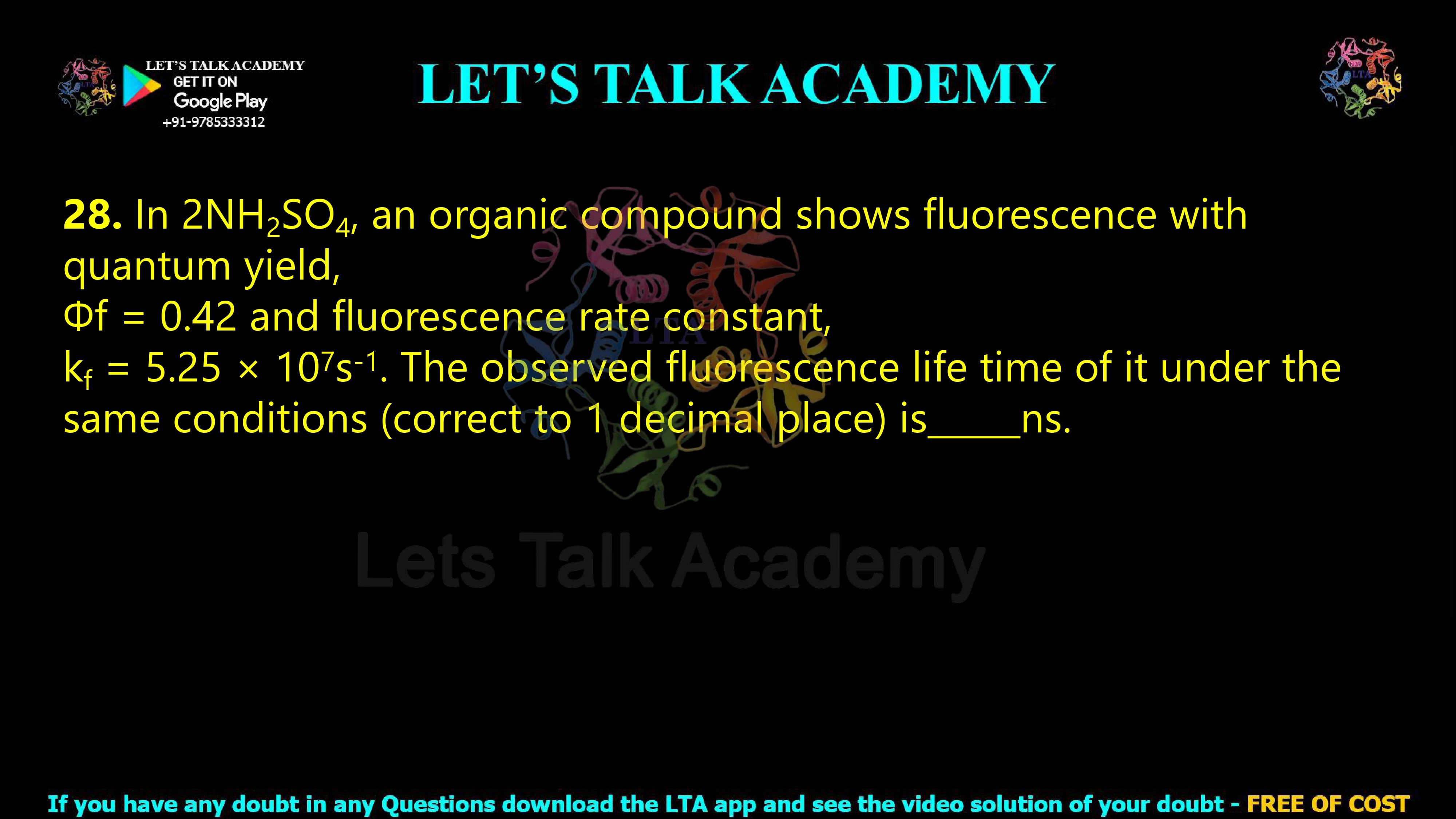
27. In 2NH2SO4, an organic compound shows fluorescence with quantum yield,
Φf = 0.42 and fluorescence rate constant,
kf = 5.25 × 10⁷s-1. The observed fluorescence life time of it under the same conditions (correct to 1 decimal place) is ns.
Calculate the Observed Fluorescence Lifetime from Quantum Yield and Fluorescence Rate Constant
Understanding the Given Fluorescence Data
This numerical problem asks us to calculate the observed fluorescence lifetime of an organic compound using its fluorescence quantum yield and fluorescence rate constant. The compound is present in 2 N H₂SO₄, and under these conditions its fluorescence quantum yield is given as 0.42, while its fluorescence rate constant is 5.25 × 10⁷ s⁻¹.
The given quantities are:
Fluorescence quantum yield, Φf = 0.42
Fluorescence rate constant, kf = 5.25 × 10⁷ s⁻¹
The required quantity is:
Observed fluorescence lifetime, τ = ? ns
To solve the problem, we need to understand the relationship between fluorescence quantum yield, fluorescence rate constant, and observed fluorescence lifetime.
Formula Relating Fluorescence Quantum Yield and Lifetime
The fluorescence quantum yield is related to the fluorescence rate constant and the observed excited-state lifetime by the equation:
Φf = kfτ
where Φf is the fluorescence quantum yield, kf is the fluorescence or radiative rate constant, and τ is the observed fluorescence lifetime.
Rearranging this equation to calculate the fluorescence lifetime gives:
τ = Φf/kf
This is the central equation required to solve the numerical problem.
Step-by-Step Calculation of the Observed Fluorescence Lifetime
Substituting the given values into the equation:
τ = Φf/kf
we obtain:
τ = 0.42/(5.25 × 10⁷ s⁻¹)
Now divide 0.42 by 5.25:
0.42/5.25 = 0.08
Therefore:
τ = 0.08 × 10⁻⁷ s
Writing this in standard scientific notation:
τ = 8.0 × 10⁻⁹ s
Thus, the observed fluorescence lifetime is:
τ = 8.0 × 10⁻⁹ s
Converting the Fluorescence Lifetime from Seconds to Nanoseconds
The calculated lifetime is currently expressed in seconds. However, the question asks for the answer in nanoseconds.
The conversion between seconds and nanoseconds is:
1 ns = 10⁻⁹ s
Therefore:
8.0 × 10⁻⁹ s = 8.0 ns
Hence, the observed fluorescence lifetime is:
τ = 8.0 ns
Correct to one decimal place:
8.0 ns
Why the Formula Φf = kfτ Is Used
Fluorescence occurs when a molecule absorbs energy and reaches an electronically excited state. The excited molecule does not remain in this state permanently. It eventually returns to a lower-energy state through one of several possible pathways.
One possible pathway is fluorescence, in which the excited molecule emits a photon. The rate constant associated with this radiative process is represented by kf.
However, fluorescence is not the only way in which an excited molecule can lose energy. Competing non-radiative processes may also occur. These include internal conversion, intersystem crossing, collisional quenching, and other radiationless relaxation pathways.
The observed fluorescence lifetime represents the average time that a molecule remains in its excited state before returning to a lower-energy state through any available decay process.
The fluorescence quantum yield represents the fraction of excited molecules that return to the lower state specifically through fluorescence. This relationship leads to:
Φf = kfτ
Therefore:
τ = Φf/kf
This equation allows the observed fluorescence lifetime to be calculated when the fluorescence quantum yield and fluorescence rate constant are known.
What Is Fluorescence Quantum Yield?
The fluorescence quantum yield, represented by Φf, is a measure of the efficiency of fluorescence emission. It compares the number of photons emitted through fluorescence with the number of photons absorbed by the sample.
It can be expressed as:
Φf = Number of fluorescence photons emitted / Number of photons absorbed
A fluorescence quantum yield of 1 would mean that every absorbed photon ultimately produces one fluorescence photon. A quantum yield smaller than 1 indicates that some excited molecules lose their energy through processes other than fluorescence.
In this problem:
Φf = 0.42
This means that approximately 42% of the relevant excitation events result in fluorescence emission, while the remaining excited-state population returns through competing non-radiative pathways.
What Is the Fluorescence Rate Constant?
The fluorescence rate constant, represented by kf, describes the probability per unit time that an excited molecule will return to the ground state through fluorescence emission.
In this question:
kf = 5.25 × 10⁷ s⁻¹
The unit s⁻¹ indicates that the rate constant represents a first-order process. A larger value of kf corresponds to a greater probability of fluorescence emission per unit time.
The reciprocal of the fluorescence rate constant gives the radiative lifetime in the absence of competing deactivation processes:
τ₀ = 1/kf
For the given value:
τ₀ = 1/(5.25 × 10⁷ s⁻¹)
which is approximately:
τ₀ = 1.90 × 10⁻⁸ s
or:
τ₀ ≈ 19.0 ns
This radiative lifetime is longer than the observed fluorescence lifetime of 8.0 ns because the actual excited molecule can also lose energy through non-radiative pathways.
Observed Fluorescence Lifetime and Radiative Lifetime
It is important to distinguish between the observed fluorescence lifetime and the natural or radiative fluorescence lifetime.
The observed fluorescence lifetime is:
τ = 1/(kf + knr)
where kf is the fluorescence rate constant and knr represents the total rate constant for all non-radiative decay processes.
The fluorescence quantum yield is:
Φf = kf/(kf + knr)
Since:
τ = 1/(kf + knr)
the quantum yield equation can be rewritten as:
Φf = kfτ
Therefore:
τ = Φf/kf
This derivation confirms the formula used in the calculation.
Calculating the Total Excited-State Decay Rate
The observed lifetime can also be used to determine the total rate of excited-state decay.
Since:
τ = 8.0 × 10⁻⁹ s
the total decay rate constant is:
ktotal = 1/τ
Therefore:
ktotal = 1/(8.0 × 10⁻⁹ s)
which gives:
ktotal = 1.25 × 10⁸ s⁻¹
This total decay rate includes both fluorescence and non-radiative decay processes.
Since the fluorescence rate constant is:
kf = 5.25 × 10⁷ s⁻¹
the remaining part of the total decay rate is due to non-radiative processes.
Thus:
knr = ktotal − kf
knr = 1.25 × 10⁸ − 5.25 × 10⁷ s⁻¹
Therefore:
knr = 7.25 × 10⁷ s⁻¹
This additional calculation shows why the observed lifetime is shorter than the purely radiative lifetime.
Why Fluorescence Lifetimes Are Usually Expressed in Nanoseconds
Fluorescence is an extremely rapid photophysical process. For many organic molecules, fluorescence lifetimes are typically in the nanosecond range.
A nanosecond is:
1 ns = 10⁻⁹ s
Therefore, a lifetime of:
8.0 × 10⁻⁹ s
is more conveniently written as:
8.0 ns
Expressing fluorescence lifetimes in nanoseconds makes the numerical values easier to understand and compare.
Role of 2 N H₂SO₄ in the Question
The problem specifies that the fluorescence measurements are performed in 2 N H₂SO₄. The solvent and chemical environment can influence the photophysical properties of an organic compound.
A strongly acidic medium may change the protonation state of the molecule. This can alter its electronic structure, absorption spectrum, fluorescence efficiency, rate constants, and excited-state lifetime.
However, no additional calculation involving the concentration of sulfuric acid is required in this problem. The important point is that both the quantum yield and fluorescence rate constant are given under the same conditions. Therefore, these two values can be directly used to calculate the observed lifetime.
Complete Numerical Solution
Given:
Φf = 0.42
kf = 5.25 × 10⁷ s⁻¹
Using:
Φf = kfτ
Therefore:
τ = Φf/kf
Substituting the values:
τ = 0.42/(5.25 × 10⁷)
τ = 8.0 × 10⁻⁹ s
Since:
1 ns = 10⁻⁹ s
we obtain:
τ = 8.0 ns
Final Answer
The relationship between fluorescence quantum yield, fluorescence rate constant, and observed fluorescence lifetime is:
Φf = kfτ
Therefore:
τ = Φf/kf
Substituting the given values:
τ = 0.42/(5.25 × 10⁷ s⁻¹)
τ = 8.0 × 10⁻⁹ s
τ = 8.0 ns
Hence, the observed fluorescence lifetime of the organic compound, correct to one decimal place, is:
Correct Answer: 8.0 ns


