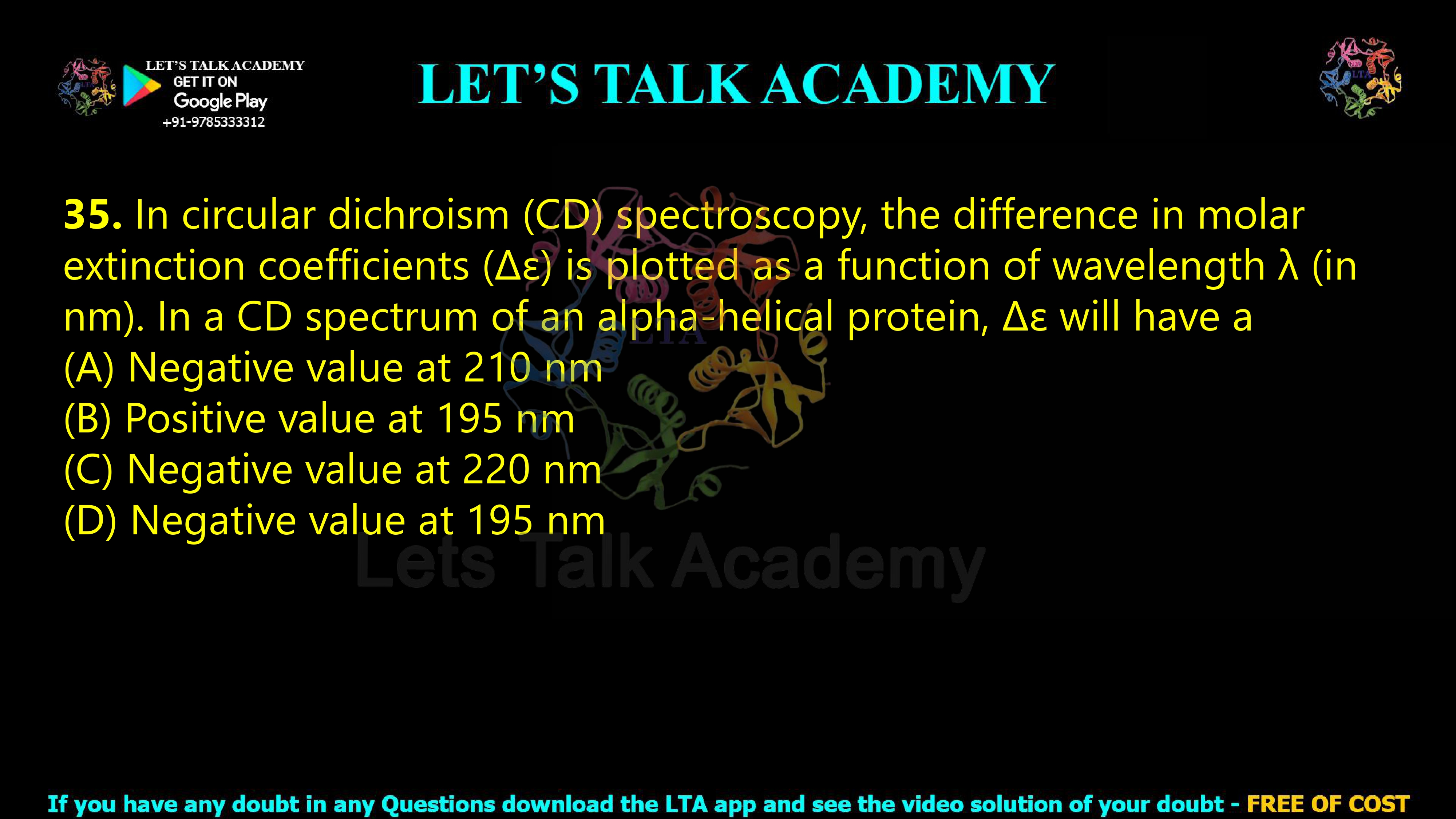
34. In circular dichroism (CD) spectroscopy, the difference in molar extinction coefficients (Δε) is plotted as a function of wavelength λ (in nm). In a CD spectrum of an alpha-helical protein, Δε will have a
(A) Negative value at 210 nm
(B) Positive value at 195 nm
(C) Negative value at 220 nm
(D) Negative value at 195 nm
Circular Dichroism Spectrum of an Alpha-Helical Protein
The correct statements are (A), (B), and (C).
An alpha-helical protein shows a highly characteristic circular dichroism (CD) spectrum. The most important spectral features are a strong positive band near 190–195 nm and two characteristic negative bands near 208 nm and 222 nm. Therefore, a negative value at 210 nm, a positive value at 195 nm, and a negative value at 220 nm are all consistent with an alpha-helical protein.
The only incorrect statement is Option (D), negative value at 195 nm, because an alpha helix normally gives a strong positive CD signal in this wavelength region.
What Is Circular Dichroism Spectroscopy?
Circular dichroism spectroscopy is a powerful technique used to study the three-dimensional structural organization of optically active molecules. In protein science, CD spectroscopy is particularly useful for determining the relative amounts of secondary structural elements such as alpha helices, beta sheets and random coils.
The fundamental principle of circular dichroism is based on the unequal absorption of left circularly polarized light and right circularly polarized light by a chiral molecule. Proteins are chiral because they are built primarily from L-amino acids and adopt ordered three-dimensional structures.
The difference in absorption can be expressed in terms of the difference in molar extinction coefficients:
Δε = εL − εR
Here, εL and εR represent the molar extinction coefficients for left and right circularly polarized light, respectively.
In a CD spectrum, Δε is plotted against wavelength (λ). A positive value of Δε produces a positive CD band, whereas a negative value produces a negative CD band.
Why Protein Secondary Structures Produce Different CD Spectra
The peptide bonds present in proteins absorb strongly in the far-ultraviolet region, particularly between approximately 190 and 250 nm. When peptide bonds become organized into regular secondary structures, such as alpha helices or beta sheets, their electronic transitions interact with one another.
These interactions produce characteristic CD spectral patterns. As a result, an alpha helix gives a different CD spectrum from a beta sheet or an unordered protein structure.
The alpha helix has one of the most easily recognizable CD spectral signatures because it produces three major spectral features: a strong positive band near 190–195 nm, a negative band near 208 nm, and a second negative band near 222 nm.
Characteristic CD Spectrum of an Alpha Helix
An alpha-helical protein shows a strong positive maximum in the region of approximately 190–195 nm. The value of Δε in this region is therefore positive.
The spectrum then crosses toward the negative region and develops a strong negative minimum at approximately 208 nm. A second negative minimum occurs at approximately 222 nm.
The characteristic pattern can therefore be summarized as:
190–195 nm → Positive CD band
208 nm → Negative CD band
222 nm → Negative CD band
The wavelengths given in the question are approximate values. Therefore, 210 nm corresponds closely to the negative band near 208 nm, while 220 nm corresponds closely to the negative band near 222 nm.
Why Option (A) Negative Value at 210 nm Is Correct
Option (A): Negative value at 210 nm
This statement is correct.
One of the characteristic negative minima of an alpha-helical protein occurs at approximately 208 nm. Since 210 nm is very close to 208 nm, the Δε value remains negative in this wavelength region.
Therefore:
At approximately 210 nm, Δε < 0
This negative band is one of the major identifying features of alpha-helical secondary structure. Thus, Option (A) is correct.
Why Option (B) Positive Value at 195 nm Is Correct
Option (B): Positive value at 195 nm
This statement is correct.
An alpha helix produces a strong positive CD band in the region of approximately 190–195 nm. Therefore, at 195 nm, the difference in molar extinction coefficients, Δε, is positive.
Thus:
At approximately 195 nm, Δε > 0
This positive band, together with the two negative bands near 208 and 222 nm, forms the classic CD signature of an alpha-helical protein. Therefore, Option (B) is correct.
Why Option (C) Negative Value at 220 nm Is Correct
Option (C): Negative value at 220 nm
This statement is correct.
The second characteristic negative minimum of an alpha helix occurs at approximately 222 nm. Since 220 nm lies very close to 222 nm, the value of Δε in this region is negative.
Therefore:
At approximately 220 nm, Δε < 0
The negative band near 222 nm is particularly important in the analysis of alpha-helical proteins and is widely used for estimating alpha-helical content. Thus, Option (C) is correct.
Why Option (D) Negative Value at 195 nm Is Incorrect
Option (D): Negative value at 195 nm
This statement is incorrect.
The region around 190–195 nm corresponds to the strong positive CD band of an alpha helix. Therefore, Δε should be positive rather than negative at approximately 195 nm.
The correct relationship is:
At approximately 195 nm, Δε > 0
Therefore, a negative value at 195 nm does not represent the characteristic CD spectrum of an alpha-helical protein. Thus, Option (D) is incorrect.
Understanding the Two Negative Bands of an Alpha Helix
The presence of two negative bands is a particularly important feature of an alpha-helical CD spectrum. One negative minimum occurs near 208 nm, while another occurs near 222 nm.
The band near 208 nm is commonly associated with the π → π* electronic transition of the peptide bond, whereas the negative band near 222 nm is associated mainly with the n → π* transition.
The strong positive band in the shorter-wavelength region near 190–195 nm is also associated primarily with peptide-bond electronic transitions and their interactions within the regular helical arrangement.
The exact positions and intensities of these bands can vary slightly depending on factors such as the protein sequence, solvent conditions, temperature and the degree of alpha-helical structure. However, the overall pattern remains characteristic.
How to Identify an Alpha-Helical Protein from a CD Spectrum
When examining a far-UV CD spectrum, the most important feature to look for is the overall spectral pattern rather than a single wavelength in isolation.
An alpha-helical protein is recognized by a strong positive signal near 190–195 nm followed by two negative signals near 208 and 222 nm. Therefore, if a CD spectrum shows this characteristic positive–negative–negative pattern, it strongly indicates the presence of alpha-helical secondary structure.
Characteristic Wavelength Pattern
The essential alpha-helix CD pattern is:
Positive maximum: approximately 190–195 nm
First negative minimum: approximately 208 nm
Second negative minimum: approximately 222 nm
Accordingly, the values given in the question can be interpreted as follows:
210 nm → Negative
195 nm → Positive
220 nm → Negative
Difference Between Alpha Helix, Beta Sheet and Random Coil CD Spectra
An alpha helix produces a strong positive band near 190–195 nm and two negative bands near 208 and 222 nm. This double-minimum pattern is one of the clearest signatures of alpha-helical secondary structure.
A beta-sheet-rich protein generally shows a positive band near approximately 195 nm and a negative band near approximately 215–218 nm. Unlike an alpha helix, it does not usually show the characteristic pair of negative minima at both 208 and 222 nm.
An unordered or random-coil structure generally produces a strong negative band near approximately 195–200 nm and a much weaker signal at longer wavelengths.
This comparison is particularly important because it explains why Option (D) is inconsistent with an alpha helix. A negative signal near 195 nm is more characteristic of an unordered or random-coil structure than of a strongly alpha-helical protein.
Analysis of All Four Options
Option (A), negative value at 210 nm, is correct because an alpha helix has a negative minimum near 208 nm.
Option (B), positive value at 195 nm, is correct because an alpha helix has a strong positive band near 190–195 nm.
Option (C), negative value at 220 nm, is correct because an alpha helix has another negative minimum near 222 nm.
Option (D), negative value at 195 nm, is incorrect because the CD signal of an alpha helix is positive in the region around 190–195 nm.
Final Answer
The characteristic circular dichroism spectrum of an alpha-helical protein contains a positive CD band near 190–195 nm and two negative CD bands near 208 nm and 222 nm.
(A) Negative value at 210 nm — Correct
(B) Positive value at 195 nm — Correct
(C) Negative value at 220 nm — Correct
(D) Negative value at 195 nm — Incorrect
Correct Answer: (A), (B) and (C)


