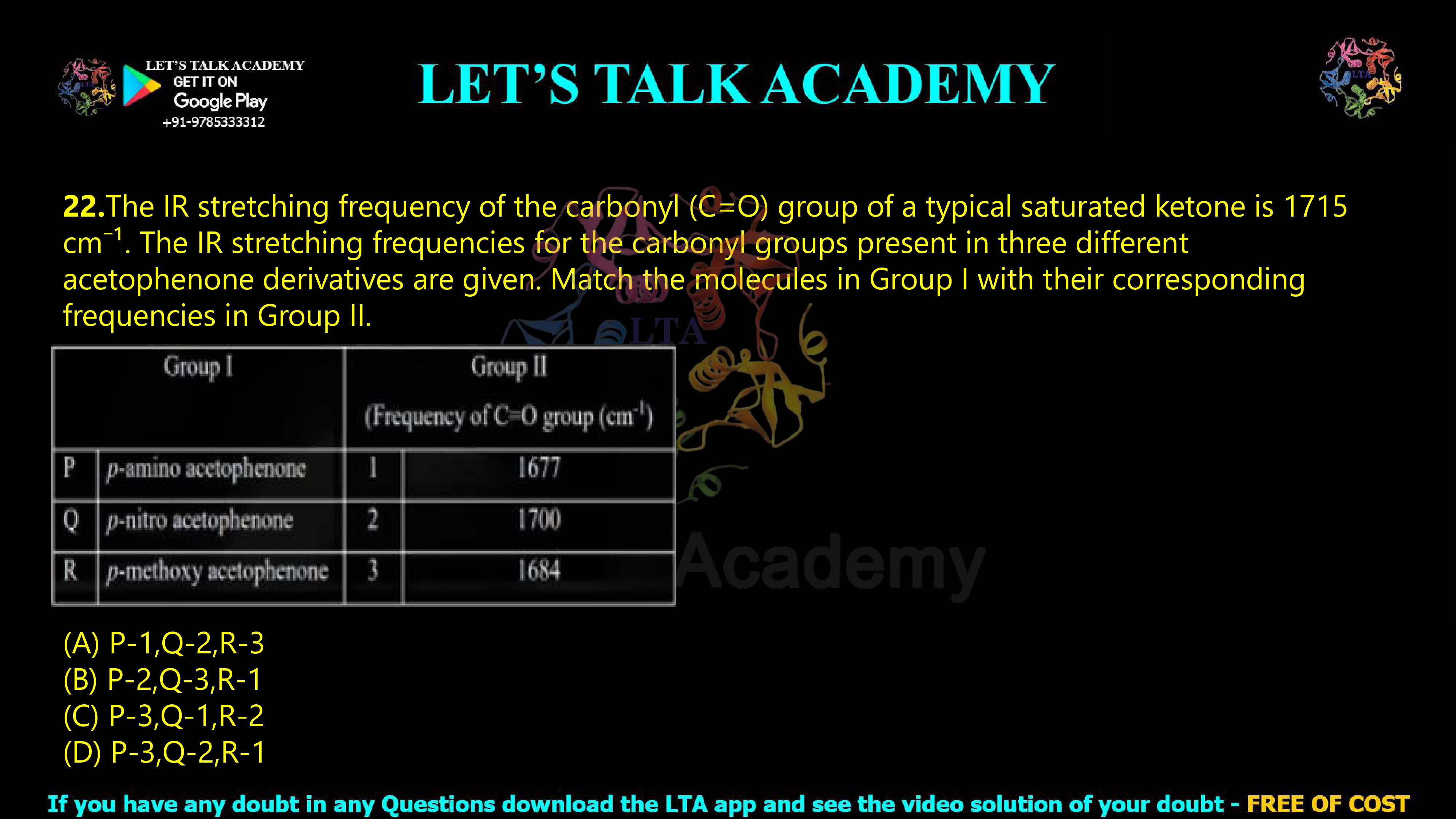
21.The IR stretching frequency of the carbonyl (C=O) group of a typical saturated ketone is 1715 cm⁻¹. The IR stretching frequencies for the carbonyl groups present in three different acetophenone derivatives are given. Match the molecules in Group I with their corresponding frequencies in Group II.
(A) P-1,Q-2,R-3
(B) P-2,Q-3,R-1
(C) P-3,Q-1,R-2
(D) P-3,Q-2,R-1
Match the IR Carbonyl Stretching Frequencies of para-Amino, para-Nitro and para-Methoxy Acetophenone
Correct Answer: (A) P-1, Q-2, R-3
The correct answer is Option (A): P-1, Q-2, R-3. Therefore, p-amino acetophenone has a carbonyl stretching frequency of 1677 cm−1, p-nitro acetophenone has a carbonyl stretching frequency of 1700 cm−1, and p-methoxy acetophenone has a carbonyl stretching frequency of 1684 cm−1.
The correct matching is:
P: p-amino acetophenone → 1 → 1677 cm−1
Q: p-nitro acetophenone → 2 → 1700 cm−1
R: p-methoxy acetophenone → 3 → 1684 cm−1
The key to solving this question is understanding how an electron-donating or electron-withdrawing substituent at the para position influences the resonance interaction between the aromatic ring and the carbonyl group. A strong electron-donating group increases electron delocalization toward the carbonyl group, decreases the effective C=O bond order and lowers the carbonyl stretching frequency. A strong electron-withdrawing group produces the opposite trend and gives the highest C=O stretching frequency among the three compounds.
Final Matching at a Glance
p-NH2 acetophenone → Strongest resonance donation → Lowest C=O bond order → 1677 cm−1
p-OCH3 acetophenone → Moderate resonance donation → Intermediate C=O bond order → 1684 cm−1
p-NO2 acetophenone → Strong electron withdrawal → Highest C=O bond order → 1700 cm−1
Therefore, the order of carbonyl stretching frequencies is:
p-amino acetophenone < p-methoxy acetophenone < p-nitro acetophenone
or:
1677 cm−1 < 1684 cm−1 < 1700 cm−1
Understanding the Basic Principle of the Question
The carbonyl stretching frequency observed in infrared spectroscopy depends strongly on the effective strength and bond order of the C=O bond. A stronger carbonyl bond generally requires more energy to stretch and therefore absorbs at a higher wavenumber. A weaker carbonyl bond requires less energy to stretch and absorbs at a lower wavenumber.
The question provides an important reference value: the C=O stretching frequency of a typical saturated ketone is approximately 1715 cm−1. In acetophenone and its derivatives, however, the carbonyl group is directly attached to an aromatic ring. This arrangement allows conjugation between the carbonyl group and the benzene ring.
Conjugation delocalizes the π electrons and gives the carbonyl bond some partial single-bond character. As a result, the effective C=O bond order decreases compared with that of an isolated saturated ketone. A decrease in bond order weakens the carbonyl bond and shifts its IR stretching frequency to a lower wavenumber.
The substituents –NH2, –OCH3 and –NO2 modify this conjugation through their electronic effects. Therefore, the carbonyl groups in the three acetophenone derivatives absorb at different frequencies.
Why Does a Typical Saturated Ketone Absorb Near 1715 cm−1?
A typical saturated ketone contains a carbonyl group that is not extensively conjugated with another π system. The C=O bond is strong because it possesses substantial double-bond character. Consequently, a relatively high amount of vibrational energy is required to stretch the bond.
For this reason, the carbonyl stretching vibration of a typical non-conjugated saturated ketone is commonly observed near:
ν(C=O) ≈ 1715 cm−1
This value provides a useful reference point. Structural features that strengthen the C=O bond can shift the absorption toward a higher wavenumber, while factors that weaken the carbonyl bond can shift it toward a lower wavenumber.
Why Does Conjugation Lower the C=O Stretching Frequency?
In acetophenone, the carbonyl group is directly connected to an aromatic ring:
C6H5–CO–CH3
The π electrons of the aromatic ring can interact with the π system of the carbonyl group. This conjugation produces electron delocalization and generates resonance contributors in which the carbonyl bond has reduced double-bond character.
The important relationship is:
Greater conjugation → Lower effective C=O bond order → Weaker C=O bond → Lower stretching frequency
Therefore, conjugated aromatic ketones generally show lower carbonyl stretching frequencies than simple saturated ketones.
Relationship Between Bond Strength and IR Frequency
The stretching frequency of a chemical bond can be understood approximately using the harmonic oscillator model:
ν̄ = (1/2πc) √(k/μ)
where ν̄ is the wavenumber, k is the force constant of the bond, μ is the reduced mass of the bonded atoms and c is the speed of light.
For the three acetophenone derivatives in this question, the atoms of the carbonyl group remain the same. Therefore, the major difference arises from changes in the effective force constant of the C=O bond.
A stronger C=O bond has a larger force constant and absorbs at a higher wavenumber. A weaker C=O bond has a smaller force constant and absorbs at a lower wavenumber.
Electronic Effects of para Substituents in Acetophenone
The three compounds differ only in the substituent attached at the para position of the aromatic ring. Because these substituents are electronically connected to the carbonyl group through the conjugated benzene ring, they influence the electron distribution of the complete system.
The amino group, –NH2, is a powerful resonance electron donor. The methoxy group, –OCH3, is also a resonance electron donor, but its net electron-donating influence in this system is weaker than that of the amino group. The nitro group, –NO2, is a powerful electron-withdrawing group.
Therefore, the general electronic order is:
Resonance donation: –NH2 > –OCH3 > –NO2
This difference in electronic behavior produces the observed order of carbonyl stretching frequencies.
Why p-Amino Acetophenone Has the Lowest C=O Stretching Frequency
p-Amino acetophenone corresponds to 1677 cm−1, the lowest carbonyl stretching frequency among the three compounds.
The amino group contains a nitrogen atom with a lone pair of electrons. This lone pair can participate strongly in resonance with the aromatic π system. Because the amino group is located at the para position relative to the carbonyl-containing substituent, electron density can be delocalized through the aromatic ring toward the carbonyl group.
The electron donation can be represented conceptually as:
–NH2 → Aromatic ring → C=O
This extended conjugation increases the contribution of resonance structures in which the carbonyl bond has reduced double-bond character. As the effective C=O bond order decreases, the carbonyl bond becomes easier to stretch.
Therefore:
Strong –NH2 resonance donation → Maximum electron delocalization → Maximum reduction in C=O bond order → Lowest IR stretching frequency
Hence:
P: p-amino acetophenone → 1677 cm−1 → Group II number 1
Why Is the –NH2 Group a Strong Resonance Donor?
The nitrogen atom of an amino group possesses a lone pair that can overlap with the adjacent aromatic π system. This overlap allows the lone pair to become delocalized into the benzene ring.
When the amino group is positioned para to the carbonyl-containing substituent, resonance communication can occur across the conjugated aromatic framework. Electron density donated by nitrogen can therefore influence the carbonyl group at the opposite side of the ring.
The strong resonance-donating ability of –NH2 causes the greatest weakening of the C=O bond among the three compounds listed in the question. Consequently, p-amino acetophenone shows the lowest carbonyl stretching frequency.
Why p-Methoxy Acetophenone Has the Intermediate C=O Stretching Frequency
p-Methoxy acetophenone corresponds to 1684 cm−1, the intermediate value among the three given frequencies.
The methoxy group contains an oxygen atom with lone pairs that can donate electron density into the aromatic ring through resonance. Therefore, –OCH3 can enhance conjugation between the para substituent, the aromatic ring and the carbonyl group.
The electron donation can be represented conceptually as:
–OCH3 → Aromatic ring → C=O
This resonance donation reduces the effective bond order of the carbonyl group and lowers its stretching frequency relative to a less electron-rich carbonyl system.
However, the methoxy group is a weaker net resonance donor than the amino group in this comparison. Oxygen is more electronegative than nitrogen and holds its lone pairs more strongly. Therefore, the reduction in C=O bond order is not as extensive as in p-amino acetophenone.
As a result:
–OCH3 donation < –NH2 donation
Therefore:
ν(C=O) of p-methoxy acetophenone > ν(C=O) of p-amino acetophenone
Hence:
R: p-methoxy acetophenone → 1684 cm−1 → Group II number 3
Why Does –OCH3 Lower the Carbonyl Frequency?
The methoxy group shows two important electronic effects. Oxygen withdraws electron density through the sigma-bond framework because of its high electronegativity, but it can also donate a lone pair into the aromatic π system through resonance.
At the para position of an aromatic conjugated system, the resonance-donating effect is highly important. This donation increases electron density in the conjugated framework and enhances delocalization toward the carbonyl group.
The result is partial weakening of the C=O bond and a decrease in its stretching frequency. However, because the methoxy group does not weaken the carbonyl bond as strongly as the amino group, its carbonyl frequency remains slightly higher at 1684 cm−1.
Why p-Nitro Acetophenone Has the Highest C=O Stretching Frequency
p-Nitro acetophenone corresponds to 1700 cm−1, the highest carbonyl stretching frequency among the three compounds.
The nitro group is a strong electron-withdrawing substituent. It removes electron density from the aromatic ring through powerful electronic effects and competes with the carbonyl group for electron density from the conjugated system.
Unlike –NH2 and –OCH3, the –NO2 group does not donate electron density through the ring toward the carbonyl group. Instead, it withdraws electron density from the aromatic system.
This reduces the electron-donating ability of the ring toward the carbonyl group and decreases the resonance-induced weakening of the C=O bond. Consequently, the carbonyl group retains greater double-bond character and has a larger effective force constant.
Therefore:
Strong electron withdrawal by –NO2 → Reduced electron donation toward C=O → Greater C=O double-bond character → Stronger C=O bond → Higher stretching frequency
Hence:
Q: p-nitro acetophenone → 1700 cm−1 → Group II number 2
Why Does an Electron-Withdrawing Group Increase the C=O Frequency?
The aromatic ring and carbonyl group of acetophenone can participate in conjugation. Electron donation through this conjugated system reduces the effective double-bond character of the carbonyl group.
A strong electron-withdrawing group such as –NO2 reduces the availability of electron density in the aromatic ring for delocalization toward the carbonyl group. Therefore, the resonance contribution that weakens the carbonyl bond becomes less important.
The C=O bond consequently retains more double-bond character. A bond with greater double-bond character is stronger and has a larger force constant, so it absorbs at a higher IR wavenumber.
This explains why p-nitro acetophenone has the highest frequency of the three compounds.
Step-by-Step Method to Solve the Matching Question
Step 1: Arrange the Given Frequencies
The three frequencies in increasing order are:
1677 cm−1 < 1684 cm−1 < 1700 cm−1
The lowest frequency must correspond to the compound with the weakest effective C=O bond, while the highest frequency must correspond to the compound with the strongest effective C=O bond.
Step 2: Identify the Strongest Electron-Donating Group
Among –NH2, –OCH3 and –NO2, the amino group is the strongest resonance donor toward the aromatic ring.
Therefore, it causes the greatest reduction in carbonyl bond order and must correspond to the lowest frequency:
p-NH2 acetophenone → 1677 cm−1
Thus:
P → 1
Step 3: Identify the Moderate Electron-Donating Group
The methoxy group also donates electron density by resonance but less strongly than the amino group in this comparison.
Therefore, it corresponds to the intermediate frequency:
p-OCH3 acetophenone → 1684 cm−1
Thus:
R → 3
Step 4: Assign the Electron-Withdrawing Group
The nitro group is strongly electron withdrawing and produces the strongest effective carbonyl bond among the three derivatives.
Therefore, it corresponds to the highest frequency:
p-NO2 acetophenone → 1700 cm−1
Thus:
Q → 2
Step 5: Write the Complete Matching
The complete matching is:
P-1, Q-2, R-3
Therefore, the correct answer is Option (A).
Relationship Between Resonance Donation and C=O Stretching Frequency
The central concept of this question can be summarized through the relationship between electron donation and carbonyl bond strength.
When an electron-donating group supplies electron density into the conjugated aromatic system, resonance delocalization toward the carbonyl group increases. This increases the contribution of resonance structures in which the carbonyl oxygen carries greater negative character and the C=O bond has reduced double-bond character.
Therefore:
Stronger resonance donation → Greater delocalization → Lower C=O bond order → Lower force constant → Lower IR frequency
Applying this principle:
–NH2 → Strongest lowering of frequency
–OCH3 → Moderate lowering of frequency
–NO2 → Highest frequency among the three
Order of Electron Donation and Carbonyl Frequency
The electron-donating ability relevant to this conjugated system follows the approximate order:
–NH2 > –OCH3 > –NO2
The order of carbonyl bond strength is therefore approximately reversed:
p-NO2 acetophenone > p-OCH3 acetophenone > p-NH2 acetophenone
Consequently, the IR carbonyl stretching frequency follows:
p-NO2 acetophenone > p-OCH3 acetophenone > p-NH2 acetophenone
Numerically:
1700 cm−1 > 1684 cm−1 > 1677 cm−1
Detailed Evaluation of Option (A)
(A) P-1, Q-2, R-3
Option (A) is correct. The amino group is the strongest resonance donor among the three substituents and therefore produces the lowest C=O stretching frequency of 1677 cm−1. The nitro group is strongly electron withdrawing and gives the highest frequency of 1700 cm−1. The methoxy group has an intermediate resonance-donating effect and corresponds to 1684 cm−1.
The matching is:
P → 1 → 1677 cm−1
Q → 2 → 1700 cm−1
R → 3 → 1684 cm−1
Therefore, Option (A) is the correct answer.
Detailed Evaluation of Option (B)
(B) P-2, Q-3, R-1
Option (B) is incorrect. This option assigns the highest frequency, 1700 cm−1, to p-amino acetophenone. This contradicts the strong resonance-donating nature of the –NH2 group.
The amino group increases electron delocalization through the aromatic ring toward the carbonyl group and causes the greatest reduction in C=O bond order. It must therefore have the lowest, not the highest, carbonyl stretching frequency.
This option also assigns the lowest frequency to the methoxy derivative instead of the more strongly donating amino derivative. Therefore, Option (B) is incorrect.
Detailed Evaluation of Option (C)
(C) P-3, Q-1, R-2
Option (C) is incorrect. This option assigns the lowest frequency, 1677 cm−1, to p-nitro acetophenone. A strong electron-withdrawing nitro group does not produce the maximum weakening of the carbonyl bond.
Instead, –NO2 withdraws electron density from the aromatic ring and reduces electron donation toward the carbonyl group. The carbonyl bond therefore retains greater double-bond character and absorbs at a relatively high frequency.
For this reason, assigning 1677 cm−1 to the nitro derivative is incorrect.
Detailed Evaluation of Option (D)
(D) P-3, Q-2, R-1
Option (D) is incorrect. This option correctly assigns the highest frequency of 1700 cm−1 to p-nitro acetophenone, but it reverses the frequencies of the amino and methoxy derivatives.
The amino group is a stronger resonance donor than the methoxy group in this comparison. Therefore, p-amino acetophenone experiences greater carbonyl bond weakening and must absorb at a lower wavenumber than p-methoxy acetophenone.
The correct relationship is:
ν(C=O) of p-amino acetophenone < ν(C=O) of p-methoxy acetophenone
Therefore:
p-amino acetophenone → 1677 cm−1
p-methoxy acetophenone → 1684 cm−1
Thus, Option (D) is incorrect.
Why the Difference Between 1677 and 1684 cm−1 Is Important
The frequencies of p-amino acetophenone and p-methoxy acetophenone are relatively close because both –NH2 and –OCH3 can donate electron density into the aromatic ring through resonance.
However, their donating abilities are not identical. The amino group donates its nitrogen lone pair more effectively into the conjugated system than the methoxy group donates an oxygen lone pair. Therefore, the amino substituent causes slightly greater weakening of the C=O bond.
This produces the observed difference:
p-amino acetophenone → 1677 cm−1
p-methoxy acetophenone → 1684 cm−1
The lower value for the amino derivative reflects its stronger resonance-donating influence.
Why All Three Values Are Below 1715 cm−1
The question states that a typical saturated ketone absorbs near 1715 cm−1, while all three acetophenone derivatives absorb below this value.
The reason is that the carbonyl group in an acetophenone derivative is conjugated with the aromatic ring. Conjugation lowers the effective C=O bond order and shifts the stretching frequency to a lower wavenumber.
Even the nitro-substituted compound, which has the highest frequency among the three derivatives, absorbs at 1700 cm−1, still below the typical 1715 cm−1 value of a saturated non-conjugated ketone.
Therefore:
Saturated non-conjugated ketone → Approximately 1715 cm−1
Conjugated aromatic ketones → Generally lower C=O stretching frequencies
Effect of Electron-Donating Groups on Carbonyl Stretching Frequency
Electron-donating groups can lower the carbonyl stretching frequency when they enhance conjugation with the C=O group. The increased electron delocalization reduces the effective carbonyl bond order.
In the present series, both –NH2 and –OCH3 are capable of donating electron density through resonance. Therefore, both compounds show lower carbonyl stretching frequencies than the nitro-substituted derivative.
The stronger donor produces the greater decrease:
–NH2 → 1677 cm−1
–OCH3 → 1684 cm−1
Effect of Electron-Withdrawing Groups on Carbonyl Stretching Frequency
An electron-withdrawing group can increase the effective strength of the carbonyl bond by reducing electron donation through the conjugated system toward the C=O group.
The nitro group is strongly electron withdrawing. Its presence at the para position decreases the electron richness of the aromatic ring and reduces the extent to which the ring can donate electron density toward the carbonyl group.
Consequently, the C=O bond retains greater double-bond character and absorbs at the highest frequency among the three compounds:
p-nitro acetophenone → 1700 cm−1
Complete Comparison of the Three Acetophenone Derivatives
p-Amino Acetophenone
The –NH2 group is the strongest resonance donor in the series. It produces the greatest electron delocalization toward the carbonyl group, causes the greatest reduction in C=O bond order and therefore gives the lowest stretching frequency.
Frequency = 1677 cm−1
p-Methoxy Acetophenone
The –OCH3 group donates electron density through resonance but less strongly than –NH2. It causes moderate weakening of the carbonyl bond and therefore gives the intermediate stretching frequency.
Frequency = 1684 cm−1
p-Nitro Acetophenone
The –NO2 group strongly withdraws electron density from the aromatic system. It reduces electron donation toward the carbonyl group, allowing the C=O bond to retain greater double-bond character. Therefore, it gives the highest stretching frequency.
Frequency = 1700 cm−1
Final Answer
Correct Answer: (A) P-1, Q-2, R-3
The correct matching is:
P: p-amino acetophenone → 1 → 1677 cm−1
Q: p-nitro acetophenone → 2 → 1700 cm−1
R: p-methoxy acetophenone → 3 → 1684 cm−1
The amino group is the strongest resonance electron donor and produces the maximum reduction in carbonyl bond order. Therefore, p-amino acetophenone has the lowest C=O stretching frequency of 1677 cm−1.
The methoxy group also donates electron density through resonance, but less strongly than the amino group. Therefore, p-methoxy acetophenone has the intermediate C=O stretching frequency of 1684 cm−1.
The nitro group strongly withdraws electron density and reduces resonance donation toward the carbonyl group. The C=O bond therefore retains the greatest double-bond character among the three compounds and shows the highest stretching frequency of 1700 cm−1.
Thus, the frequency order is:
p-amino acetophenone (1677 cm−1) < p-methoxy acetophenone (1684 cm−1) < p-nitro acetophenone (1700 cm−1)
Therefore, the correct answer is Option (A): P-1, Q-2, R-3.


