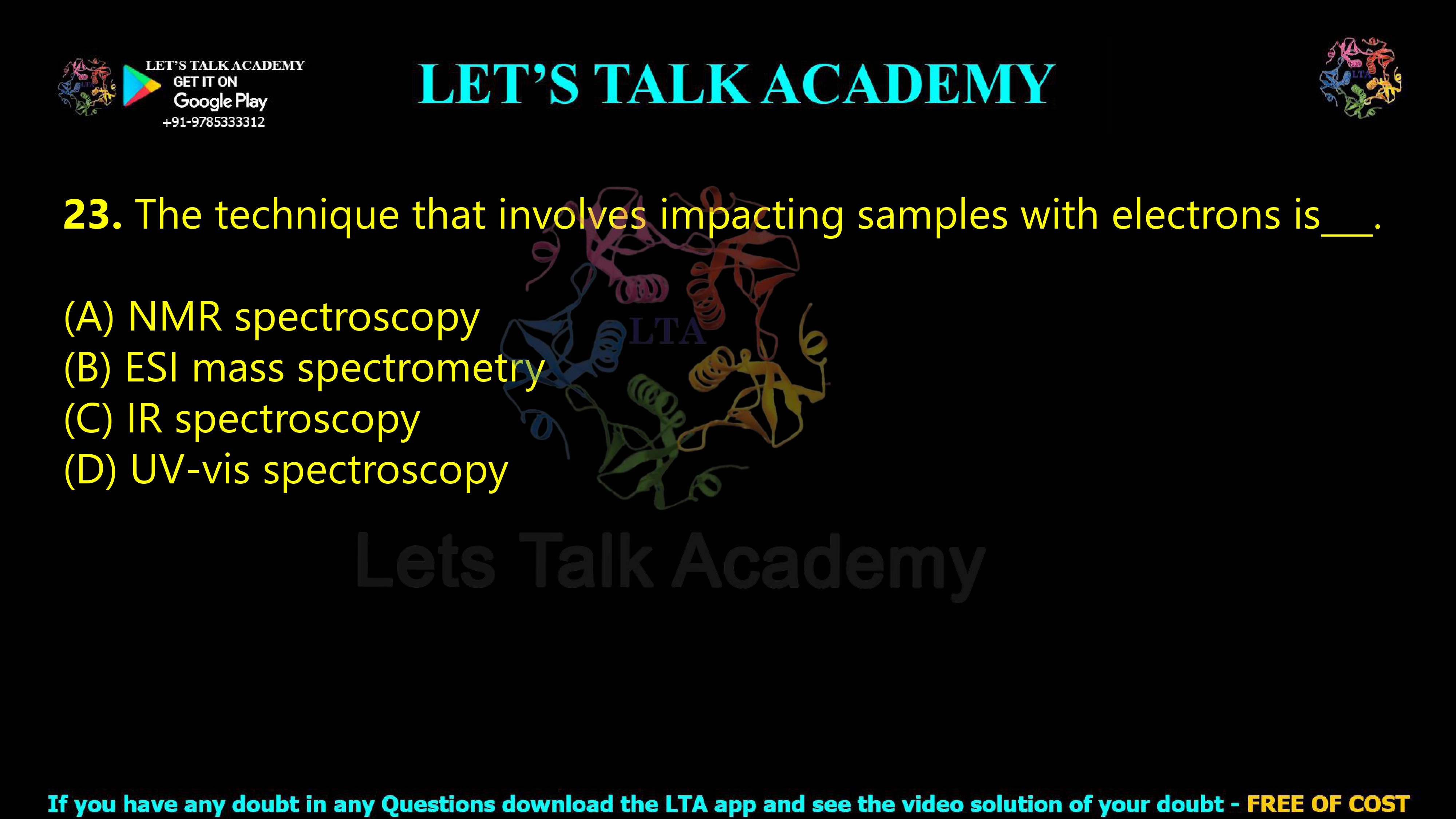
22. The technique that involves impacting samples with electrons is .
(A) NMR spectroscopy
(B) ESI mass spectrometry
(C) IR spectroscopy
(D) UV-vis spectroscopy
Technique That Involves Impacting Samples with Electrons – Detailed Explanation
Correct Option: (B) ESI mass spectrometry
Understanding the Correct Answer
Among the given options, mass spectrometry is the analytical technique associated with the ionization of sample molecules for mass analysis, and electron impact is a well-known ionization method used in mass spectrometry. Therefore, the expected answer to this question is Option (B) ESI mass spectrometry.
However, an important technical distinction should be understood. Electron impact ionization, more accurately called electron ionization (EI), and electrospray ionization (ESI) are two different ionization techniques used in mass spectrometry. In electron ionization, gaseous sample molecules are directly bombarded with high-energy electrons. In ESI, ions are primarily produced from a charged solution by applying a high electric potential and forming a fine spray of charged droplets.
Therefore, the wording of the question is not perfectly precise. If the question specifically asks about a technique in which the sample is directly impacted or bombarded with electrons, the exact term should be electron ionization mass spectrometry or electron impact mass spectrometry. Nevertheless, among the options provided, ESI mass spectrometry is the intended and closest correct answer because it is the only mass spectrometric technique listed.
What Is Electron Impact Ionization in Mass Spectrometry?
Electron impact ionization is a classical ionization technique used in mass spectrometry. In this method, the sample is first converted into the gas phase. The gaseous molecules are then exposed to a beam of high-energy electrons, commonly with an energy of approximately 70 electron volts (eV).
When a high-energy electron collides with a sample molecule, it can remove one electron from that molecule. As a result, a positively charged molecular ion is produced.
The general process can be represented as:
M + e⁻ → M⁺• + 2e⁻
Here, M represents the neutral sample molecule, while M⁺• represents the positively charged molecular radical ion. The ion formed is then separated and detected according to its mass-to-charge ratio (m/z).
Because electron impact transfers considerable energy to molecules, it often causes extensive fragmentation. These fragments generate a characteristic mass spectrum that can be used to identify the molecular structure of an unknown compound.
Why Electron Impact Is Important in Chemical Analysis
Electron impact ionization is especially valuable because the fragmentation pattern of a compound is often highly reproducible. The resulting spectrum acts like a molecular fingerprint. Scientists can compare the observed fragmentation pattern with reference spectral databases to identify unknown compounds.
This technique is widely associated with the analysis of small, volatile, and thermally stable molecules. It is commonly used in combination with gas chromatography, where the separated compounds enter the mass spectrometer and are subsequently ionized and analyzed.
Why Option (B) ESI Mass Spectrometry Is the Expected Correct Answer
ESI mass spectrometry, or electrospray ionization mass spectrometry, is the only mass spectrometric technique among the four options. Mass spectrometry requires the formation of ions before molecules can be separated according to their mass-to-charge ratios.
In ESI, the sample is usually dissolved in a suitable solvent and passed through a fine capillary. A strong electrical potential is applied, producing a spray of electrically charged droplets. As the solvent evaporates, the droplets become progressively smaller until gas-phase ions are produced. These ions then enter the mass analyzer.
ESI is considered a soft ionization technique because it usually produces much less fragmentation than electron impact ionization. This makes ESI particularly suitable for large and fragile biological molecules such as proteins, peptides, nucleic acids, and other biomolecules.
The major difference is that electron impact directly bombards gaseous molecules with electrons, whereas ESI generates ions from electrically charged droplets. Therefore, the scientifically exact technique described by the phrase “impacting samples with electrons” is electron impact mass spectrometry, but Option (B) remains the expected answer from the choices provided.
Detailed Explanation of Option (A): NMR Spectroscopy
NMR spectroscopy is not the correct answer because it does not involve bombarding the sample with electrons. NMR stands for Nuclear Magnetic Resonance spectroscopy, and it is based on the interaction between certain atomic nuclei, a strong external magnetic field, and radiofrequency radiation.
When a sample containing nuclei such as hydrogen-1 or carbon-13 is placed inside a strong magnetic field, the nuclear spins occupy different energy states. Radiofrequency radiation of the appropriate frequency is then applied to the sample. The nuclei absorb this energy and undergo transitions between spin states.
When the nuclei return to their lower-energy states, they generate signals that are detected and converted into an NMR spectrum. The chemical environment surrounding each nucleus influences its resonance frequency, providing valuable information about molecular structure.
NMR spectroscopy is extensively used to determine the structures of organic molecules, study protein conformations, analyze molecular interactions, and identify compounds. The important point is that NMR uses magnetic fields and radiofrequency radiation rather than electron bombardment.
Therefore, Option (A) is incorrect.
Detailed Explanation of Option (B): ESI Mass Spectrometry
Option (B) is the expected correct answer because mass spectrometry is the analytical field in which electron impact ionization is used. In mass spectrometry, molecules must first be converted into ions. These ions are then separated according to their mass-to-charge ratios and finally detected.
Different mass spectrometry methods use different ionization techniques. Two important examples are electron ionization (EI) and electrospray ionization (ESI).
In electron ionization, molecules are directly bombarded with high-energy electrons. In ESI, the sample is converted into charged droplets by applying a high voltage. Thus, although ESI itself does not use classical electron impact bombardment, it belongs to the mass spectrometry category and is the intended answer among the available choices.
ESI is particularly important in modern biological and biochemical research because it allows large molecules to be transferred from solution into the gas phase without extensive decomposition. It is widely used for protein identification, peptide analysis, metabolomics, proteomics, pharmaceutical research, and biomolecular characterization.
Therefore, Option (B) is the best and expected answer among the given alternatives.
Detailed Explanation of Option (C): IR Spectroscopy
IR spectroscopy is incorrect because it uses infrared electromagnetic radiation rather than electrons. IR stands for Infrared spectroscopy, a technique primarily used to study molecular vibrations.
When infrared radiation passes through a sample, specific frequencies are absorbed if they match the vibrational frequencies of chemical bonds within the molecules. Different bonds absorb infrared radiation at characteristic frequencies.
For example, O–H, N–H, C=O, and C–H bonds show characteristic absorption regions in an infrared spectrum. By analyzing these absorption peaks, scientists can identify the functional groups present in an unknown molecule.
IR spectroscopy is widely used for functional group identification, compound characterization, quality control, polymer analysis, and chemical structure determination. Since the sample interacts with infrared photons rather than a beam of electrons, this technique does not match the description given in the question.
Therefore, Option (C) is incorrect.
Detailed Explanation of Option (D): UV-Vis Spectroscopy
UV-vis spectroscopy is also incorrect because it uses ultraviolet and visible light rather than electrons. UV-vis stands for Ultraviolet-Visible spectroscopy.
In this technique, molecules absorb ultraviolet or visible electromagnetic radiation. The absorbed energy promotes electrons within the molecule from lower-energy electronic states to higher-energy electronic states.
Common electronic transitions include transitions involving π electrons and nonbonding electrons. Molecules containing conjugated double bonds and chromophores often show characteristic absorption in the ultraviolet or visible regions.
UV-vis spectroscopy is commonly used to determine the concentration of substances in solution, study enzyme reactions, analyze nucleic acids and proteins, monitor chemical reactions, and investigate light-absorbing compounds.
Although UV-vis spectroscopy studies electronic transitions, the sample is not bombarded with electrons. Instead, photons of ultraviolet or visible light provide the energy required to excite electrons already present within the molecules.
Therefore, Option (D) is incorrect.
Electron Impact Ionization vs Electrospray Ionization
Electron impact ionization and electrospray ionization are both associated with mass spectrometry, but their mechanisms are significantly different. Electron impact ionization directly exposes gaseous sample molecules to a beam of energetic electrons. This often produces extensive molecular fragmentation and is particularly suitable for relatively small and volatile compounds.
Electrospray ionization, in contrast, begins with a sample dissolved in a liquid. A high electrical potential produces charged droplets, and evaporation eventually releases gas-phase ions. ESI generally causes much less fragmentation and is therefore suitable for large biological molecules.
This distinction is important for understanding the scientific terminology behind the question. The phrase “impacting samples with electrons” precisely describes electron impact ionization, whereas the option given is ESI mass spectrometry. The question therefore appears to use mass spectrometry terminology somewhat broadly.
Comparison of All Four Techniques
NMR spectroscopy studies the behavior of atomic nuclei in a magnetic field and uses radiofrequency radiation. IR spectroscopy examines molecular vibrations by measuring the absorption of infrared radiation. UV-vis spectroscopy studies electronic transitions caused by the absorption of ultraviolet or visible light. Mass spectrometry, in contrast, analyzes ions according to their mass-to-charge ratios and can use ionization methods involving energetic electrons.
This fundamental difference makes mass spectrometry the relevant analytical technique for a question referring to the impact of electrons on sample molecules.
Final Answer
The expected correct answer is (B) ESI mass spectrometry.
Mass spectrometry includes ionization methods in which sample molecules can be bombarded with energetic electrons. The precise term for direct electron bombardment is electron impact ionization or electron ionization mass spectrometry. ESI itself uses an electrically charged spray rather than direct electron bombardment, but among the options provided, Option (B) is the intended and closest correct answer.


