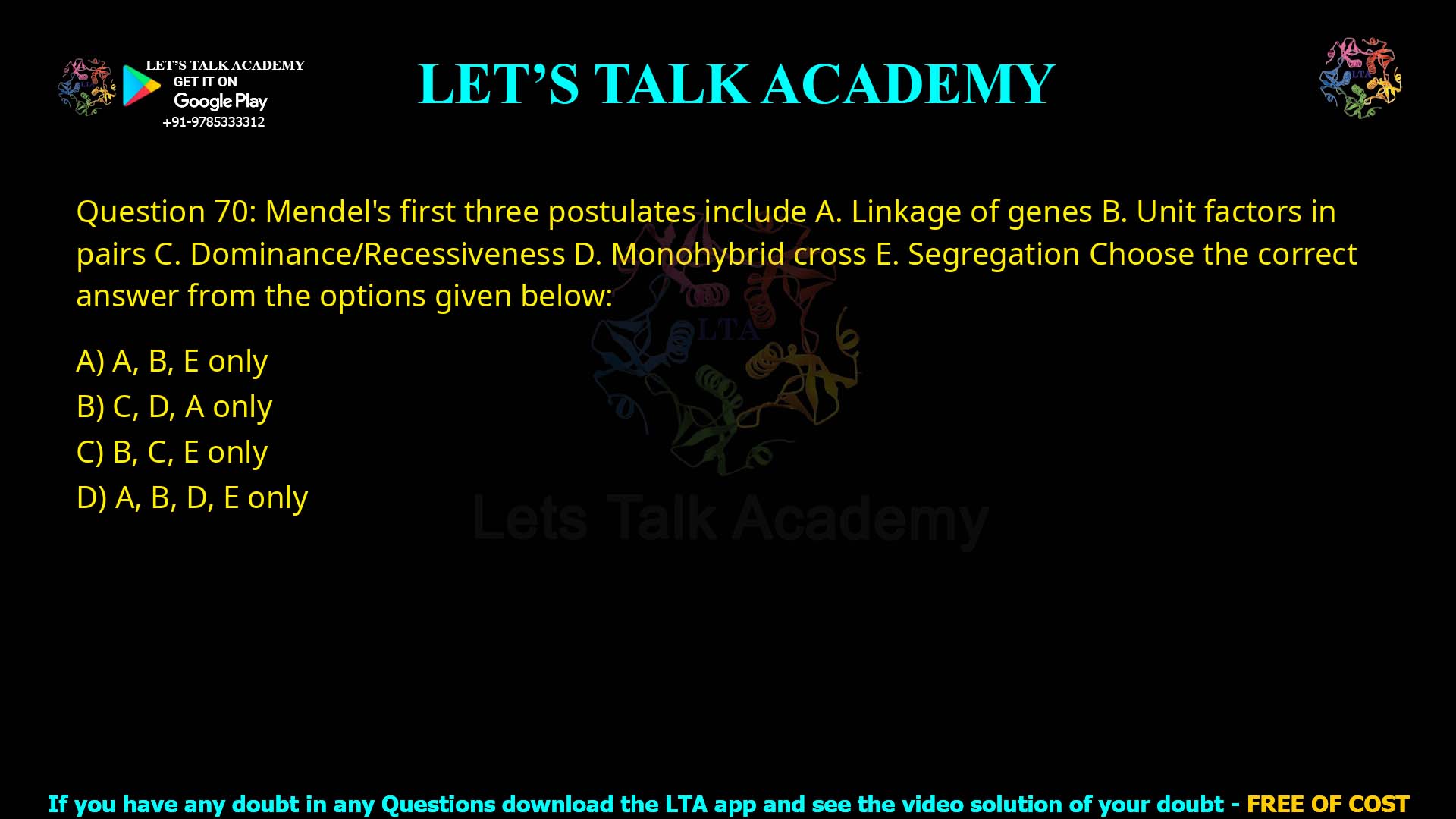
Q.70 Mendel’s first three postulates include:
- A. Linkage of genes
- B. Unit factors in pairs
- C. Dominance/Recessiveness
- D. Monohybrid cross
- E. Segregation
Choose the correct answer from the options given below:
- A, B, E only
- C, D, A only
- B, C, E only
- A, B, D, E only
Correct Answer: Option 3 (B, C, E only)
Mendel’s first three postulates are the foundational principles from his pea plant experiments: unit factors in pairs (B), dominance/recessiveness (C), and segregation (E). These form the core of classical genetics before linkage or independent assortment.
Postulate Analysis
Mendel’s postulates establish how traits are inherited:
-
B. Unit factors in pairs: Each trait controlled by paired hereditary units (alleles); one from each parent.
-
C. Dominance/Recessiveness: In heterozygotes, one allele masks the other (complete dominance).
-
E. Segregation: Allele pairs separate during gamete formation; each gamete gets one allele.
Not included: A (linkage – discovered later by Morgan), D (monohybrid cross – experimental method, not postulate).
Option Breakdown
Option Includes Excludes Issue Correct? 1 A, B, E C Adds linkage (not Mendel’s) No 2 C, D, A B, E Includes cross method + linkage No 3 B, C, E A, D Exact three postulates Yes 4 A, B, D, E C Too many; adds linkage + method No Historical Context
Mendel proposed these in 1866:
-
Paired unit factors (B)
-
Dominance principle (C)
-
Segregation law (E)
Independent assortment (4th) came from dihybrid crosses.
Introduction to Mendel’s First Three Postulates
Mendel’s first three postulates form the bedrock of genetics: unit factors in pairs (B), dominance/recessiveness (C), and segregation (E). NEET Q.70 tests precise recall excluding later discoveries like linkage. These principles explain monohybrid 3:1 ratios.
Detailed Postulate Explanations
1. Unit Factors in Pairs (B)
-
Each trait controlled by two alleles (one maternal, one paternal)
-
Organisms diploid: homozygous (AA) or heterozygous (Aa)
-
Mendel’s insight: Inheritance particulate, not blending
2. Dominance/Recessiveness (C)
-
Dominant allele expresses in heterozygote (Aa → A phenotype)
-
Recessive allele masked but unchanged
-
Explains F1 uniformity, F2 3:1 ratio
3. Segregation (E) – Law of Segregation
-
Alleles separate during meiosis
-
Each gamete gets one allele randomly
-
Genotypic ratio F2: 1 AA : 2 Aa : 1 aa
Why Other Options Wrong
-
Linkage (A): Morgan 1910, not Mendel
-
Monohybrid cross (D): Experimental technique, not postulate
-
Only B+C+E = first three postulates
NEET Memory Aid
“BCE” = Basic Characters Equal (paired factors, complete dominance, equal segregation)
Punnett square verification:
textA a
A AA Aa
a Aa aa
3 dominant : 1 recessive phenotype confirms all three postulates working together.
Exam Strategy
-
Recognize “first three” excludes Independent Assortment (dihybrid)
-
Postulates = principles; crosses = methods
-
B,C,E sequence matches Mendel’s publication order
-


