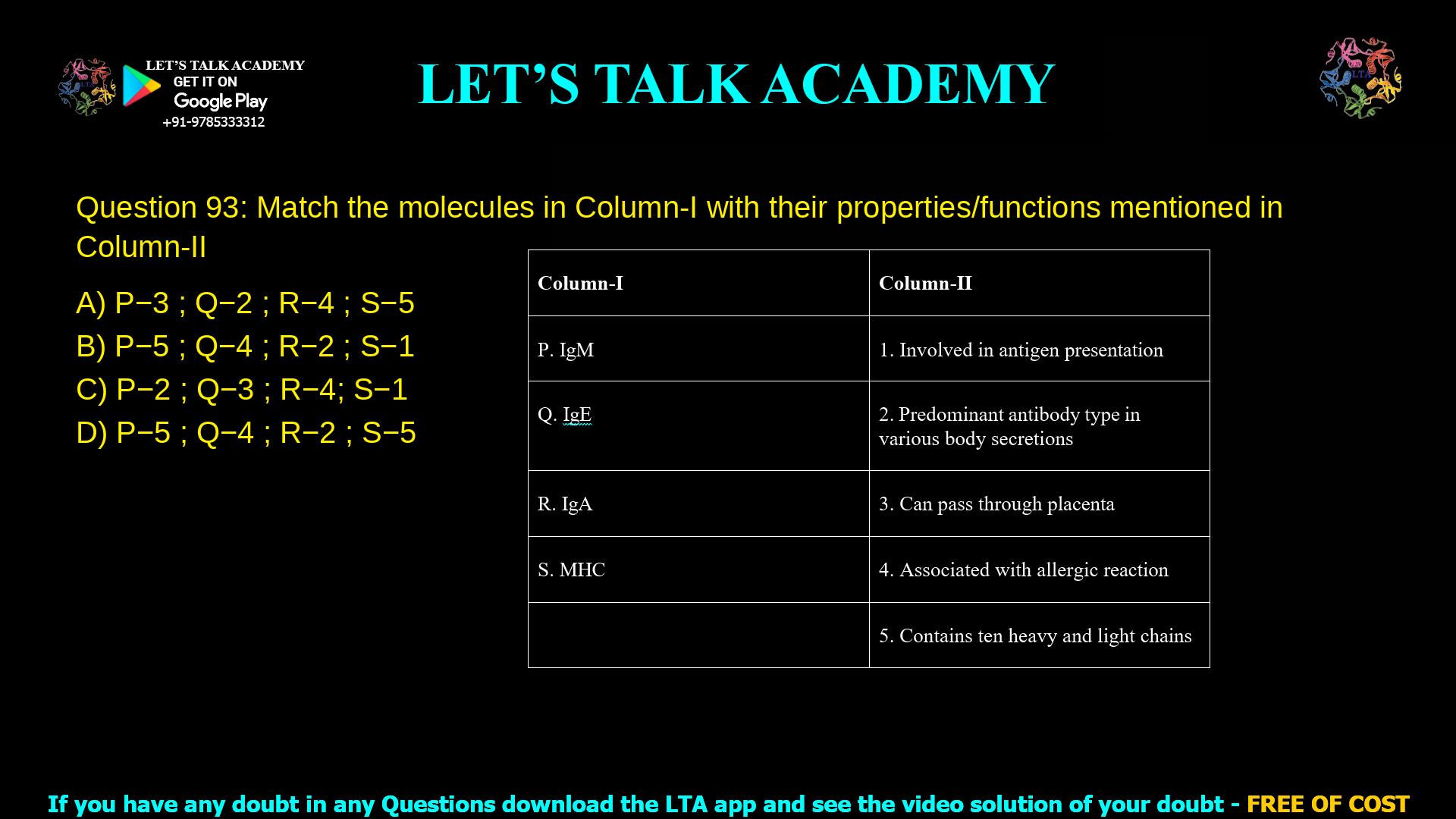
| Q.93 Match the molecules in Column-I with their properties/functions mentioned in Column-II | |
|---|---|
| Column-I | Column-II |
| P. IgM | 5. Contains ten heavy and light chains |
| Q. IgE | 4. Associated with allergic reaction |
| R. IgA | 2. Predominant antibody type in various body secretions |
| S. MHC | 1. Involved in antigen presentation |
(A) P−3 ; Q−2 ; R−4 ; S−5
(B) P−5 ; Q−4 ; R−2 ; S−1
(C) P−2 ; Q−3 ; R−4; S−1
(D) P−5 ; Q−4 ; R−2 ; S−5
The correct matching is: P–5, Q–4, R–2, S–1, so the right option is (B).
Question breakdown
Column‑I contains different immune molecules and Column‑II lists their characteristic properties:
-
P. IgM
-
Q. IgE
-
R. IgA
-
S. MHC
Column‑II statements:
-
Involved in antigen presentation
-
Predominant antibody type in various body secretions
-
Can pass through placenta
-
Associated with allergic reaction
-
Contains ten heavy and light chains
The task is to assign each molecule its correct property.
Matching each molecule
P. IgM → 5. Contains ten heavy and light chains
-
Secreted IgM is typically a pentamer made of five basic antibody units joined by a J‑chain.
-
Each unit has two heavy and two light chains, so the pentamer has 10 heavy and 10 light chains, matching statement 5 exactly.
Hence: P–5 is correct.
Q. IgE → 4. Associated with allergic reaction
-
IgE binds with high affinity to FcεRI receptors on mast cells and basophils in tissues.
-
When an allergen cross‑links bound IgE, these cells degranulate and release mediators like histamine, producing classic type I hypersensitivity (allergic) reactions such as asthma or urticaria.
Hence: Q–4 is correct.
R. IgA → 2. Predominant antibody type in secretions
-
IgA is the major immunoglobulin class in external secretions such as saliva, tears, colostrum, intestinal and respiratory mucus.
-
Secretory IgA, mainly dimeric, protects mucosal surfaces by neutralizing pathogens at these sites.
Hence: R–2 is correct.
S. MHC → 1. Involved in antigen presentation
-
Major histocompatibility complex (MHC) class I and II molecules bind peptide fragments and display them on the cell surface.
-
This antigen presentation is essential for activation of T lymphocytes and for immune surveillance of infected or abnormal cells.
Hence: S–1 is correct.
Why other options are wrong
Option (A): P–3; Q–2; R–4; S–5
-
P–3 would mean IgM can pass through placenta, but IgG, not IgM, is the placenta‑crossing antibody; IgM is large (pentameric) and does not cross.
-
Q–2 incorrectly makes IgE the predominant secretory antibody, whereas secretions are dominated by IgA, not IgE.
-
R–4 links IgA to allergy; allergies are primarily mediated by IgE, not IgA.
-
S–5 would imply MHC has ten heavy and light chains, which is false; that structure is specific for pentameric IgM.
Option (C): P–2; Q–3; R–4; S–1
-
P–2 wrongly suggests IgM is the main secretory antibody; mucosal secretions are dominated by IgA.
-
Q–3 assigns placental transfer to IgE, but only IgG efficiently crosses the placenta; IgE does not.
-
R–4 again mislabels IgA as the major player in allergic reactions instead of IgE.
-
Only S–1 is correct here.
Option (D): P–5; Q–4; R–2; S–5
-
P–5, Q–4 and R–2 are all correct, but S–5 is wrong because MHC molecules do not possess ten heavy and light chains like IgM pentamers.
-
Therefore option (D) fails due to the incorrect S–5 pairing.
SEO‑friendly explanation of the question
Introduction
For competitive exams like GATE and CSIR NET, questions often ask you to match the molecules IgM IgE IgA MHC with their functions, testing both factual recall and conceptual clarity of immunology. Understanding the unique structure and roles of each immunoglobulin class and MHC molecule makes such matching questions straightforward.
Role of IgM in immune response
-
IgM is the first antibody isotype produced during a primary immune response and usually circulates as a large pentamer.
-
This pentamer consists of 10 heavy and 10 light chains plus a J‑chain, giving it high avidity and directly matching statement 5 in the question.
IgE and allergic reactions
-
IgE is found mainly bound to mast cells and basophils via high‑affinity Fc receptors in tissues.
-
On re‑exposure to the allergen, cross‑linking of IgE triggers degranulation and mediator release, making IgE the classical mediator of allergic reactions, which fits statement 4.
IgA as the secretory antibody
-
IgA is the predominant immunoglobulin in mucosal and glandular secretions such as saliva, tears, colostrum and intestinal mucus.
-
Secretory IgA forms a protective immune barrier at mucosal surfaces, so it perfectly matches statement 2 about being the predominant antibody type in various body secretions.
MHC and antigen presentation
-
MHC class I and II molecules bind peptide fragments and display them on the cell surface for recognition by T cells.
-
This antigen presentation function is fundamental to adaptive immunity and clearly corresponds to statement 1 in the matching question.
By mapping these core properties, the correct answer P–5, Q–4, R–2, S–1 (Option B) becomes easy to remember for future exam questions on matching immunological molecules with their functions.


5 Comments
Ritika Jangir
January 5, 2026Done
Meenakshi Choudhary
January 8, 2026P–5, Q–4, R–2, S–1
Komal Pareek
January 8, 2026B
Sonal Nagar
January 8, 2026Option 2
AKANKSHA RAJPUT
January 13, 2026option 2