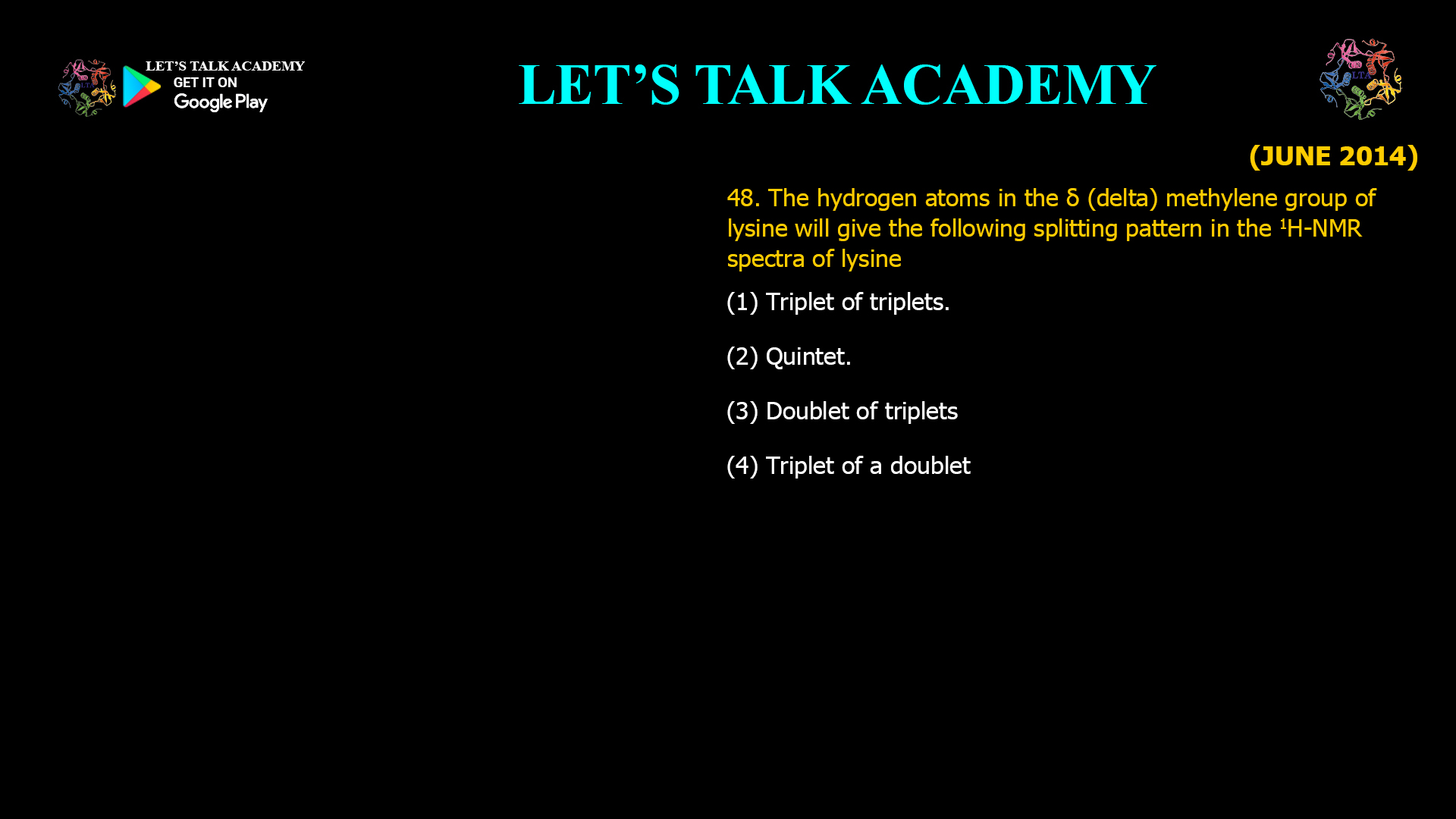
48. The hydrogen atoms in the δ (delta) methylene group of lysine will give the following splitting pattern in the ¹H-NMR spectra of lysine
(A) Triplet of triplets.
(B) Quintet.
(C) Doublet of triplets.
(D) Triplet of a doublet.
Splitting Pattern of the δ-Methylene Protons of Lysine in ¹H NMR Spectroscopy
Correct Answer
Option (2): Quintet
Explanation
Proton Nuclear Magnetic Resonance (¹H NMR) spectroscopy provides detailed information about the chemical environment of hydrogen atoms and their interactions with neighboring protons. One of the most important phenomena observed in ¹H NMR is spin-spin coupling, in which a proton signal is split by adjacent nonequivalent hydrogen atoms. The splitting pattern is generally predicted using the n + 1 rule, where n is the number of equivalent neighboring protons directly attached to adjacent carbon atoms.
The side chain of lysine has the following structure:
–CH2–CH2–CH2–CH2–NH2
These carbon atoms are designated as β, γ, δ, and ε, respectively.
The δ-methylene group is located between the γ-methylene group and the ε-methylene group. Therefore, the δ-CH2 protons are coupled to:
- Two equivalent protons on the γ-carbon.
- Two equivalent protons on the ε-carbon.
In total, the δ-methylene protons have four neighboring protons. If the coupling constants to both neighboring CH2 groups are approximately equal, these four neighboring protons behave as one equivalent set. According to the n + 1 rule, four neighboring protons split the signal into:
4 + 1 = 5 peaks
This produces a quintet, which is the characteristic splitting pattern expected for the δ-methylene group of lysine.
Why Option (1) is Incorrect
A triplet of triplets is observed when a proton couples independently to two different sets of neighboring protons with significantly different coupling constants. In the lysine side chain, the γ-CH2 and ε-CH2 groups have very similar chemical environments and similar vicinal coupling constants. As a result, their couplings merge into a single apparent quintet rather than resolving into a triplet of triplets.
Why Option (2) is Correct
The δ-methylene protons are adjacent to two CH2 groups containing a total of four neighboring protons. Because these neighboring protons produce nearly identical coupling constants, they act collectively as four equivalent neighboring nuclei. Application of the n + 1 rule therefore predicts a five-line splitting pattern, giving a quintet.
Why Option (3) is Incorrect
A doublet of triplets requires coupling to one proton with one coupling constant and two equivalent protons with another coupling constant. The δ-methylene group of lysine is not adjacent to a single isolated proton. Instead, it is flanked by two methylene groups, each contributing two neighboring protons. Therefore, this splitting pattern is not expected.
Why Option (4) is Incorrect
A triplet of a doublet arises when a proton is simultaneously coupled to two equivalent protons and one additional nonequivalent proton. The δ-methylene group of lysine has four neighboring methylene protons rather than three differently arranged neighboring protons. Consequently, this splitting pattern does not match the structure of lysine.
Structure of the Lysine Side Chain
Lysine contains a flexible aliphatic side chain consisting of four consecutive methylene groups terminated by a primary amino group. Starting from the α-carbon, the carbon atoms are designated as β, γ, δ, and ε. The δ-carbon occupies the central region of the side chain and is directly connected to the γ-CH2 and ε-CH2 groups, giving rise to the characteristic coupling pattern observed in the proton NMR spectrum.
Spin-Spin Coupling in Aliphatic Chains
Vicinal proton-proton coupling occurs between hydrogen atoms attached to adjacent carbon atoms through three covalent bonds. In linear aliphatic chains such as the lysine side chain, methylene groups commonly interact with neighboring methylene groups. When adjacent coupling constants are nearly identical, the resulting multiplet often simplifies into the pattern predicted by the total number of neighboring equivalent protons, producing characteristic triplets, quartets, quintets, or higher-order multiplets.
Why a Quintet Is Observed Instead of a Complex Multiplet
In principle, coupling to two different methylene groups could produce a more complex multiplet if the coupling constants differed substantially. However, in lysine the vicinal coupling constants between the δ-methylene protons and the adjacent γ- and ε-methylene protons are very similar. Because these couplings are nearly equal, the individual splittings overlap, producing an apparent quintet rather than a more complicated splitting pattern.
Conclusion
The δ-methylene group of lysine is coupled to four neighboring methylene protons located on the adjacent γ- and ε-carbons. Since these neighboring protons exhibit similar coupling constants, the signal follows the n + 1 rule and appears as a quintet in the proton NMR spectrum. Therefore, the correct answer is Option (2): Quintet.


