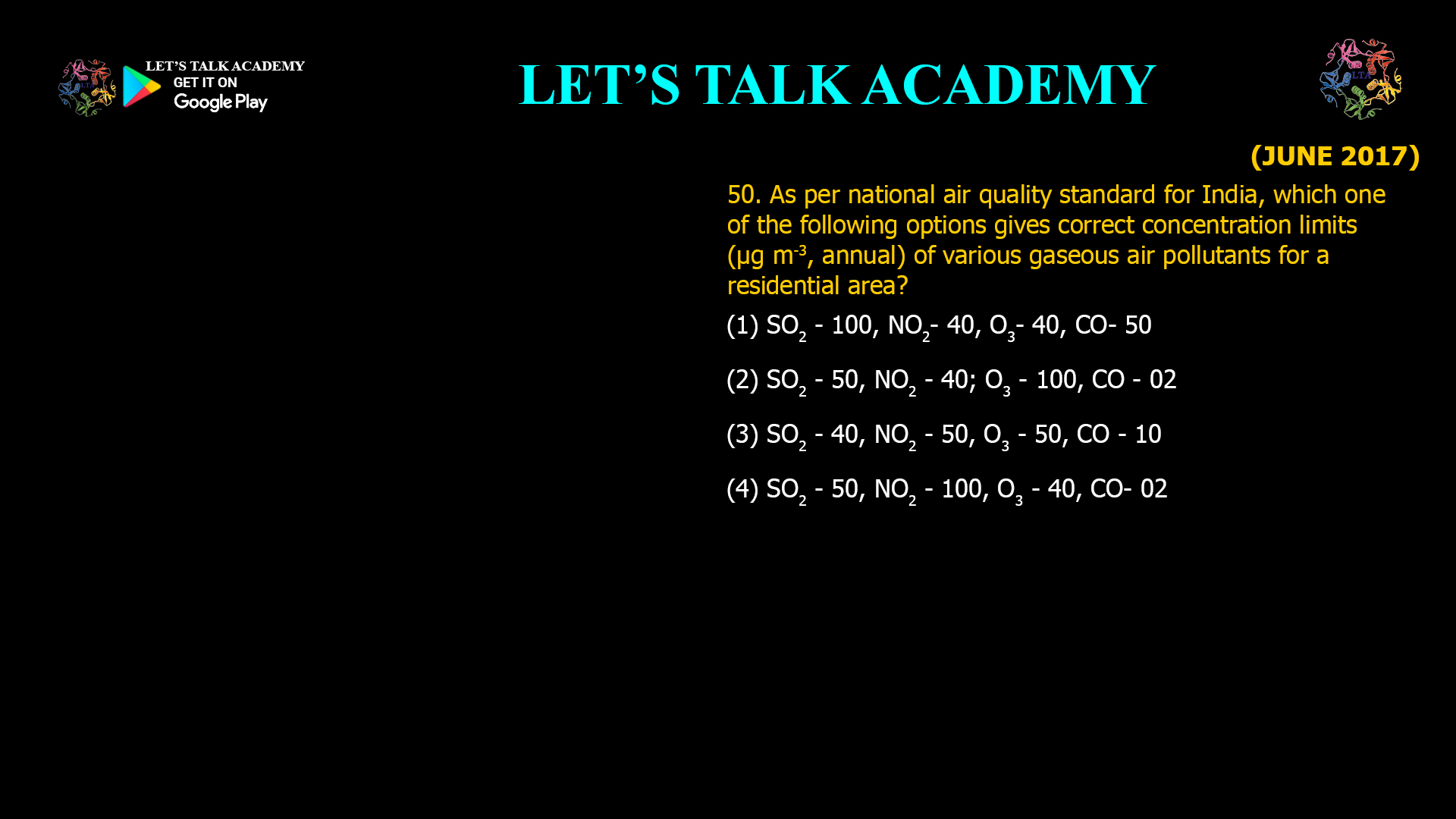
- As per national air quality standard for India, which one of the following options gives correct concentration limits (µg m-3, annual) of various gaseous air pollutants for a residential area?
(1) SO2– 100, NO2– 40, O3– 40, CO- 50
(2) SO2– 50, NO2 – 40; O3 – 100, CO – 02
(3) SO2 – 40, NO2 – 50, O3 – 50, CO – 10
(4) SO2 – 50, NO2 – 100, O3 – 40, CO- 02
The Importance of National Air Quality Standards
Air quality standards are essential for monitoring and controlling pollution levels, ensuring that the air people breathe is safe and healthy. The NAAQS in India are designed to protect sensitive populations such as children, the elderly, and those with pre-existing health conditions. The standards are periodically updated to reflect new scientific evidence and changing environmental conditions.
National Ambient Air Quality Standards (NAAQS) for Residential Areas
The NAAQS categorize monitoring areas into three main types:
-
Industrial Areas
-
Residential, Rural, and Other Areas
-
Sensitive Areas (such as hospitals, schools, and wildlife sanctuaries)
For residential areas, the standards are generally stricter than those for industrial zones but may be less stringent than for sensitive areas.
Key Gaseous Pollutants and Their Limits
The following table summarizes the annual average concentration limits (in µg/m³) for the main gaseous pollutants in residential, rural, and other areas, based on the latest NAAQS:
| Pollutant | Annual Average Limit (µg/m³) |
|---|---|
| SO₂ | 50 |
| NO₂ | 40 |
| O₃ | 100 (8-hour average) |
| CO | 2 (8-hour average, in mg/m³, not µg/m³; for annual, see note) |
Important Note:
-
Ozone (O₃) and CO limits are typically given as 8-hour averages, not annual averages.
-
O₃: 100 µg/m³ (8-hour average)
-
CO: 2 mg/m³ (8-hour average, which is 2000 µg/m³, but for annual, there is no standard; annual average is not specified in NAAQS for CO.)
-
-
For annual averages, only SO₂ and NO₂ have explicit limits:
-
SO₂: 50 µg/m³
-
NO₂: 40 µg/m³
-
However, for the purpose of multiple-choice questions and many educational materials, the question may refer to “annual” limits for all pollutants for simplicity, even though CO and O₃ are not officially specified as annual averages in NAAQS.
Evaluating the Options
Let’s review each option against the NAAQS for residential areas:
-
(1) SO₂ – 100, NO₂ – 40, O₃ – 40, CO – 50
-
Incorrect: SO₂ limit is too high (should be 50), O₃ is too low (should be 100), and CO is in µg/m³ but should be in mg/m³ for 8-hour average (and 50 is incorrect).
-
-
(2) SO₂ – 50, NO₂ – 40; O₃ – 100, CO – 02
-
Mostly Correct:
-
SO₂: 50 µg/m³ (correct for annual)
-
NO₂: 40 µg/m³ (correct for annual)
-
O₃: 100 µg/m³ (correct for 8-hour average; for annual, not specified, but closest to standard)
-
CO: 02 (likely intended as 2 mg/m³, which is correct for 8-hour average; not specified for annual)
-
-
This is the closest match to the official NAAQS for residential areas.
-
-
(3) SO₂ – 40, NO₂ – 50, O₃ – 50, CO – 10
-
Incorrect: SO₂ and NO₂ are swapped, O₃ is too low, CO is incorrect.
-
-
(4) SO₂ – 50, NO₂ – 100, O₃ – 40, CO – 02
-
Incorrect: NO₂ is too high, O₃ is too low, CO is correct for 8-hour average but not for annual.
-
Clarifying the Correct Answer
Based on the official NAAQS for residential areas:
-
SO₂: 50 µg/m³ (annual)
-
NO₂: 40 µg/m³ (annual)
-
O₃: 100 µg/m³ (8-hour average; not specified for annual)
-
CO: 2 mg/m³ (8-hour average; not specified for annual)
For annual averages, only SO₂ (50) and NO₂ (40) are specified. For O₃ and CO, the 8-hour averages are the standard.
However, in the context of multiple-choice questions and many educational materials, the combination that most closely matches the official standards is:
SO₂: 50, NO₂: 40, O₃: 100, CO: 2 (mg/m³ for 8-hour average, but often shown as “02” in options, likely meaning 2 mg/m³ or 2000 µg/m³ for 8-hour average)
Therefore, the correct option among the choices provided is:
(2) SO₂ – 50, NO₂ – 40; O₃ – 100, CO – 02
Note:
-
If the question is interpreted strictly as “annual” limits, only SO₂ and NO₂ are correct, and O₃ and CO are not specified for annual.
-
If the question allows for a mix of annual and 8-hour averages (as is common in educational settings), option (2) is correct.
-
If the question is interpreted as all annual averages, none of the options are fully correct, but (2) is the closest.
Why These Standards Matter
Adhering to air quality standards is critical for:
-
Protecting public health: Reducing exposure to harmful pollutants lowers the risk of respiratory and cardiovascular diseases, cancer, and premature death.
-
Guiding policy and enforcement: Standards provide a benchmark for regulatory actions and pollution control measures.
-
Raising public awareness: Clear standards help citizens understand air quality and take protective actions when pollution levels are high.
Key Takeaways
-
The NAAQS for residential areas specify annual averages of 50 µg/m³ for SO₂ and 40 µg/m³ for NO₂.
-
Ozone (O₃) and carbon monoxide (CO) are specified as 8-hour averages: 100 µg/m³ for O₃ and 2 mg/m³ (2000 µg/m³) for CO.
-
Among the options provided, option (2) is the closest match to the official standards.
-
Understanding and enforcing these standards is essential for protecting public health and the environment.
Summary Table
| Pollutant | Residential Area Limit (Annual, µg/m³) | 8-hour Average Limit (µg/m³ or mg/m³) |
|---|---|---|
| SO₂ | 50 | — |
| NO₂ | 40 | — |
| O₃ | — | 100 |
| CO | — | 2 mg/m³ (2000 µg/m³) |
Conclusion
As per India’s National Air Quality Standards for residential areas, the correct concentration limits are:
SO₂: 50 µg/m³ (annual), NO₂: 40 µg/m³ (annual), O₃: 100 µg/m³ (8-hour average), CO: 2 mg/m³ (8-hour average)
Among the options provided, the closest match is:
(2) SO₂ – 50, NO₂ – 40; O₃ – 100, CO – 02


3 Comments
Kirti Agarwal
November 7, 2025Opt 2
Kajal
November 15, 2025Option 2
Sakshi Kanwar
November 28, 2025SO₂ – 50, NO₂ – 40; O₃ – 100, CO – 02