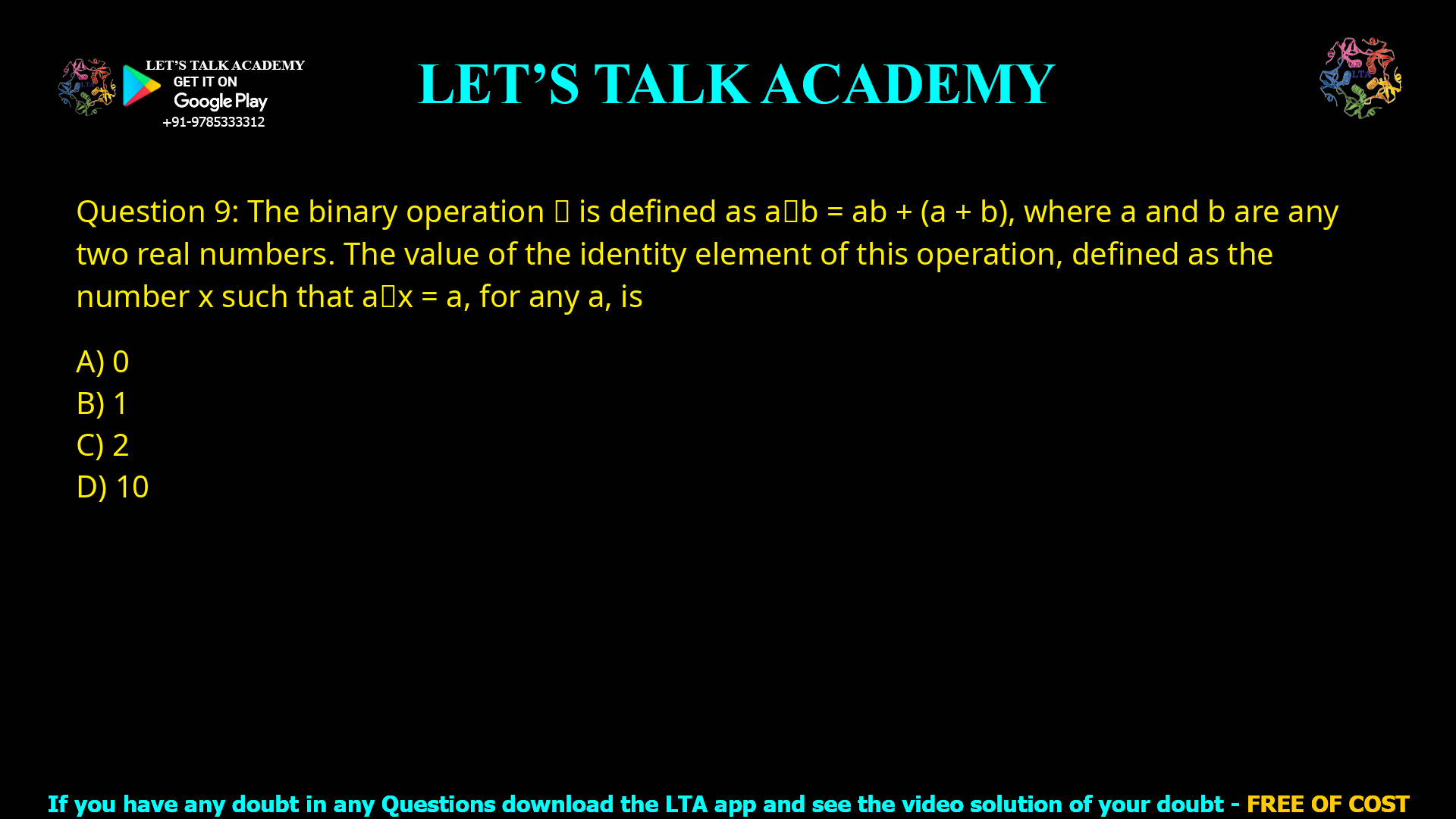
Q.9 The binary operation □ is defined as a □ b = ab+(a+b), where a and b are any two real numbers.
The value of the identity element of this operation, defined as the number x such that a □ x = a, for
any a, is .
(A) 0 (B) 1 (C) 2 (D) 10
Solution Overview
The identity element for the binary operation a□b=ab+(a+b) is 0. This satisfies a□x=a for any real number a.
Finding Identity Element
Set up the equation a□x=a, substituting the operation definition:
ax+(a+x)=a
Rearrange terms:
ax+x+a=a
x(a+1)+a=a
x(a+1)=0
For this to hold for all real a (where a+1≠0 in general), x=0.
Verifying with x=0
Substitute x=0:
a□0=a⋅0+(a+0)=0+a=a
The equation holds true for any a.
Option Analysis
- (A) 0: Correct, as shown above.
- (B) 1: a□1=a⋅1+(a+1)=a+a+1=2a+1≠a (unless a=-1, not for all a).
- (C) 2: a□2=2a+(a+2)=3a+2≠a.
- (D) 10: a□10=10a+(a+10)=11a+10≠a.
SEO Context
The identity element binary operation a□b=ab+(a+b) appears frequently in GATE exams for engineering mathematics. This operation combines multiplication and addition, requiring careful algebraic manipulation to find the element x where a□x=a holds for any real a. Understanding this builds foundational skills in abstract algebra and binary operations on real numbers.
Why Options Fail – Comparison Table
| Option | Calculation | Equals a? | Reason |
|---|---|---|---|
| 0 | a⋅0+a+0=a | Yes | Satisfies for all a |
| 1 | a+a+1=2a+1 | No | Only if a=-1 |
| 2 | 2a+a+2=3a+2 | No | Linear mismatch |
| 10 | 10a+a+10=11a+10 | No | Constant term fails |


