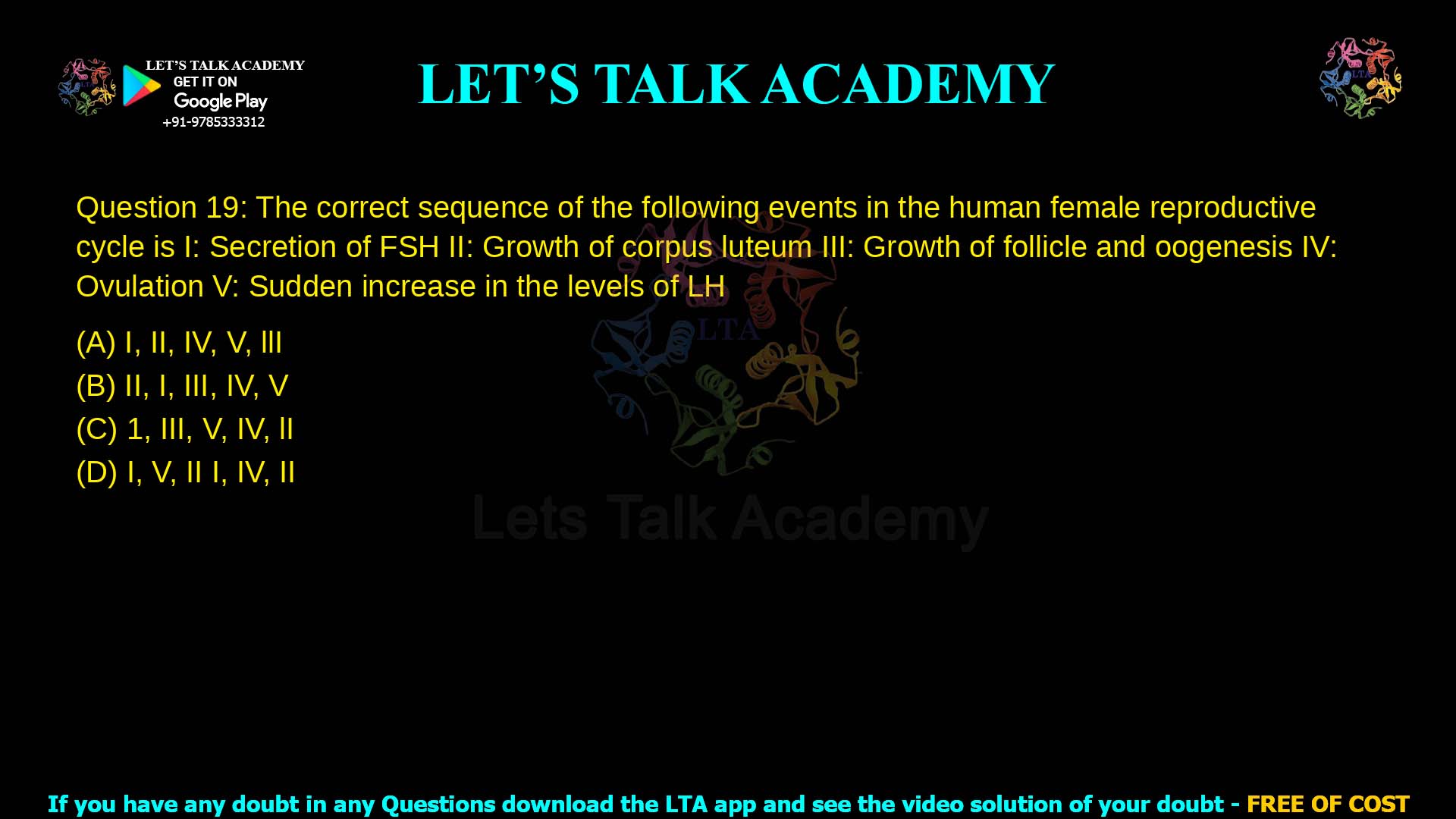
Q.19 The correct sequence of the following events in the human female reproductive cycle is
I: Secretion of FSH
II: Growth of corpus luteum
III: Growth of follicle and oogenesis
IV: Ovulation
V: Sudden increase in the levels of LH
(A) I, II, IV, V, III
(B) II, I, III, IV, V
(C) I, III, V, IV, II
(D) I, V, III, IV, II
The correct answer is (C) I, III, V, IV, II.
This sequence accurately reflects the hormonal and ovarian events in the human female reproductive cycle, starting with FSH secretion and ending with corpus luteum growth.
Option Analysis
Each option rearranges the events: I (FSH secretion), II (corpus luteum growth), III (follicle growth and oogenesis), IV (ovulation), V (LH surge).
-
(A) I, II, IV, V, III: Incorrect. Places corpus luteum growth (II) too early, before follicle development and ovulation, which defies the cycle’s follicular-to-luteal progression.
-
(B) II, I, III, IV, V: Incorrect. Starts with corpus luteum growth (II), which occurs post-ovulation, not at cycle onset when FSH initiates follicle recruitment.
-
(C) I, III, V, IV, II: Correct. FSH (I) stimulates follicle growth/oogenesis (III); rising estrogen triggers LH surge (V); LH causes ovulation (IV); ruptured follicle forms/grows as corpus luteum (II).
-
(D) I, V, III, IV, II: Incorrect. Positions LH surge (V) before follicle growth (III), but follicles must mature first to produce estrogen that induces the LH surge.
Cycle Sequence Explained
FSH secretion from the anterior pituitary rises in the early follicular phase, recruiting primordial follicles for growth and oogenesis. Mature follicles produce estrogen, creating positive feedback for the mid-cycle LH surge ~36-44 hours before ovulation. LH triggers follicular rupture (ovulation), after which granulosa/theca cells luteinized into the corpus luteum, secreting progesterone.
The human female reproductive cycle, also known as the menstrual cycle, follows a precise sequence of hormonal and ovarian events critical for ovulation and fertility. Understanding this sequence—human female reproductive cycle sequence—is essential for CSIR NET Life Sciences aspirants tackling reproductive biology MCQs. Key events include FSH secretion, follicle growth and oogenesis, sudden LH increase, ovulation, and corpus luteum growth.
Follicular Phase: FSH and Follicle Development
The cycle begins with secretion of FSH (event I) from the anterior pituitary, typically days 1-14. FSH stimulates 5-15 primordial follicles to grow, with one becoming dominant; this drives growth of follicle and oogenesis (event III), where the oocyte matures amid granulosa cell proliferation and estrogen rise.
Ovulatory Phase: LH Surge to Ovulation
Rising estrogen from the dominant follicle triggers a positive feedback loop, causing a sudden increase in LH levels (event V) around day 14. This 10-fold LH surge, lasting 24-36 hours, induces ovulation (event IV), rupturing the Graafian follicle to release the secondary oocyte.
Luteal Phase: Corpus Luteum Formation
Post-ovulation, the ruptured follicle transforms into the corpus luteum (event II), which grows under LH influence to secrete progesterone and estrogen. This prepares the endometrium for implantation; without pregnancy, it degenerates after ~14 days.


