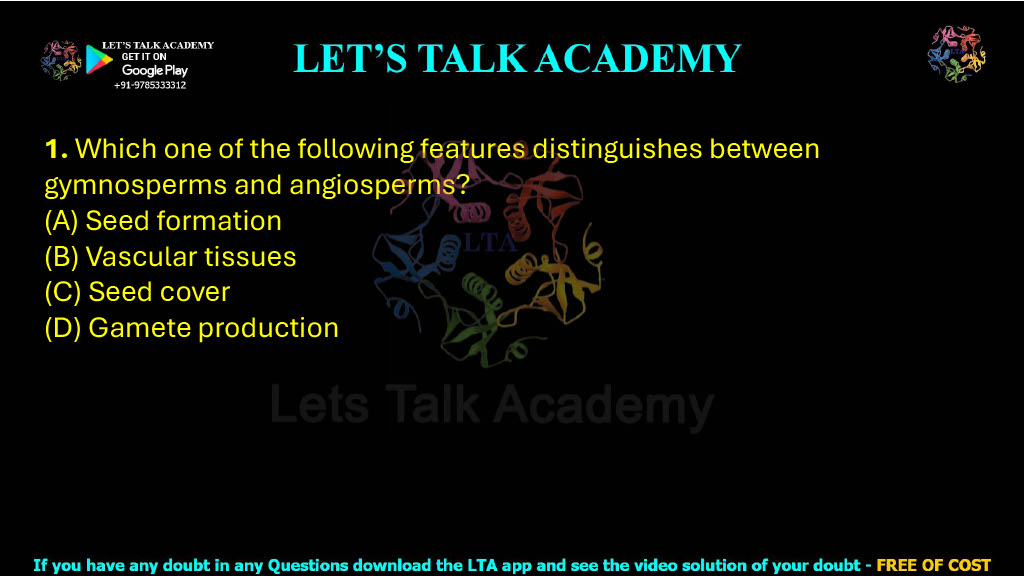
1. Which one of the following features distinguishes between gymnosperms and angiosperms?
(A) Seed formation
(B) Vascular tissues
(C) Seed cover
(D) Gamete production
Seed Cover Distinguishes Gymnosperms and Angiosperms
Introduction
Gymnosperms and angiosperms are the two major groups of seed-producing plants (Spermatophytes) and represent advanced stages of plant evolution. Both groups possess well-developed vascular tissues, produce seeds, and exhibit a dominant sporophytic generation. Despite these similarities, they differ significantly in their reproductive structures and seed development. The most important distinguishing feature is the presence or absence of a protective seed cover formed by the ovary.
In gymnosperms, the ovules and seeds remain exposed or “naked” on the surface of cone scales because there is no ovary surrounding them. In contrast, angiosperms produce flowers in which ovules are enclosed within an ovary. After fertilization, the ovary develops into a fruit that surrounds and protects the seeds. This enclosed seed is the defining characteristic of angiosperms and is considered one of the most significant evolutionary innovations in the plant kingdom.
Correct Answer
Correct Option: (C) Seed cover
Detailed Explanation
The principal feature that distinguishes gymnosperms from angiosperms is the presence of a seed cover. Gymnosperms produce naked seeds because their ovules are not enclosed within an ovary. Their seeds develop directly on the surface of cone scales without any protective fruit surrounding them. Examples include Pinus, Cycas, Cedrus, and Ginkgo.
Angiosperms, on the other hand, possess flowers in which ovules are enclosed within an ovary. Following fertilization, the ovary matures into a fruit that encloses and protects the developing seeds. This protective covering not only safeguards the seeds but also aids in their dispersal by animals, wind, or water. Therefore, the presence of an enclosed seed or seed cover is the defining characteristic that separates angiosperms from gymnosperms.
Although both plant groups produce seeds and possess vascular tissues consisting of xylem and phloem, these characteristics are shared and therefore cannot distinguish one group from the other. Likewise, both groups produce male and female gametes as part of their reproductive cycle, making gamete production another common feature rather than a distinguishing one.
Explanation of Each Option
Option (A): Seed Formation
This option is incorrect. Both gymnosperms and angiosperms are seed-producing plants. Seed formation is therefore a common feature and cannot be used to distinguish between them.
Option (B): Vascular Tissues
This option is incorrect. Both groups possess well-developed vascular tissues composed of xylem and phloem for the transport of water, minerals, and food.
Option (C): Seed Cover
This option is correct. Angiosperms possess seeds enclosed within fruits derived from the ovary, whereas gymnosperms produce naked seeds that are not enclosed by any fruit.
Option (D): Gamete Production
This option is incorrect. Both gymnosperms and angiosperms produce male and female gametes for sexual reproduction. This feature is common to both groups.
Why Option (C) is Correct
The defining feature of angiosperms is the presence of seeds enclosed within a fruit, while gymnosperms bear exposed or naked seeds. This structural difference reflects the evolution of flowers and fruits in angiosperms and is the most reliable characteristic used in plant classification.
Why the Other Options are Incorrect
Why Option (A) is Incorrect
Seed formation occurs in both gymnosperms and angiosperms because both belong to the group Spermatophyta.
Why Option (B) is Incorrect
Both plant groups possess vascular tissues, making this a shared feature rather than a distinguishing one.
Why Option (D) is Incorrect
Sexual reproduction involving male and female gametes occurs in both gymnosperms and angiosperms.
Comparison Between Gymnosperms and Angiosperms
| Feature | Gymnosperms | Angiosperms |
|---|---|---|
| Seed Cover | Naked seeds | Seeds enclosed within fruits |
| Reproductive Organ | Cones | Flowers |
| Fruit Formation | Absent | Present |
| Ovary | Absent | Present |
| Double Fertilization | Absent | Present |
| Examples | Pinus, Cycas, Cedrus | Mango, Wheat, Rose, Rice |
Common Features of Gymnosperms and Angiosperms
| Characteristic | Present in Both? |
|---|---|
| Seed Production | Yes |
| Vascular Tissues | Yes |
| Sporophyte Dominance | Yes |
| Alternation of Generations | Yes |
| Male and Female Gametes | Yes |
Major Differences Between Naked and Enclosed Seeds
| Feature | Naked Seed (Gymnosperm) | Enclosed Seed (Angiosperm) |
|---|---|---|
| Protection | Exposed | Protected inside fruit |
| Seed Dispersal | Mainly wind | Wind, water, animals and other agents |
| Fruit Development | Absent | Present |
Biological Significance
The evolution of enclosed seeds represents one of the greatest advancements in plant evolution. Fruits protect developing seeds from environmental damage and predators while improving seed dispersal efficiency. This evolutionary innovation has allowed angiosperms to become the most diverse and dominant group of land plants. Gymnosperms, although evolutionarily older, continue to play essential ecological and economic roles, particularly in forest ecosystems and timber production.
Final Answer
Correct Option: (C) Seed cover
The most important distinguishing feature between gymnosperms and angiosperms is the presence of a seed cover. Gymnosperms produce naked seeds that are not enclosed by an ovary, whereas angiosperms produce seeds enclosed within fruits formed from the ovary after fertilization.


