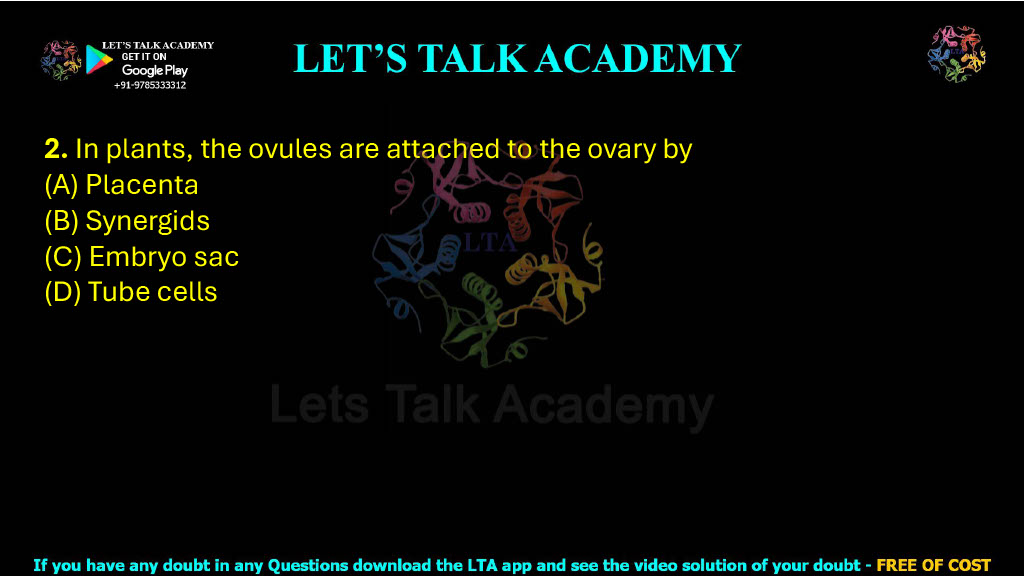
2. In plants, the ovules are attached to the ovary by
(A) Placenta
(B) Synergids
(C) Embryo sac
(D) Tube cells
Ovules are Attached to the Ovary by the Placenta
Introduction
Sexual reproduction in flowering plants (angiosperms) depends on the proper organization of the female reproductive organ, known as the pistil or carpel. The pistil consists of three major parts: the stigma, style, and ovary. Inside the ovary are one or more ovules that contain the female gametophyte, also known as the embryo sac. After fertilization, the ovules develop into seeds, while the ovary matures into a fruit. Therefore, understanding the structure of the ovary and the attachment of ovules is fundamental to plant reproductive biology.
Each ovule is connected to the inner wall of the ovary through a specialized tissue called the placenta. The arrangement of ovules on the placenta is referred to as placentation, and it varies among different plant species. Structures such as synergids, embryo sac, and tube cells play important roles during fertilization but are not involved in attaching the ovule to the ovary.
Correct Answer
Correct Option: (A) Placenta
Detailed Explanation
The placenta is a specialized tissue located on the inner wall of the ovary to which ovules are attached. Each ovule is connected to the placenta by a short stalk called the funicle (funiculus). Through the funicle, the ovule receives water, minerals, and nutrients necessary for its growth and development. The position and arrangement of the placenta within the ovary determine the type of placentation, such as marginal, axile, parietal, basal, free-central, or superficial placentation.
After pollination and successful fertilization, the ovules attached to the placenta develop into seeds, while the ovary enlarges and forms the fruit. Thus, the placenta plays a structural as well as nutritional role during seed development.
The remaining options describe structures involved in fertilization rather than ovule attachment. Synergids are two specialized cells located near the egg cell inside the embryo sac and help guide the pollen tube during fertilization. The embryo sac itself is the female gametophyte that houses the egg apparatus, central cell, and antipodal cells. Tube cells belong to the pollen grain and are responsible for producing the pollen tube during pollen germination. None of these structures attach the ovule to the ovary.
Explanation of Each Option
Option (A): Placenta
This option is correct. The placenta is the tissue inside the ovary where ovules are attached through the funicle. It supplies nutrients and provides structural support to developing ovules.
Option (B): Synergids
This option is incorrect. Synergids are part of the egg apparatus within the embryo sac. Their primary role is to attract and guide the pollen tube toward the egg cell during fertilization.
Option (C): Embryo Sac
This option is incorrect. The embryo sac is the female gametophyte situated inside the ovule. It contains the egg cell, synergids, antipodal cells, and central cell, but it does not attach the ovule to the ovary.
Option (D): Tube Cells
This option is incorrect. Tube cells are present in the pollen grain and give rise to the pollen tube that transports male gametes to the embryo sac during fertilization.
Why Option (A) is Correct
The placenta serves as the attachment site for ovules within the ovary. It supports ovule development and determines the pattern of placentation, making it the correct answer.
Why the Other Options are Incorrect
Why Option (B) is Incorrect
Synergids function in pollen tube guidance and fertilization rather than ovule attachment.
Why Option (C) is Incorrect
The embryo sac is located inside the ovule and functions as the female gametophyte, not as an attachment structure.
Why Option (D) is Incorrect
Tube cells are components of the male gametophyte (pollen grain) and are involved in pollen tube formation.
Comparison of All Options
| Option | Structure | Main Function | Correct or Incorrect |
|---|---|---|---|
| A | Placenta | Attaches ovules to the ovary | Correct |
| B | Synergids | Guide pollen tube toward egg cell | Incorrect |
| C | Embryo Sac | Female gametophyte containing egg apparatus | Incorrect |
| D | Tube Cells | Produce pollen tube | Incorrect |
Structure of an Ovule
| Part | Function |
|---|---|
| Placenta | Attaches ovules to ovary wall |
| Funicle | Connects ovule to placenta |
| Integuments | Protect the ovule |
| Micropyle | Opening through which pollen tube enters |
| Nucellus | Nutritive tissue surrounding embryo sac |
| Embryo Sac | Female gametophyte containing egg cell |
Cells Present in the Mature Embryo Sac
| Cell Type | Number | Function |
|---|---|---|
| Egg Cell | 1 | Fuses with one male gamete to form the zygote |
| Synergids | 2 | Guide pollen tube toward the egg apparatus |
| Central Cell | 1 | Contains two polar nuclei and forms endosperm after fertilization |
| Antipodal Cells | 3 | Supportive and nutritive role |
Major Types of Placentation
| Type | Characteristic | Example |
|---|---|---|
| Marginal | Ovules attached along one margin | Pea |
| Axile | Ovules attached to central axis | Tomato, Hibiscus |
| Parietal | Ovules attached to ovary wall | Mustard |
| Basal | Single ovule at base of ovary | Sunflower |
| Free Central | Ovules attached to central column | Dianthus |
Biological Significance
The placenta plays a vital role in supporting ovule development and ensuring successful reproduction in flowering plants. By attaching the ovules securely within the ovary and supplying nutrients through the funicle, it enables proper seed formation after fertilization. The arrangement of ovules on the placenta also influences fruit structure, seed number, and classification of flowering plants, making placentation an important taxonomic and developmental characteristic.
Final Answer
Correct Option: (A) Placenta
In flowering plants, the placenta is the specialized tissue inside the ovary to which ovules are attached through the funicle. It provides structural support and nutrition to developing ovules and determines the type of placentation observed in different plant species.


