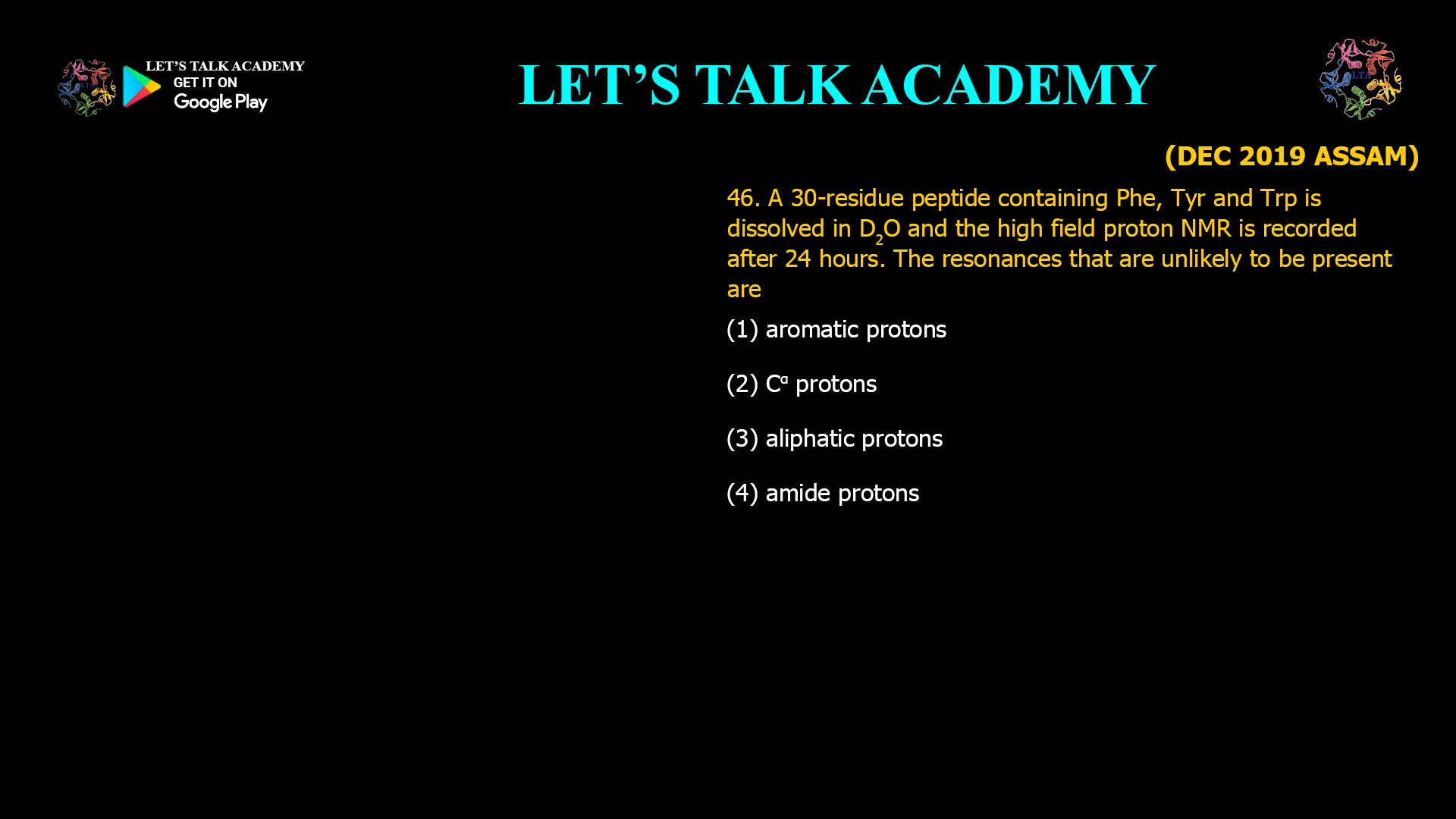
46. A 30-residue peptide containing Phe, Tyr and Trp is dissolved in D₂O and the high field proton NMR is recorded after 24 hours. The resonances that are unlikely to be present are
(A) Aromatic protons
(B) Cα protons
(C) Aliphatic protons
(D) Amide protons
Effect of D₂O on Proton NMR of Peptides: Why Amide Proton Signals Disappear
Correct Answer
Option (4): Amide protons
Explanation
Proton Nuclear Magnetic Resonance (¹H NMR) detects hydrogen atoms that remain attached to carbon, nitrogen, oxygen, or sulfur atoms within a molecule. When a peptide is dissolved in heavy water (D₂O), certain hydrogen atoms are capable of exchanging with deuterium because they are chemically labile. Deuterium (2H) possesses different magnetic properties from protium (1H) and therefore is not detected in a conventional proton NMR experiment. As hydrogen atoms are replaced by deuterium, the corresponding proton NMR signals gradually disappear.
The backbone amide protons (-NH-) of peptides are among the most readily exchangeable hydrogen atoms. These protons continuously exchange with solvent molecules through acid- and base-catalyzed mechanisms. After remaining in D₂O for an extended period such as 24 hours, the majority of backbone amide hydrogens are replaced by deuterium. Since deuterium does not contribute to the proton NMR spectrum, the amide proton resonances disappear or become extremely weak.
The extent of hydrogen-deuterium exchange depends on factors such as temperature, pH, solvent accessibility, and hydrogen bonding. Although a few deeply buried amide protons involved in exceptionally stable hydrogen bonds may exchange more slowly, a peptide of only 30 amino acid residues generally undergoes extensive exchange during 24 hours in D₂O. Therefore, the amide proton signals are the resonances most unlikely to remain in the recorded spectrum.
Why Option (1) is Incorrect
The aromatic protons present on the benzene ring of phenylalanine, the phenolic ring of tyrosine, and the indole ring of tryptophan are directly bonded to carbon atoms. These carbon-hydrogen bonds are chemically stable and do not undergo exchange with deuterium under normal experimental conditions. Consequently, aromatic proton resonances remain clearly visible in the proton NMR spectrum.
Why Option (2) is Incorrect
The Cα proton is attached directly to the α-carbon of each amino acid residue. Carbon-hydrogen bonds at the α-carbon are not readily exchanged with deuterium simply by dissolving the peptide in D₂O. Therefore, these proton signals continue to appear in the proton NMR spectrum after incubation in heavy water.
Why Option (3) is Incorrect
Aliphatic protons attached to carbon atoms in amino acid side chains are also non-exchangeable under normal NMR conditions. Their resonances remain present after the peptide is dissolved in D₂O because the carbon-hydrogen bonds are chemically stable and are not replaced by deuterium during the experiment.
Why Option (4) is Correct
Backbone amide protons are exchangeable hydrogens that readily undergo hydrogen-deuterium exchange in D₂O. Once replaced by deuterium, these nuclei no longer contribute to the conventional proton NMR spectrum. Therefore, after 24 hours in D₂O, the amide proton resonances are the signals most likely to disappear.
Hydrogen-Deuterium Exchange in Proteins and Peptides
Hydrogen-deuterium exchange occurs when exchangeable hydrogen atoms are replaced by deuterium from the solvent. In proteins and peptides, the most commonly exchanged hydrogens include backbone amide protons, hydroxyl hydrogens of serine, threonine, and tyrosine, sulfhydryl hydrogens of cysteine, and amino hydrogens of lysine and arginine side chains. Exchange occurs much more rapidly for solvent-exposed groups than for hydrogens protected by strong hydrogen bonds or buried within the protein interior.
Exchangeable and Non-Exchangeable Protons in Proton NMR
Hydrogen atoms bonded to heteroatoms such as nitrogen, oxygen, and sulfur are generally exchangeable and may disappear from proton NMR spectra after exposure to D₂O. In contrast, hydrogen atoms attached directly to carbon atoms, including aromatic, aliphatic, and Cα protons, remain unaffected because carbon-hydrogen bonds are not readily broken under normal experimental conditions. This difference allows D₂O exchange experiments to distinguish exchangeable from non-exchangeable proton environments.
Applications of D₂O Exchange Experiments
D₂O exchange experiments are widely used to identify exchangeable protons, investigate hydrogen bonding, study protein folding, examine solvent accessibility, and analyze structural dynamics. Amide protons that exchange slowly often participate in stable hydrogen bonds or are buried within the protein core, whereas rapidly exchanging amide protons usually indicate flexible or solvent-exposed regions of the molecule.
Conclusion
After dissolving the peptide in D₂O for 24 hours, the backbone amide hydrogens undergo hydrogen-deuterium exchange and are replaced by deuterium. Since deuterium is not observed in a conventional proton NMR experiment, the corresponding amide proton resonances disappear, while aromatic, Cα, and aliphatic proton signals remain detectable. Therefore, the correct answer is Option (4): Amide protons.


