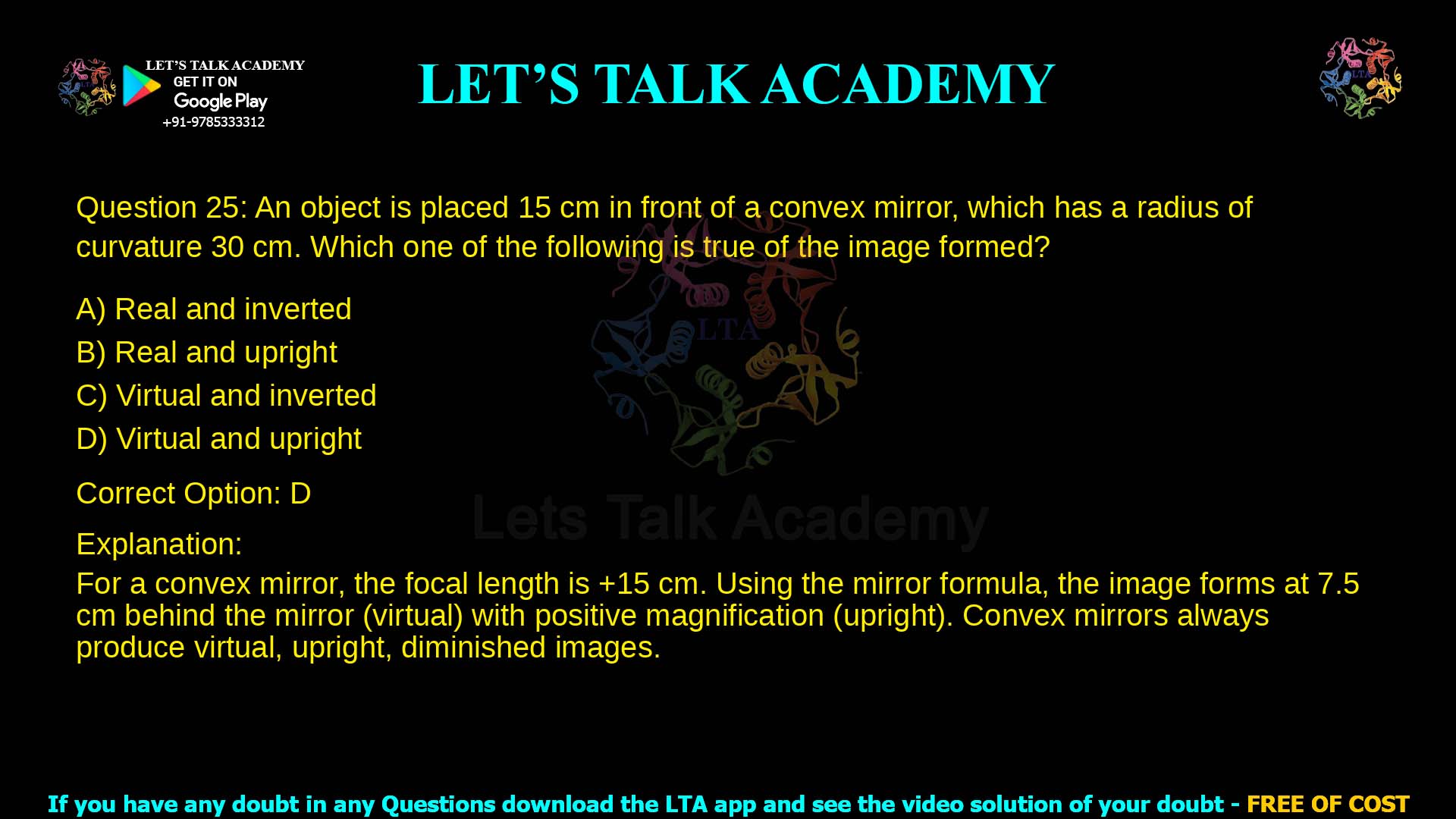
Q.25 An object is placed 15 𝑐𝑚 in front of a convex mirror, which has a radius of
curvature 30 𝑐𝑚. Which one of the following is true of the image formed?
(A) Real and inverted
(B) Real and upright
(C) Virtual and inverted
(D) Virtual and upright
Correct Answer
The image formed is virtual and upright. (D)
Sign Convention
Distances follow the New Cartesian sign convention for mirrors. Object distance (u) is negative when in front of the mirror, focal length (f) is positive for convex mirrors, image distance (v) is positive for virtual images behind the mirror, and magnification (m) is positive for upright images.
Step-by-Step Calculation
Radius of curvature R = 30 cm gives focal length f = +R/2 = +15 cm. Object distance u = -15 cm.
Mirror formula 1/f = 1/v + 1/u yields:
1/v = 1/15 – 1/(-15) = 1/30
so v = +7.5 cm (virtual image behind mirror).
Magnification m = -v/u = -7.5/-15 = +0.5 (upright, diminished).
Option Analysis
- (A) Real and inverted: Incorrect; convex mirrors never form real images, as v is always positive. Real images require converging rays, absent here.
- (B) Real and upright: Incorrect; combines impossible traits for convex mirrors.
- (C) Virtual and inverted: Incorrect; images are virtual but always upright (m > 0). Inverted images need negative m, not possible.
- (D) Virtual and upright: Correct; matches v > 0 and m > 0 for all object positions in convex mirrors.
Key Properties of Convex Mirrors
Convex mirrors diverge light rays, producing virtual, upright, diminished images between pole and focus, regardless of object distance. This wide field of view suits applications like vehicle rearview mirrors.
SEO Optimized Introduction
Convex mirror image formation for an object 15 cm in front with a 30 cm radius of curvature always results in a virtual and upright image. This physics problem, common in exams like CSIR NET, uses the mirror formula and sign convention to determine image nature. Explore detailed calculations and why options like real or inverted fail.
Understanding Convex Mirror Basics
Convex mirrors bulge outward and diverge parallel rays, placing the focus behind the mirror (f positive). For any real object, images form virtually behind the mirror—upright and smaller—offering a broad view ideal for safety mirrors.
Mirror Formula and Sign Convention Explained
The mirror formula 1/f = 1/v + 1/u applies with:
- u = -15 cm (object left of mirror)
- R = 30 cm, so f = +15 cm
- Solving: v = +7.5 cm (virtual)
- Magnification m = +0.5 confirms upright image
Analyzing All MCQ Options
| Option | Nature | Why Correct/Incorrect |
|---|---|---|
| (A) | Real and inverted | Converging rays needed Convex diverges; no real images |
| (B) | Real and upright | Real requires inversion usually Impossible for convex |
| (C) | Virtual and inverted | Virtual yes, but m always positive Upright only |
| (D) | Virtual and upright | Matches v > 0, m > 0 Always true |
Practical Applications and Exam Tips
Convex mirrors excel in security and vehicles due to distortion-free wide views. For exams, memorize: convex always virtual/upright; verify with formula. Practice similar problems like object at 30 cm (v ≈10 cm).


