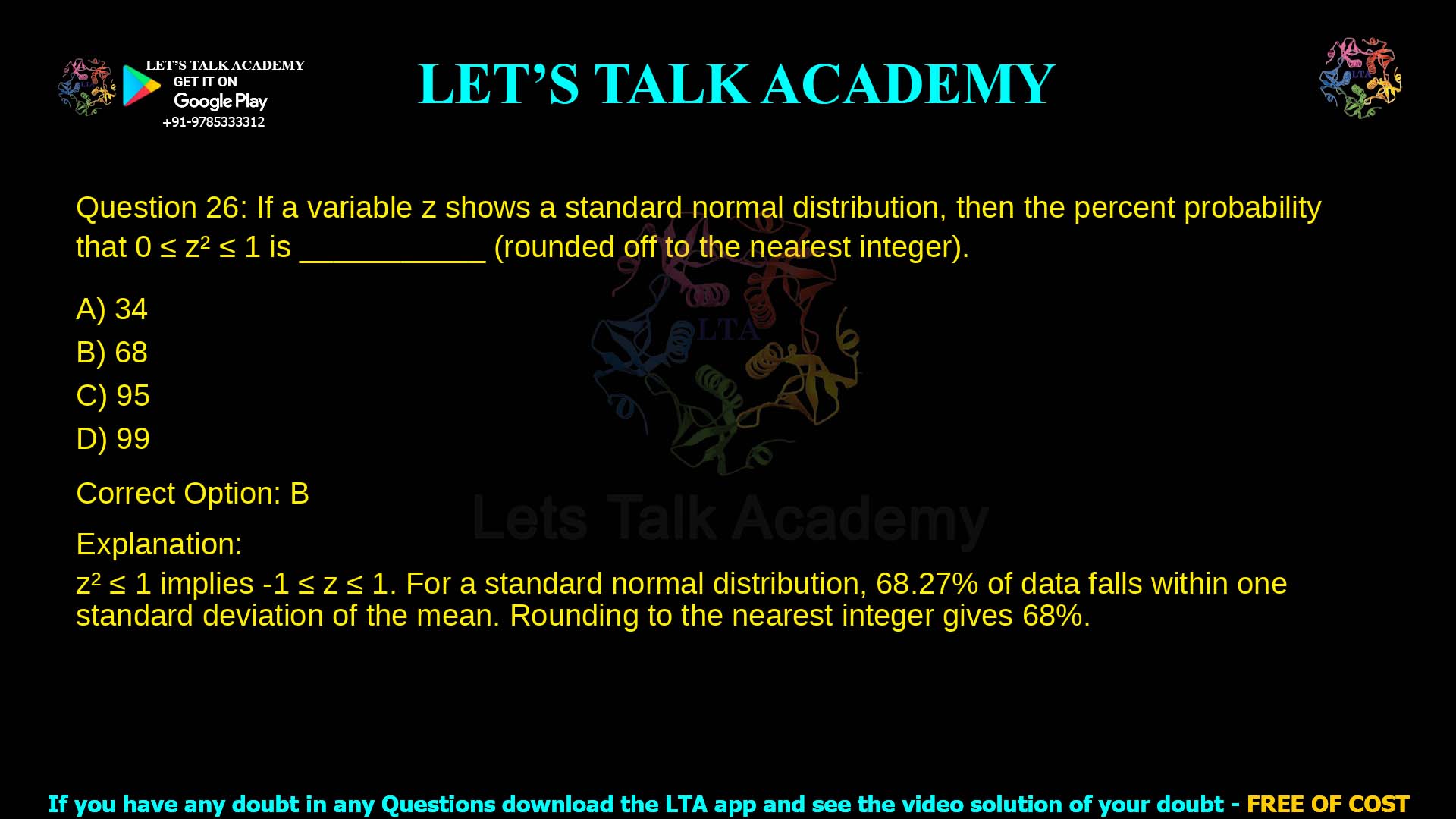
Q.26 If a variable 𝑧 shows a standard normal distribution, then the percent
probability that
0 ≤ 𝑧2 ≤ 1
is ___________ (rounded off to the nearest integer).
(A) 34
(B) 68
(C) 95
(D) 99
Problem Explanation
A standard normal distribution has mean 0 and variance 1. The condition 0 ≤ z² ≤ 1 means |z| ≤ 1, or -1 ≤ z ≤ 1. This interval captures 68.27% of the distribution, rounded to 68.
Step-by-Step Solution
Transform z² follows a chi-square distribution with 1 degree of freedom, so P(0 ≤ z² ≤ 1) = P(-1 ≤ z ≤ 1).
Use symmetry: P(-1 ≤ z ≤ 1) = 2 × P(0 ≤ z ≤ 1) – P(z=0), where P(0 ≤ z ≤ 1) = 0.3413.
Thus, 2 × 0.3413 = 0.6826, or 68% when rounded.
Option Analysis
- (A) 34: Matches one tail (P(0 ≤ z ≤ 1)), not the full interval.
- (B) 68: Correct, as it covers ±1 standard deviation.
- (C) 95: Applies to ±1.96 standard deviations.
- (D) 99: Applies to ±2.58 standard deviations.
Understanding z² in Standard Normal Distribution
When z follows standard normal N(0,1), z² follows χ²(1). The inequality 0 ≤ z² ≤ 1 equals P(-1 ≤ z ≤ 1), covering the central 68.27% area under the bell curve.
Z-tables confirm P(0 ≤ z ≤ 1) = 0.3413, doubling to 0.6826.
Detailed Calculation for CSIR NET
Compute via CDF: 2Φ(1) – 1 = 0.6827. Chi-square CDF verifies: Fχ²₁(1) – Fχ²₁(0) = 0.6827. Round to nearest integer: 68.
Options Comparison Table
| Option | Probability | Interval Match | Correct? |
|---|---|---|---|
| (A) 34 | 34% | 0 ≤ z ≤ 1 only | No |
| (B) 68 | 68% | -1 ≤ z ≤ 1 | Yes |
| (C) 95 | 95% | -1.96 ≤ z ≤ 1.96 | No |
| (D) 99 | 99% | -2.58 ≤ z ≤ 2.58 | No |
Exam Tips for Standard Normal Questions
- Practice z-table lookups and chi-square conversions for genetics, ecology stats in CSIR NET.
- Visualize: 68% lies within 1 SD, empirical rule benchmark.
- Remember: z² ~ χ²(1) transformation is key for such problems.
CSIR NET Life Sciences Key Takeaway: Master standard normal distribution probability calculations like P(0 ≤ z² ≤ 1) = 68% for quantitative aptitude success.


