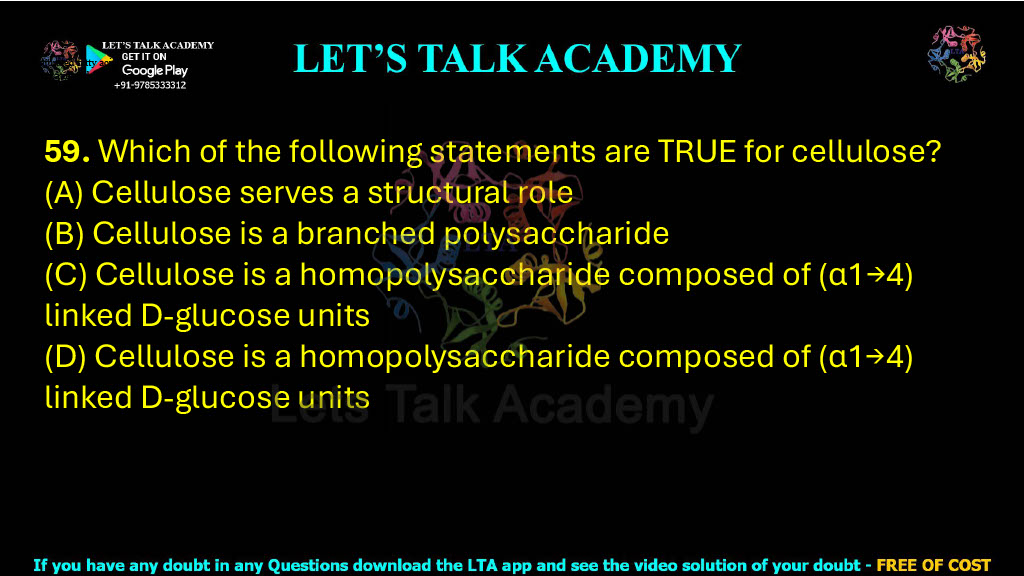
59. Which of the following statements are TRUE for cellulose?
(A) Cellulose serves a structural role
(B) Cellulose is a branched polysaccharide
(C) Cellulose is a homopolysaccharide composed of (α1→4) linked D-glucose units
(D) Cellulose is a homopolysaccharide composed of (α1→4) linked D-glucose units
Which Statements Are True for Cellulose?
Correct Answer
(A) and (D)
Introduction
Cellulose is the most abundant organic polymer on Earth and is the principal structural component of the plant cell wall. It provides mechanical strength, rigidity, and protection to plant cells, enabling plants to maintain their shape and withstand environmental stress. Unlike storage polysaccharides such as starch and glycogen, cellulose is designed to provide structural support rather than energy storage. Its unique physical properties arise from the arrangement of glucose molecules and the formation of extensive hydrogen bonding between adjacent cellulose chains.
Chemically, cellulose is a linear homopolysaccharide composed entirely of D-glucose molecules linked by β(1→4) glycosidic bonds. This β-linkage forces successive glucose units to rotate by 180°, producing long, straight chains that align parallel to one another. Numerous hydrogen bonds between neighboring chains generate highly stable microfibrils, making cellulose insoluble and mechanically strong.
Understanding the Concept Behind the Question
Cellulose possesses several characteristic features:
- It is a structural polysaccharide.
- It is composed entirely of D-glucose.
- The glucose units are connected by β(1→4) glycosidic bonds.
- It is linear and unbranched.
- Multiple chains associate through hydrogen bonds to form strong cellulose fibers.
These characteristics distinguish cellulose from starch and glycogen, both of which contain α-glycosidic linkages and function primarily as energy-storage polysaccharides.
Analysis of Option (A)
Cellulose Serves a Structural Role
This statement is correct.
Cellulose is the major structural material of the plant cell wall, where it provides rigidity, tensile strength, and protection. The extensive hydrogen bonding between cellulose molecules forms strong microfibrils that support plant tissues and resist mechanical stress.
Unlike starch or glycogen, cellulose is not used for energy storage but functions almost exclusively as a structural polymer.
Therefore,
Option (A) is correct.
Analysis of Option (B)
Cellulose Is a Branched Polysaccharide
This statement is incorrect.
Cellulose is a completely linear polysaccharide.
Every glucose residue is connected through β(1→4) glycosidic bonds, and no branching occurs.
Branching is characteristic of glycogen and amylopectin, not cellulose.
Therefore,
Option (B) is incorrect.
Analysis of Option (C)
Cellulose Is Composed of α(1→4) Linked D-Glucose Units
This statement is incorrect.
The α(1→4) glycosidic linkage is found in amylose, which is the linear component of starch.
Cellulose contains β(1→4) glycosidic bonds, not α-linkages.
The β configuration is responsible for the extended linear structure and extensive hydrogen bonding characteristic of cellulose.
Therefore,
Option (C) is incorrect.
Analysis of Option (D)
Cellulose Is a Homopolysaccharide Composed of β(1→4) Linked D-Glucose Units
This statement is correct.
Cellulose consists entirely of D-glucose monomers, making it a homopolysaccharide.
These glucose molecules are connected by β(1→4) glycosidic linkages, producing long, straight chains capable of forming strong hydrogen-bonded microfibrils.
This molecular architecture is responsible for the remarkable strength and insolubility of cellulose.
Therefore,
Option (D) is correct.
Cellulose vs Starch
Although both cellulose and starch are polymers of D-glucose, they differ significantly in structure and biological function.
| Feature | Cellulose | Starch |
|---|---|---|
| Biological Role | Structural | Energy Storage |
| Monomer | D-Glucose | D-Glucose |
| Glycosidic Bond | β(1→4) | α(1→4), α(1→6) |
| Structure | Linear | Linear or Branched |
| Digestibility in Humans | No | Yes |
The difference in glycosidic linkage is sufficient to produce completely different biological properties.
Biological Importance
Cellulose forms the structural framework of plant cell walls, allowing plants to maintain rigidity while remaining lightweight. Because humans lack the enzyme cellulase, cellulose cannot be digested and instead functions as dietary fiber, promoting intestinal motility and digestive health.
Many microorganisms, including bacteria, fungi, and protozoa, produce cellulase enzymes that hydrolyze β(1→4) glycosidic bonds. Herbivorous animals digest cellulose indirectly through symbiotic microorganisms living in the rumen or hindgut. Cellulose also has major industrial applications in paper production, textiles, biofuels, and biodegradable materials.
High-Yield Points
- Cellulose is the most abundant natural polysaccharide.
- It is a structural polysaccharide.
- Cellulose is composed entirely of D-glucose.
- Glucose residues are connected by β(1→4) glycosidic bonds.
- Cellulose is linear and unbranched.
- Humans cannot digest cellulose because they lack cellulase.
- Extensive hydrogen bonding produces strong microfibrils in plant cell walls.
Frequently Asked Questions
Why is cellulose stronger than starch?
Cellulose contains β(1→4) glycosidic linkages, producing straight chains that align parallel and form numerous hydrogen bonds. This creates rigid microfibrils with high tensile strength.
Why can’t humans digest cellulose?
Humans do not produce the enzyme cellulase, which is required to hydrolyze β(1→4) glycosidic bonds. Consequently, cellulose passes through the digestive tract as dietary fiber.
What type of polysaccharide is cellulose?
Cellulose is a linear homopolysaccharide composed exclusively of β(1→4)-linked D-glucose molecules.
Key Takeaways
Cellulose is a linear structural homopolysaccharide found in the cell walls of plants. It consists entirely of D-glucose molecules joined by β(1→4) glycosidic bonds, which allow adjacent chains to form extensive hydrogen bonds and strong microfibrils. Unlike starch and glycogen, cellulose is unbranched and serves a structural rather than a storage function. These unique structural features explain its mechanical strength, biological importance, and resistance to digestion in humans. Therefore, the correct statements are Option (A) and Option (D).
Final Answer
Correct Options: (A) and (D)
Explanation
Cellulose is a structural homopolysaccharide that forms the major component of the plant cell wall, providing rigidity and mechanical strength. It consists entirely of D-glucose molecules linked through β(1→4) glycosidic bonds, producing long, straight, unbranched chains that associate through hydrogen bonding to form strong microfibrils. Cellulose is not branched, and it does not contain α(1→4) glycosidic linkages, which are characteristic of starch. Therefore, the correct statements are (A) and (D).


