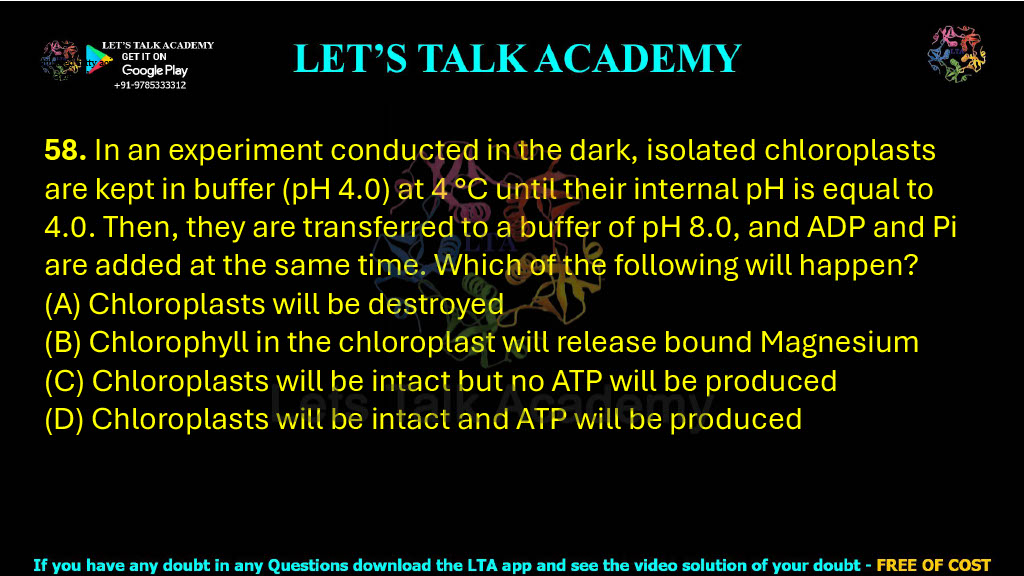
58. In an experiment conducted in the dark, isolated chloroplasts are kept in buffer (pH 4.0) at 4 °C until their internal pH is equal to 4.0. Then, they are transferred to a buffer of pH 8.0, and ADP and Pi are added at the same time. Which of the following will happen?
(A) Chloroplasts will be destroyed
(B) Chlorophyll in the chloroplast will release bound Magnesium
(C) Chloroplasts will be intact but no ATP will be produced
(D) Chloroplasts will be intact and ATP will be produced
Why Do Isolated Chloroplasts Produce ATP After a Sudden pH Shift?
Correct Answer
(D) Chloroplasts will be intact and ATP will be produced
Introduction
One of the most elegant experiments demonstrating the mechanism of ATP synthesis in photosynthesis was performed by André Jagendorf in the 1960s. His experiment provided the first direct experimental evidence supporting Peter Mitchell’s Chemiosmotic Theory, which proposed that ATP synthesis is driven by a proton electrochemical gradient rather than by a stable chemical intermediate. Jagendorf demonstrated that ATP could be synthesized even in complete darkness, provided that an artificial proton gradient existed across the thylakoid membrane.
In the experiment, isolated chloroplasts were first equilibrated in an acidic medium and then suddenly transferred to an alkaline solution containing ADP and inorganic phosphate (Pi). This rapid pH shift generated a proton gradient across the thylakoid membrane identical to the one normally produced by light-driven electron transport. The resulting proton motive force activated ATP synthase, leading to ATP production without any requirement for light.
Understanding the Concept Behind the Question
Initially, the isolated chloroplasts are placed in a buffer of pH 4.0.
Over time, both the thylakoid lumen and the surrounding solution reach the same acidic pH.
When the chloroplasts are rapidly transferred to a buffer of pH 8.0, the external medium immediately becomes alkaline, while the inside of the thylakoid lumen remains acidic for a short period.
As a result:
- Inside the thylakoid lumen: High proton concentration (low pH)
- Outside the thylakoid membrane (stroma): Low proton concentration (high pH)
This difference in proton concentration establishes a proton motive force across the thylakoid membrane.
When ADP and inorganic phosphate (Pi) are supplied, ATP synthase allows protons to move down their electrochemical gradient through the enzyme, and the released energy is used to synthesize ATP.
Therefore, ATP production occurs even though the experiment is performed entirely in darkness.
Analysis of Option (A)
Chloroplasts Will Be Destroyed
The transfer from pH 4 to pH 8 does not destroy the chloroplasts.
The pH change is used only to establish an artificial proton gradient.
The membranes remain intact throughout the experiment.
Therefore,
Option (A) is incorrect.
Analysis of Option (B)
Chlorophyll Will Release Bound Magnesium
Loss of magnesium from chlorophyll occurs only under strongly acidic and damaging conditions, producing pheophytin.
The brief pH treatment used in Jagendorf’s experiment is not intended to remove magnesium from chlorophyll.
Furthermore, ATP synthesis in this experiment does not depend on chlorophyll excitation because the experiment is conducted in darkness.
Therefore,
Option (B) is incorrect.
Analysis of Option (C)
Chloroplasts Will Be Intact but No ATP Will Be Produced
This statement contradicts the purpose of Jagendorf’s experiment.
Although there is no light, ATP is synthesized because the artificial proton gradient replaces the proton gradient normally generated by photosynthetic electron transport.
Therefore,
Option (C) is incorrect.
Analysis of Option (D)
Chloroplasts Will Be Intact and ATP Will Be Produced
The sudden transfer from pH 4 to pH 8 establishes a large proton gradient across the thylakoid membrane.
ATP synthase utilizes this proton motive force to convert ADP and inorganic phosphate into ATP.
Thus, ATP synthesis occurs even in complete darkness.
Therefore,
Option (D) is correct.
Jagendorf Experiment
The sequence of the experiment can be summarized as follows:
Step 1
Chloroplasts are incubated in pH 4 buffer.
↓
The thylakoid lumen becomes highly acidic.
↓
Step 2
Chloroplasts are rapidly transferred to pH 8 buffer containing ADP and Pi.
↓
A proton gradient develops across the thylakoid membrane.
↓
Step 3
Protons flow through ATP synthase.
↓
ATP is synthesized without light.
This experiment conclusively demonstrated that light is required only to generate the proton gradient, not to drive ATP synthase directly.
Biological Importance
Jagendorf’s experiment revolutionized our understanding of biological energy conversion by proving that ATP synthesis depends on the proton motive force rather than on direct chemical coupling. The same fundamental principle operates in both chloroplasts and mitochondria, where ATP synthase converts the energy stored in proton gradients into ATP.
This discovery provided strong experimental support for Peter Mitchell’s Chemiosmotic Theory, which later earned the Nobel Prize in Chemistry. Today, the chemiosmotic mechanism is recognized as one of the universal principles of bioenergetics.
High-Yield Points
- Jagendorf experiment demonstrated chemiosmotic ATP synthesis.
- ATP synthesis can occur in complete darkness if a proton gradient already exists.
- ATP synthase utilizes the proton motive force, not light directly.
- Light is required only to establish the proton gradient during normal photosynthesis.
- The thylakoid membrane must remain intact for ATP synthesis.
- ADP and Pi are essential substrates for ATP formation.
Frequently Asked Questions
Why is ATP produced in the dark?
ATP is produced because an artificial proton gradient has already been established across the thylakoid membrane. ATP synthase requires only this proton motive force and does not directly require light.
What did Jagendorf’s experiment prove?
The experiment demonstrated that ATP synthesis is driven by a proton gradient, providing direct evidence for Peter Mitchell’s Chemiosmotic Theory.
Why are ADP and Pi added after transferring to pH 8?
ADP and inorganic phosphate are the substrates required by ATP synthase. Once the proton gradient exists, ATP synthase converts these molecules into ATP.
Key Takeaways
Jagendorf’s chloroplast experiment demonstrated that ATP synthesis depends on the proton motive force rather than on light itself. When chloroplasts equilibrated at pH 4 are suddenly transferred to pH 8 buffer, an artificial proton gradient is created across the thylakoid membrane. This gradient drives ATP synthase to synthesize ATP from ADP and inorganic phosphate, even in complete darkness. The chloroplasts remain structurally intact throughout the experiment, making this one of the strongest experimental validations of the Chemiosmotic Theory of ATP synthesis.
Final Answer
Correct Option: (D) Chloroplasts will be intact and ATP will be produced
Explanation
When isolated chloroplasts are first equilibrated in a pH 4.0 buffer, both the thylakoid lumen and surrounding medium become acidic. Rapid transfer to a pH 8.0 buffer creates a large proton concentration difference across the intact thylakoid membrane because the lumen remains acidic while the external medium becomes alkaline. This proton motive force drives ATP synthase, which converts ADP and inorganic phosphate (Pi) into ATP. Therefore, even though the experiment is performed in complete darkness, ATP is synthesized, demonstrating the principle established by Jagendorf’s experiment and supporting Peter Mitchell’s Chemiosmotic Theory. Therefore, the correct answer is Option (D).


