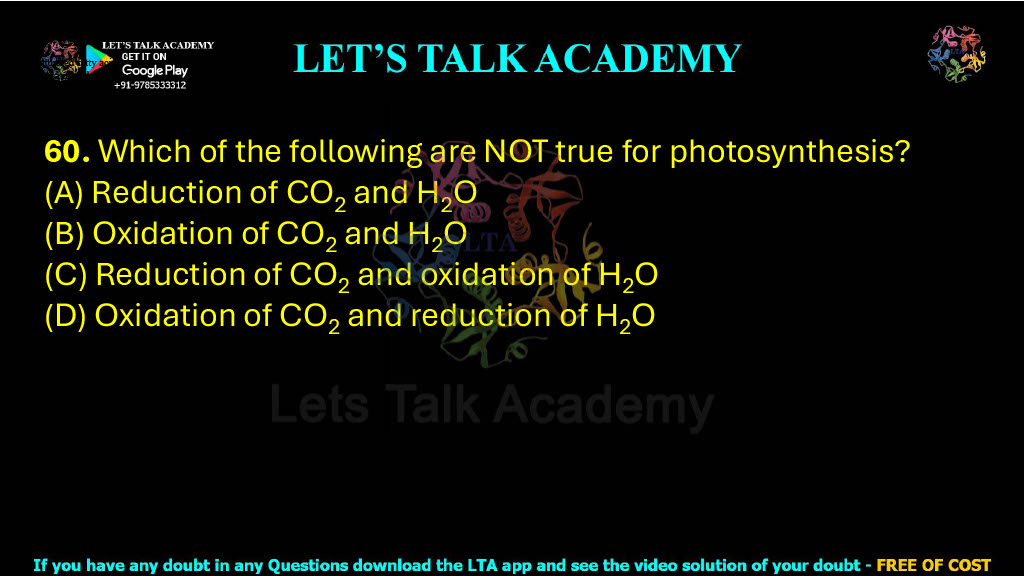
60. Which of the following are NOT true for photosynthesis?
(A) Reduction of CO2 and H2O
(B) Oxidation of CO2 and H2O
(C) Reduction of CO2 and oxidation of H2O
(D) Oxidation of CO2 and reduction of H2O
Which Statements Are NOT True for Photosynthesis? Complete Redox Reaction Explanation
Correct Answer
(A), (B) and (D)
Introduction
Photosynthesis is one of the most important biochemical processes on Earth, converting solar energy into chemical energy while producing oxygen that sustains almost all aerobic life. Green plants, algae, and cyanobacteria perform photosynthesis inside chloroplasts, where light energy drives a series of oxidation-reduction (redox) reactions. These reactions convert atmospheric carbon dioxide into carbohydrates while simultaneously oxidizing water to release molecular oxygen. The ATP and NADPH generated during the light reactions provide the reducing power and energy required for carbon fixation in the Calvin cycle.
From a biochemical perspective, photosynthesis is fundamentally a redox process involving the transfer of electrons from water to carbon dioxide. Water acts as the electron donor, losing electrons and undergoing oxidation, whereas carbon dioxide acts as the electron acceptor, gaining electrons and becoming reduced to carbohydrates such as glucose. U
Understanding the Concept Behind the Question
The overall photosynthetic reaction can be written as:
6CO₂ + 6H₂O + Light Energy → C₆H₁₂O₆ + 6O₂
Although this equation appears simple, two simultaneous redox reactions occur:
- Carbon dioxide gains electrons and is reduced to carbohydrate.
- Water loses electrons and is oxidized to oxygen.
Thus, the correct biochemical description of photosynthesis is:
Reduction of CO₂ and oxidation of H₂O.
Any statement that differs from this redox pattern is not true.
Analysis of Option (A)
Reduction of CO₂ and H₂O
This statement is incorrect.
The first part is correct because carbon dioxide is reduced during the Calvin cycle to produce carbohydrates.
However, the second part is incorrect because water is not reduced during photosynthesis. Instead, water serves as the electron donor and undergoes oxidation, releasing electrons, protons, and molecular oxygen.
Since one part of the statement is false, the entire statement is incorrect.
Therefore,
Option (A) is NOT true.
Analysis of Option (B)
Oxidation of CO₂ and H₂O
This statement is incorrect.
Carbon dioxide does not undergo oxidation during photosynthesis. Instead, it accepts electrons supplied indirectly from water and is reduced to form glucose and other carbohydrates.
Water is indeed oxidized, but because the first part of the statement is incorrect, the overall statement is false.
Therefore,
Option (B) is NOT true.
Analysis of Option (C)
Reduction of CO₂ and Oxidation of H₂O
This statement is correct.
Photosystem II oxidizes water, generating oxygen, electrons, and protons.
The electrons ultimately reduce NADP⁺ to NADPH, which supplies reducing power for the Calvin cycle. During carbon fixation, carbon dioxide gains these electrons and is converted into carbohydrate molecules.
Thus, this option accurately describes the redox chemistry of photosynthesis.
Therefore,
Option (C) is true and is not included among the incorrect statements.
Analysis of Option (D)
Oxidation of CO₂ and Reduction of H₂O
This statement is incorrect.
It completely reverses the actual redox events occurring during photosynthesis.
Carbon dioxide is never oxidized, and water is never reduced in this process.
Instead, the opposite occurs:
- CO₂ is reduced.
- H₂O is oxidized.
Therefore,
Option (D) is NOT true.
Redox Reactions During Photosynthesis
The oxidation half-reaction is:
2H₂O → O₂ + 4H⁺ + 4e⁻
Water loses electrons and is therefore oxidized.
The reduction half-reaction is:
CO₂ + Electrons + H⁺ → Carbohydrates
Carbon dioxide gains electrons and is therefore reduced.
These two complementary reactions together constitute the redox basis of photosynthesis.
Biological Importance
The oxidation of water provides the electrons required for all photosynthetic electron transport and is responsible for the release of atmospheric oxygen. The reduction of carbon dioxide enables plants to synthesize carbohydrates that serve as the primary energy source for nearly all ecosystems. These coupled oxidation-reduction reactions are therefore fundamental to global carbon cycling, oxygen production, food synthesis, and energy flow through living organisms.
High-Yield Points
- Water is oxidized during photosynthesis.
- Carbon dioxide is reduced during photosynthesis.
- Oxygen released during photosynthesis originates from water, not from carbon dioxide.
- Water functions as the electron donor.
- Carbon dioxide functions as the electron acceptor.
- NADPH provides reducing power for CO₂ reduction in the Calvin cycle.
- The light reactions generate ATP and NADPH required for carbon fixation.
Frequently Asked Questions
Why is carbon dioxide reduced during photosynthesis?
Carbon dioxide gains electrons supplied through NADPH and is converted into carbohydrates during the Calvin cycle. Gain of electrons is defined as reduction.
Why is water oxidized instead of reduced?
Water donates electrons to Photosystem II. Loss of electrons is oxidation, producing oxygen, protons, and electrons.
Where does the oxygen released during photosynthesis come from?
The oxygen evolved during photosynthesis originates from the oxidation of water, not from carbon dioxide.
Key Takeaways
Photosynthesis is a biological redox process in which water acts as the electron donor and carbon dioxide acts as the electron acceptor. During the light reactions, water is oxidized to molecular oxygen, releasing electrons that ultimately reduce NADP⁺ to NADPH. The Calvin cycle then uses this reducing power to convert carbon dioxide into carbohydrates. Therefore, the only correct description of photosynthesis is reduction of CO₂ and oxidation of H₂O. Consequently, statements (A), (B), and (D) are incorrect, whereas Option (C) accurately describes the redox chemistry of photosynthesis.
Final Answer
Correct Options: (A), (B) and (D)
Explanation
Photosynthesis involves the oxidation of water and the reduction of carbon dioxide. During the light-dependent reactions, water loses electrons and is oxidized to produce oxygen, while the electrons are transferred through the photosynthetic electron transport chain to generate NADPH. In the Calvin cycle, carbon dioxide gains these electrons and is reduced to carbohydrates. Therefore, only Option (C) correctly describes the process. Options (A), (B), and (D) incorrectly assign the oxidation and reduction reactions and are therefore NOT true for photosynthesis.


