(DEC 2004) 76. The best example of regulation of enzyme by reversible covalent modification is- (1) Phosphorylation (2) Acetylation (3) Glycosylation (4) proteolytic cleavage The correct answer is (1) Phosphorylation. Introduction […]

(DEC 2004) 76. The best example of regulation of enzyme by reversible covalent modification is- (1) Phosphorylation (2) Acetylation (3) Glycosylation (4) proteolytic cleavage The correct answer is (1) Phosphorylation. Introduction […]
![(SEPT 2022-1) 75. Dixon plot is used to study the enzyme inhibition by plotting various expressions of velocity (v) and inhibitor concentration [l] on the X-axis (column A) and Y-axis (column B) as given below: Which one of the following options is the correct combination from columns A and B to draw the Dixon plot? 1. Column A -iv, Column B- i 2. Column A -i, Column B- ii 3. Column A- ii, Column B- iii 4. Column A- iii, Column B- iv](https://www.letstalkacademy.com/wp-content/uploads/2025/09/75.jpg)
The correct answer is (3) Column A-ii, Column B-ii. Introduction Dixon plots are essential tools in enzyme kinetics, allowing researchers to analyze and visualize enzyme inhibition data accurately. The choice of […]

The correct answer is Introduction Quantitative analysis of enzyme inhibition is essential for both basic biochemistry research and drug development. The Dixon plot is a classic graphical method used to […]
![The correct answer is (3) Non-competitive inhibitor. Title Interpreting Double Reciprocal Equations: Identifying Non-Competitive Inhibition in Enzyme Kinetics Meta Description Learn how to distinguish non-competitive inhibition using changes in Lineweaver-Burk plot equations. See why only Vmax changes—classic for non-competitive inhibitors—in detailed biochemical analysis. Slug noncompetitive-inhibition-lineweaver-burk-double-reciprocal-equation Introduction Enzyme kinetics is foundational for understanding metabolic regulation and drug mechanisms. Identifying different inhibition types is pivotal when analyzing altered Lineweaver-Burk plots or double reciprocal equations. Non-competitive inhibition is characterized by a change in the y-intercept (reflecting Vmax) while Km remains unchanged. This article shows how to recognize non-competitive inhibition from the mathematical forms and the biochemical impact it has on enzyme activity. Double Reciprocal Equations Overview Given: Without inhibitor (X): 1 v 0 = K m V m a x ( 1 [ S ] ) + 1 V m a x v 0 1 = V max K m ( [S] 1 )+ V max 1 With inhibitor (X): 1 V 0 = K m V m a x ( 1 [ S ] ) + 1 V m a x ( 1 + [ X ] K X ) V 0 1 = V max K m ( [S] 1 )+ V max 1 (1+ K X [X] ) Analysis: Identifying Inhibition Type In the presence of inhibitor, the slope K m V m a x V max K m (linked to Km) is unchanged. The y-intercept is increased by a factor ( 1 + [ X ] K X ) (1+ K X [X] ), decreasing apparent Vmax but leaving Km unaltered. This matches the action of a non-competitive inhibitor, which binds at a site distinct from the substrate binding site and reduces enzyme activity regardless of substrate concentration. In competitive inhibition, the slope (dependent on Km) would increase; in uncompetitive inhibition, both Km and Vmax are affected proportionally. Mechanistic Understanding Non-competitive inhibitors bind to either free enzyme or the ES complex at an allosteric site. This reduces the overall number of catalytically competent enzyme molecules, decreasing Vmax. Importantly, Km (substrate affinity) remains unchanged—substrate can bind just as well, but some enzyme can’t convert it to product. Summary Table Inhibitor Type Double Reciprocal Equation Change Km Vmax Effect on Plot/Activity Competitive Slope increases, y-intercept unchanged ↑ — Can be overcome by substrate Non-competitive y-intercept increases, slope unchanged — ↓ Can’t be overcome by substrate Uncompetitive Both slope and y-intercept change ↓ ↓ Lower Km and Vmax Visual Summary Non-competitive inhibition: Lines (with and without inhibitor) have the same x-intercept (Km unchanged) but different y-intercepts (Vmax decreased). Conclusion The molecule X is a non-competitive inhibitor, as indicated by the unchanged Km and decreased Vmax represented in the altered double reciprocal equation. This is a classic kinetic pattern, crucial for enzyme pharmacology and molecular biology.](https://www.letstalkacademy.com/wp-content/uploads/2025/09/73.jpg)
The correct answer is (3) Non-competitive inhibitor. Introduction Enzyme kinetics is foundational for understanding metabolic regulation and drug mechanisms. Identifying different inhibition types is pivotal when analyzing altered Lineweaver-Burk plots or […]
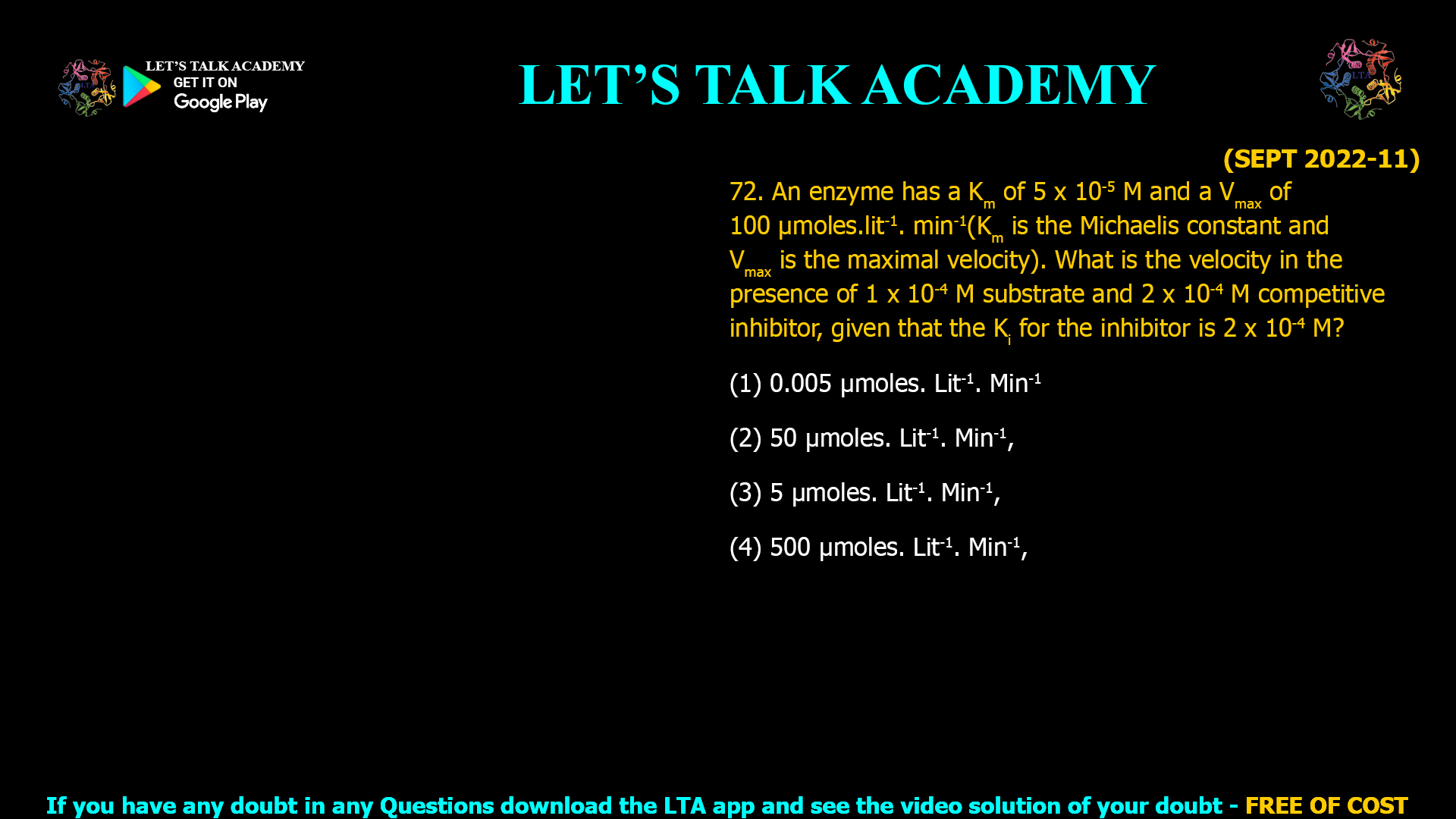
(SEPT 2022-11) 72. An enzyme has a Km of 5 x 10⁻⁵ M and a Vmax of 100 µmoles.lit-1. min-1(Km is the Michaelis constant and Vmax is the maximal velocity). […]
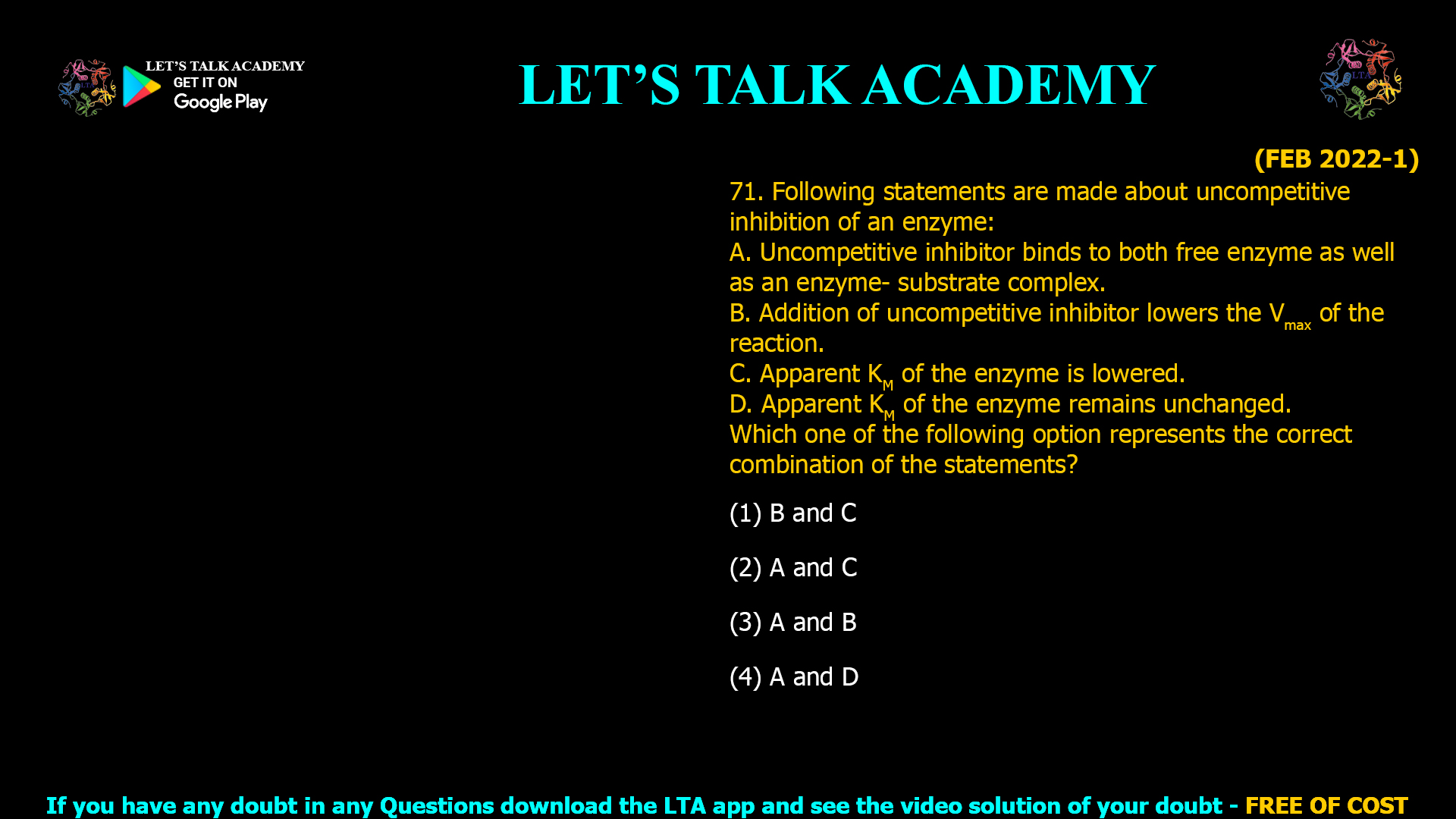
(FEB 2022-1) 71. Following statements are made about uncompetitive inhibition of an enzyme: A. Uncompetitive inhibitor binds to both free enzyme as well as an enzyme- substrate complex. B. Addition […]
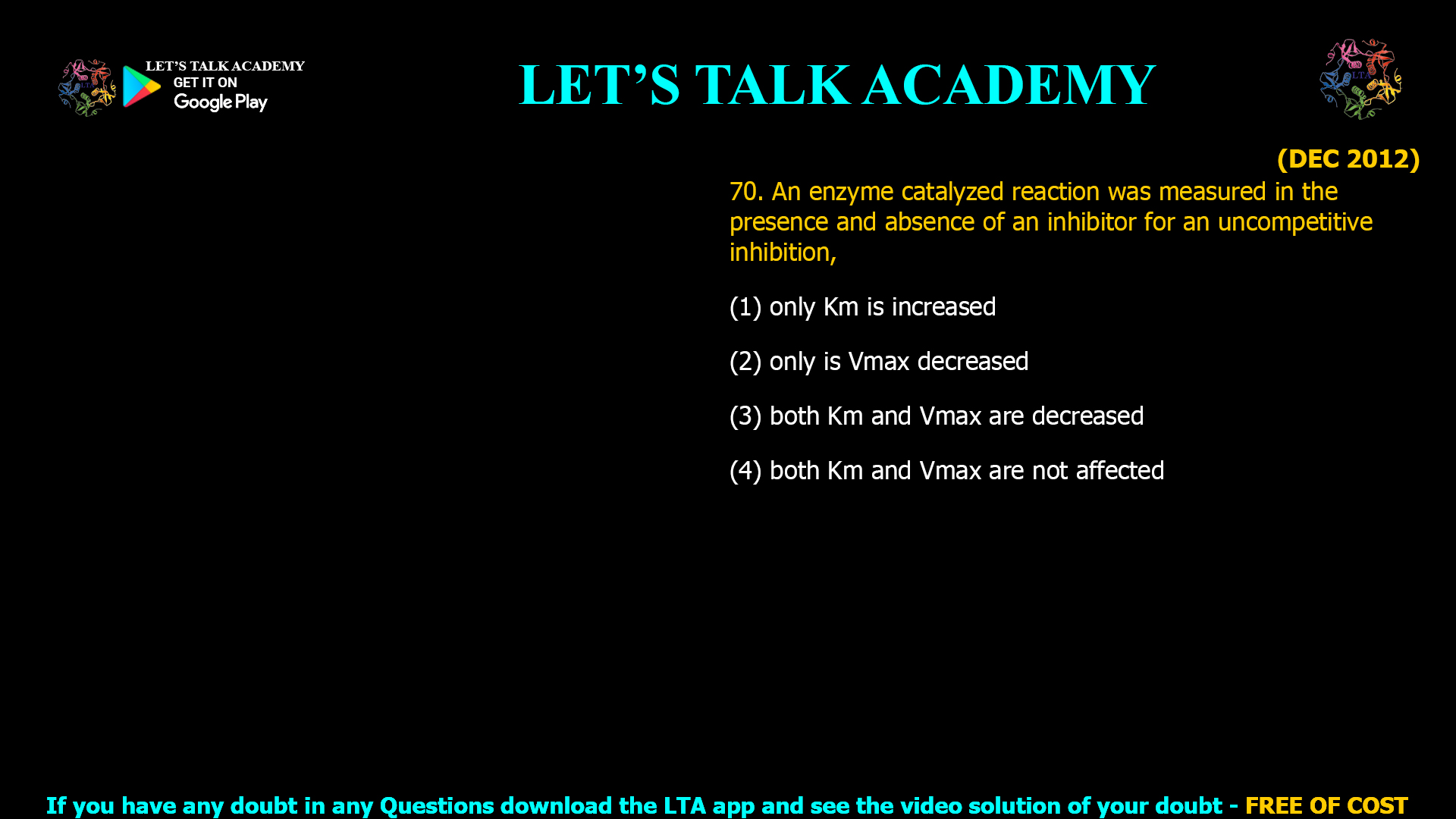
(DEC 2012) 70. An enzyme catalyzed reaction was measured in the presence and absence of an inhibitor for an uncompetitive inhibition, (1) only Km is increased (2) only is Vmax […]
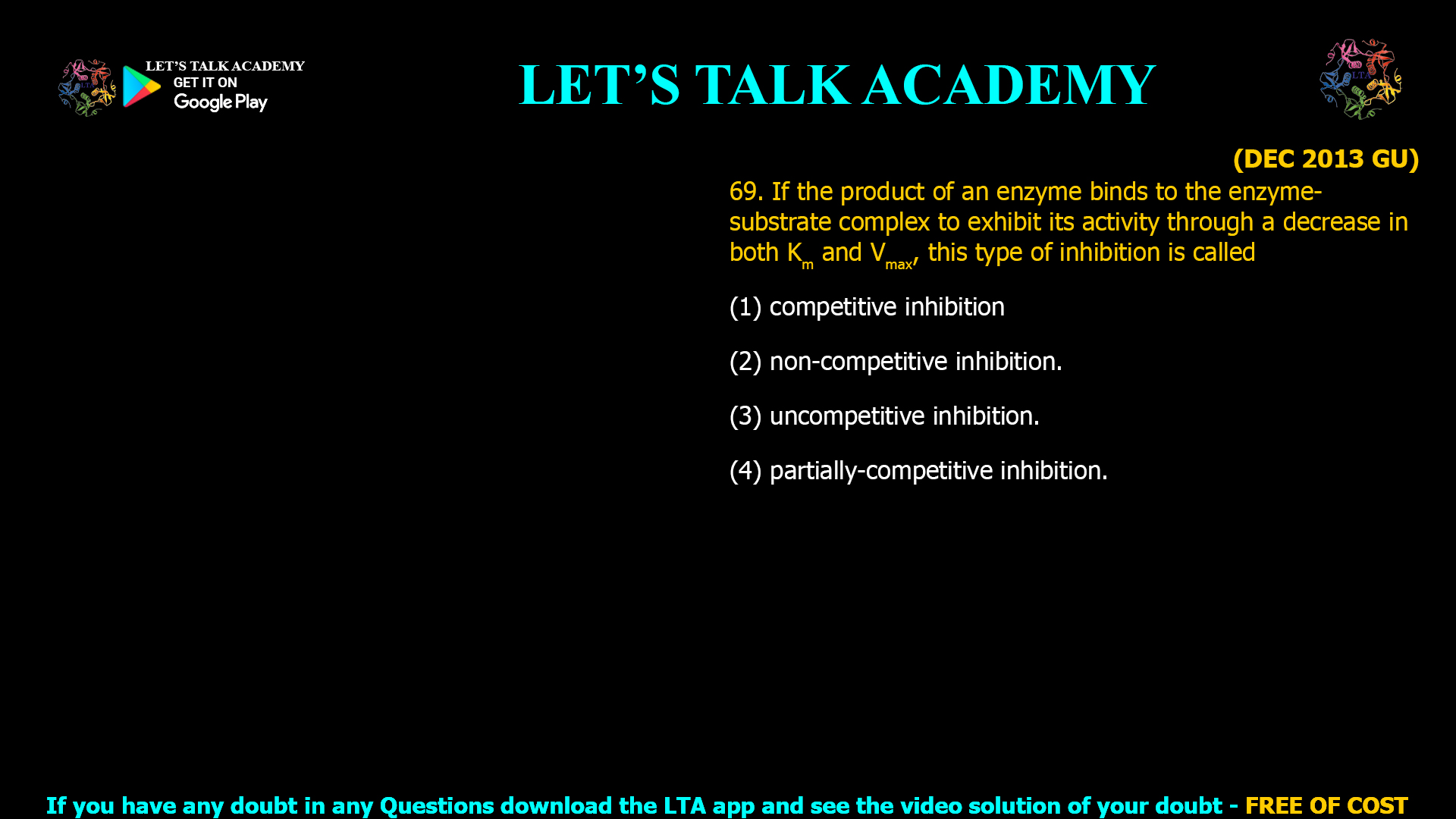
(DEC 2013 GU) 69. If the product of an enzyme binds to the enzyme- substrate complex to exhibit its activity through a decrease in both Km and Vmax, this type […]

The correct answer is (3) Both X and Y are specific for the substrate, S. Introduction Substrate specificity is a key property for enzymes, defining their role in cellular metabolism and […]
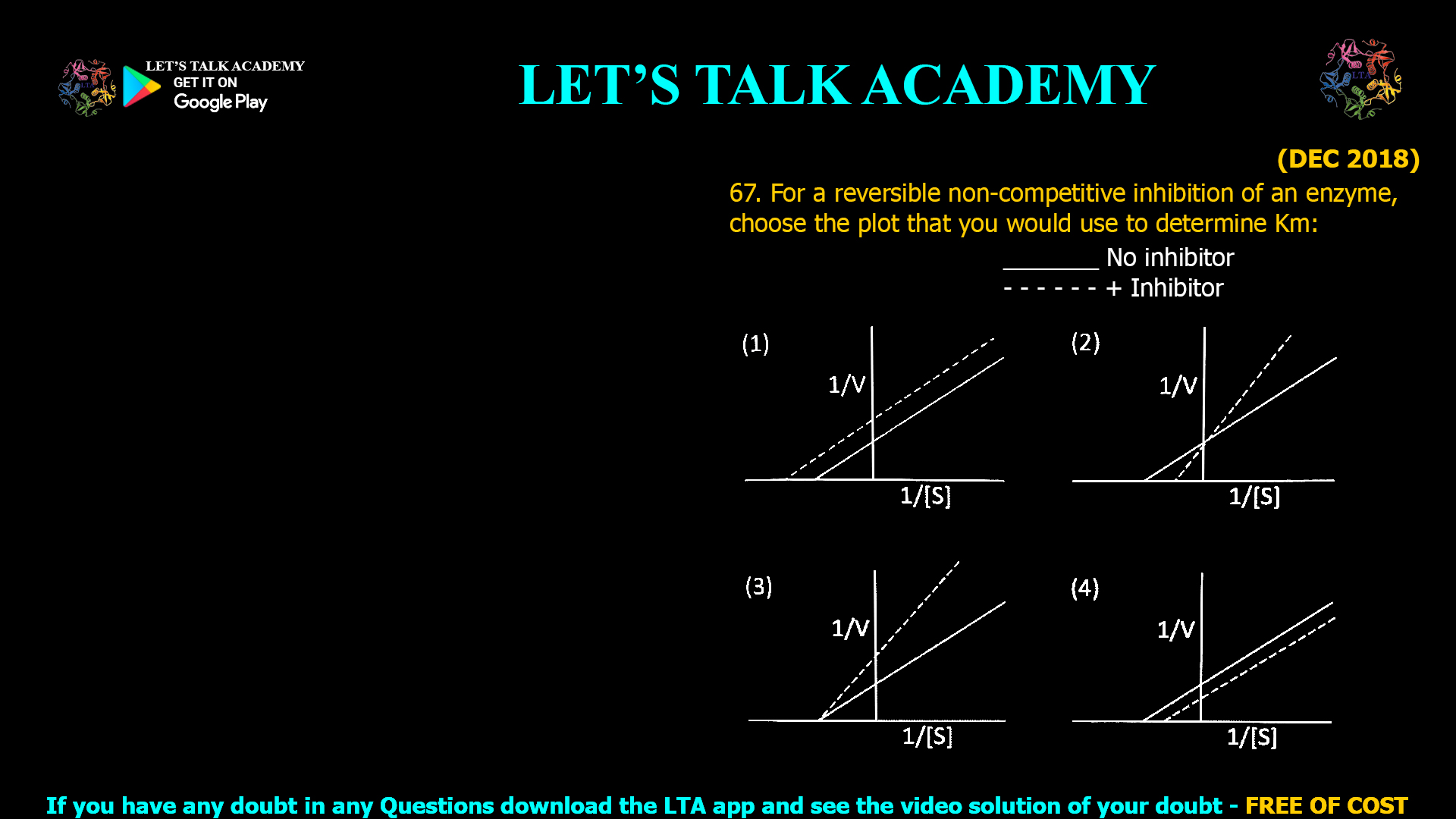
The correct answer is (1). Introduction Enzyme inhibition is a cornerstone of biochemistry and pharmacology, and visualizing its effects on kinetic parameters is essential. The Lineweaver-Burk double reciprocal plot provides a […]


