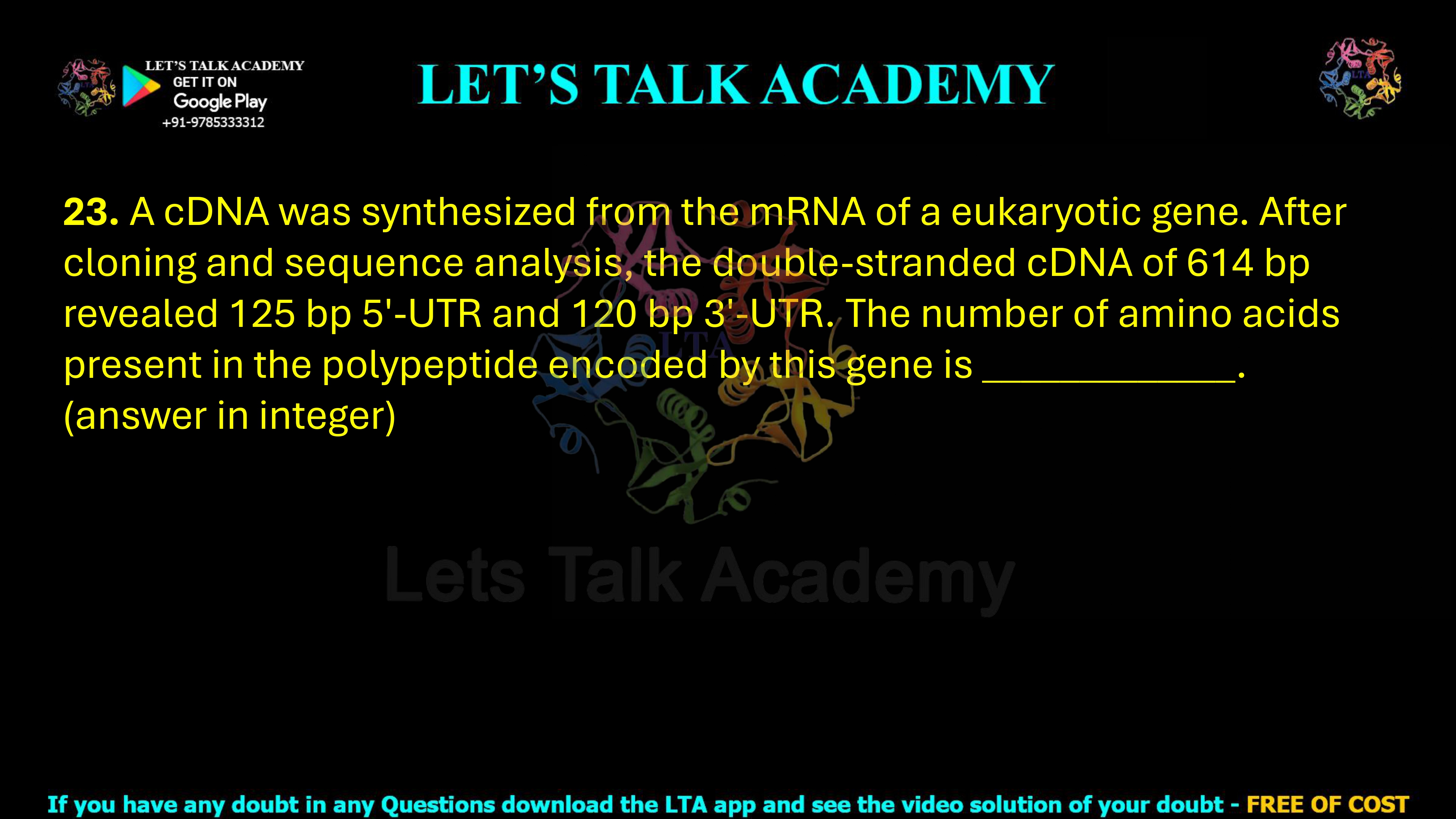
23. A cDNA was synthesized from the mRNA of a eukaryotic gene. After cloning and sequence analysis, the double-stranded cDNA of 614 bp revealed 125 bp 5′-UTR and 120 bp 3′-UTR. The number of amino acids present in the polypeptide encoded by this gene is _____________. (answer in integer)
How to Calculate the Number of Amino Acids from cDNA Length and UTRs?
Understanding the Given cDNA Sequence Information
To calculate the number of amino acids present in the encoded polypeptide, we must first identify the actual protein-coding region of the cDNA. The total length of the double-stranded cDNA is given as 614 base pairs (bp). However, the complete cDNA does not consist entirely of protein-coding sequence because it also contains a 5′ untranslated region (5′-UTR) and a 3′ untranslated region (3′-UTR).
The 5′-UTR is 125 bp long, while the 3′-UTR is 120 bp long. Since neither of these untranslated regions is translated into amino acids, both must first be subtracted from the total cDNA length.
After removing the two UTRs, the remaining nucleotide sequence represents the coding region, which contains the start codon, the codons specifying amino acids and the stop codon. The stop codon terminates translation but does not encode any amino acid. Therefore, the three nucleotides of the stop codon must also be considered separately before determining the final number of amino acids.
Step-by-Step Calculation of the Number of Amino Acids
Step 1: Calculate the Total Length of the Untranslated Regions
The cDNA contains two untranslated regions. The 5′-UTR has a length of 125 bp, and the 3′-UTR has a length of 120 bp. Therefore, the total length of the untranslated sequence is calculated as follows:
Total UTR length = 5′-UTR + 3′-UTR
Total UTR length = 125 + 120 = 245 bp
Thus, out of the total 614 bp cDNA sequence, 245 bp belong to untranslated regions and do not contribute directly to the amino acid sequence of the polypeptide.
Step 2: Calculate the Length of the Coding Region
The coding region can now be calculated by subtracting the total length of the untranslated regions from the total length of the cDNA:
Coding region length = Total cDNA length − 5′-UTR − 3′-UTR
Coding region length = 614 − 125 − 120
Coding region length = 369 bp
Therefore, the sequence extending from the start codon through the stop codon is 369 nucleotides long.
Step 3: Determine the Total Number of Codons
Each codon consists of three nucleotides. Therefore, the total number of codons present in the 369-nucleotide coding region is calculated by dividing the coding sequence length by three:
Total number of codons = 369 ÷ 3
Total number of codons = 123 codons
However, all 123 codons do not encode amino acids. One of these codons is the stop codon, which signals the termination of translation and does not specify any amino acid.
Step 4: Subtract the Stop Codon
Since one of the 123 codons is a termination codon, it must be subtracted from the total number of codons to determine the actual number of amino acids in the polypeptide:
Number of amino acids = Total codons − 1 stop codon
Number of amino acids = 123 − 1
Number of amino acids = 122
Therefore, the polypeptide encoded by this gene contains 122 amino acids.
Complete Calculation in a Single Expression
The entire calculation can be represented in a single expression:
Number of amino acids = [(Total cDNA length − 5′-UTR − 3′-UTR) ÷ 3] − 1
Substituting the given values:
Number of amino acids = [(614 − 125 − 120) ÷ 3] − 1
Number of amino acids = [369 ÷ 3] − 1
Number of amino acids = 123 − 1
Number of amino acids = 122
Why Are the 5′-UTR and 3′-UTR Subtracted?
The 5′ untranslated region and 3′ untranslated region are parts of a mature eukaryotic mRNA and are therefore represented in a cDNA synthesized from that mRNA. Although these regions are transcribed, they are not translated into the amino acid sequence of the protein.
The 5′-UTR is located upstream of the start codon. It can play important roles in the regulation of translation initiation, mRNA stability and other aspects of gene expression. However, because it occurs before the translation start site, its nucleotides do not encode the amino acids of the main polypeptide.
The 3′-UTR is located downstream of the stop codon. It can contain regulatory elements involved in mRNA stability, localization and translational control. Like the 5′-UTR, it is not translated into protein. Therefore, both UTRs must be removed from the total cDNA length when calculating the length of the protein-coding region.
Why Is the Stop Codon Subtracted?
The stop codon is a crucial part of the coding sequence because it signals the termination of protein synthesis. The three standard stop codons are UAA, UAG and UGA in mRNA. In the corresponding DNA or cDNA sequence, these are represented as TAA, TAG and TGA.
Unlike ordinary codons, a stop codon does not specify an amino acid. Instead, it is recognized by release factors that promote the termination of translation and the release of the completed polypeptide from the ribosome.
For this reason, dividing the 369-nucleotide coding region by three gives 123 total codons, but only 122 of these codons specify amino acids. The remaining one is the stop codon. Therefore, the final polypeptide contains 122 amino acids, not 123.
Does the Start Codon Encode an Amino Acid?
Yes. Unlike the stop codon, the start codon is included in the amino acid count. The most common start codon is AUG in mRNA, corresponding to ATG in DNA or cDNA. AUG specifies the amino acid methionine in eukaryotic cells.
Therefore, the start codon should not be subtracted when calculating the number of amino acids. It represents the first amino acid of the newly synthesized polypeptide. Only the stop codon is excluded because no amino acid corresponds to it.
This distinction is essential in molecular biology numerical problems. A coding sequence containing 123 codons, including one start codon and one stop codon, produces a polypeptide containing 122 amino acids because the start codon contributes one amino acid whereas the stop codon contributes none.
What Is the Relationship Between cDNA, mRNA and Protein?
A complementary DNA or cDNA molecule is synthesized using a mature mRNA molecule as a template. Because mature eukaryotic mRNA has already undergone RNA processing, the corresponding cDNA generally lacks the introns that were removed during RNA splicing.
The cDNA therefore represents the sequence of the mature RNA transcript and may contain the 5′-UTR, the protein-coding sequence and the 3′-UTR. Only the coding sequence is translated into a polypeptide.
In this question, the total cDNA length is 614 bp. After removing the 125 bp 5′-UTR and the 120 bp 3′-UTR, 369 nucleotides remain. These 369 nucleotides form 123 codons, of which one is a stop codon. Consequently, the gene encodes a polypeptide containing 122 amino acids.
Understanding the Calculation Through the cDNA Structure
The sequence organization can be represented conceptually as follows:
5′-UTR (125 bp) + Protein-coding region including stop codon (369 bp) + 3′-UTR (120 bp) = Total cDNA (614 bp)
The 369 bp region contains 123 codons:
123 total codons = 122 amino acid-coding codons + 1 stop codon
Therefore:
Polypeptide length = 122 amino acids
Final Answer
Correct Answer: 122
The total length of the cDNA is 614 bp. The 125 bp 5′-UTR and 120 bp 3′-UTR are untranslated and must first be subtracted. This leaves a coding region of 369 bp. Dividing 369 by 3 gives 123 codons. Since one of these is a stop codon and does not encode an amino acid, it must be subtracted from the total. Therefore, the polypeptide encoded by this gene contains 122 amino acids.
Final Integer Answer: 122


