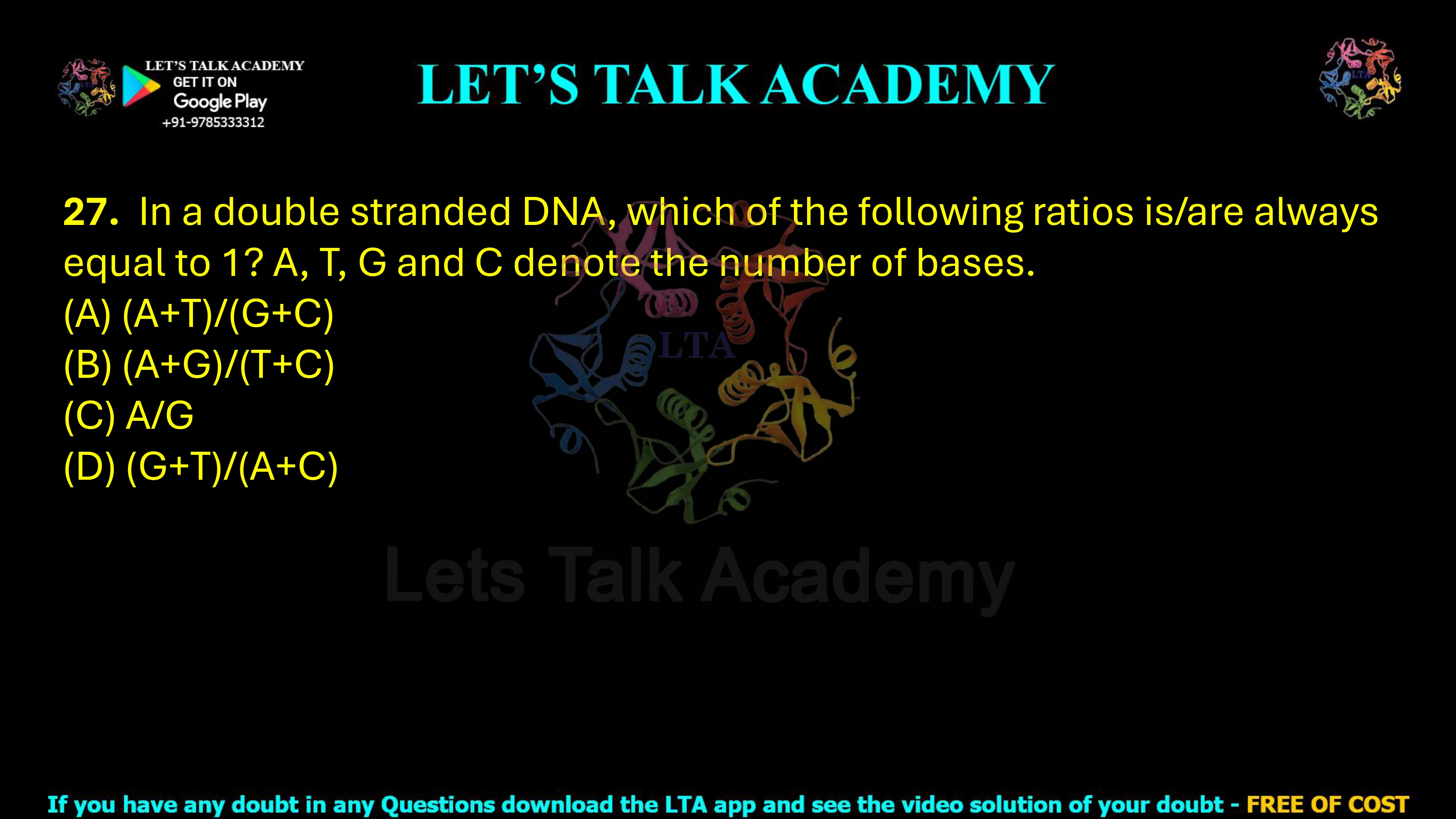
27. In a double stranded DNA, which of the following ratios is/are always equal to 1? A, T, G and C denote the number of bases.
(A) (A+T)/(G+C)
(B) (A+G)/(T+C)
(C) A/G
(D) (G+T)/(A+C)
Which Base Ratios Are Always Equal to 1 in Double-Stranded DNA?
Understanding the Correct Answer
The correct statements are (B) and (D). To solve this question correctly, we must apply Chargaff’s rules for double-stranded DNA. According to complementary base pairing, adenine pairs with thymine and guanine pairs with cytosine. Therefore, in a complete double-stranded DNA molecule, the total number of adenine bases is equal to the total number of thymine bases, while the total number of guanine bases is equal to the total number of cytosine bases.
The two fundamental relationships are:
A = T
G = C
These equalities allow us to test each ratio mathematically. The ratio (A + G)/(T + C) is always equal to 1 because A = T and G = C. Similarly, the ratio (G + T)/(A + C) is also always equal to 1 because G = C and T = A.
In contrast, the ratio (A + T)/(G + C) depends on the AT and GC composition of a particular DNA molecule, while A/G depends on the relative abundance of adenine and guanine. Therefore, these two ratios are not necessarily equal to 1.
What Is Chargaff’s Rule in Double-Stranded DNA?
Chargaff’s rule describes the relationship among the four nitrogenous bases in double-stranded DNA. The four bases are adenine (A), thymine (T), guanine (G) and cytosine (C). Because the two DNA strands are complementary, each adenine on one strand pairs with a thymine on the opposite strand, while each guanine pairs with a cytosine.
As a result, the total number of adenine residues in the complete double-stranded DNA molecule must equal the total number of thymine residues. Similarly, the total number of guanine residues must equal the total number of cytosine residues.
Therefore:
A = T and G = C
From these relationships, another important conclusion can be derived. Adenine and guanine are purines, whereas thymine and cytosine are pyrimidines. Because every base pair contains one purine and one pyrimidine, the total number of purines is always equal to the total number of pyrimidines in double-stranded DNA.
Therefore:
A + G = T + C
Hence:
(A + G)/(T + C) = 1
Why Are Purines and Pyrimidines Equal in Double-Stranded DNA?
The structure of double-stranded DNA is based on specific complementary base pairing. Adenine, which is a purine, pairs with thymine, which is a pyrimidine. Guanine, another purine, pairs with cytosine, another pyrimidine.
Therefore, every base pair contains exactly one purine and one pyrimidine. An A–T base pair contains the purine adenine and the pyrimidine thymine, while a G–C base pair contains the purine guanine and the pyrimidine cytosine.
This means that regardless of the actual nucleotide composition of the DNA molecule, the total number of purines must always equal the total number of pyrimidines.
Thus:
Total purines = A + G
Total pyrimidines = T + C
Since total purines equal total pyrimidines:
A + G = T + C
Therefore:
(A + G)/(T + C) = 1
This directly proves that option (B) is correct.
Mathematical Relationships Among DNA Bases
For any complete double-stranded DNA molecule, we begin with the two fundamental equations:
A = T
G = C
These relationships can be rearranged and combined in several ways. For example, adding A and G on one side and their respective complementary bases T and C on the other side gives:
A + G = T + C
Therefore:
(A + G)/(T + C) = 1
We can also combine G with T. Since G = C and T = A:
G + T = C + A
Because addition is commutative:
C + A = A + C
Therefore:
G + T = A + C
Hence:
(G + T)/(A + C) = 1
This proves that both option (B) and option (D) are always equal to 1.
Detailed Explanation of Each Option
Option (A): (A + T)/(G + C)
Option (A) is incorrect. The numerator represents the total number of adenine and thymine bases, commonly called the AT content. The denominator represents the total number of guanine and cytosine bases, commonly called the GC content.
Chargaff’s rule tells us that A = T and G = C, but it does not state that the total number of A + T bases must equal the total number of G + C bases. Different DNA molecules can have very different AT and GC compositions.
For example, consider a double-stranded DNA molecule in which:
A = 30, T = 30, G = 20 and C = 20
Then:
(A + T)/(G + C) = (30 + 30)/(20 + 20)
= 60/40 = 1.5
The ratio is 1.5, not 1. Therefore, the ratio depends on the base composition of the DNA molecule and is not always equal to 1.
Hence, option (A) is incorrect.
Option (B): (A + G)/(T + C)
Option (B) is correct. Adenine and guanine are purines, while thymine and cytosine are pyrimidines. Every base pair in double-stranded DNA contains one purine and one pyrimidine.
According to Chargaff’s rule:
A = T and G = C
Therefore:
A + G = T + C
Dividing two equal quantities gives:
(A + G)/(T + C) = 1
This relationship is always valid for a complete double-stranded DNA molecule, regardless of whether the DNA is AT-rich or GC-rich.
Hence, option (B) is correct.
Option (C): A/G
Option (C) is incorrect. Chargaff’s rule establishes equality between complementary bases. Adenine is complementary to thymine, so A = T. Guanine is complementary to cytosine, so G = C.
However, there is no universal rule stating that adenine must equal guanine. Therefore, the ratio A/G can have different values depending on the nucleotide composition of the DNA molecule.
Using the same example:
A = 30 and G = 20
Then:
A/G = 30/20 = 1.5
In another DNA molecule, A and G may happen to be equal, giving a ratio of 1, but this would be a property of that particular DNA sample rather than a universal rule.
Hence, option (C) is incorrect.
Option (D): (G + T)/(A + C)
Option (D) is correct. This ratio may initially appear less obvious than option (B), but it can be proved directly using Chargaff’s rule.
We know that:
G = C
and:
T = A
Therefore, replacing G with C and T with A gives:
G + T = C + A
Since:
C + A = A + C
we obtain:
G + T = A + C
Therefore:
(G + T)/(A + C) = 1
This equality is always valid for complete double-stranded DNA.
Hence, option (D) is correct.
Numerical Verification of All Four Options
Consider a double-stranded DNA molecule with the following base composition:
A = 30, T = 30, G = 20 and C = 20
This composition follows Chargaff’s rule because A = T and G = C.
Calculation for Option (A)
(A + T)/(G + C) = (30 + 30)/(20 + 20) = 60/40 = 1.5
Therefore, option (A) is not always equal to 1.
Calculation for Option (B)
(A + G)/(T + C) = (30 + 20)/(30 + 20) = 50/50 = 1
Therefore, option (B) is always equal to 1.
Calculation for Option (C)
A/G = 30/20 = 1.5
Therefore, option (C) is not always equal to 1.
Calculation for Option (D)
(G + T)/(A + C) = (20 + 30)/(30 + 20) = 50/50 = 1
Therefore, option (D) is always equal to 1.
Why Is the AT-to-GC Ratio Not Always Equal to 1?
One of the most important concepts in DNA base composition is that Chargaff’s rule does not require all four bases to be present in equal amounts. The rule only requires adenine to equal thymine and guanine to equal cytosine.
A DNA molecule can therefore contain 40% adenine and 40% thymine, with only 10% guanine and 10% cytosine. Such a molecule is highly AT-rich but still perfectly follows Chargaff’s rule.
Similarly, another DNA molecule can contain 10% adenine, 10% thymine, 40% guanine and 40% cytosine. This molecule is GC-rich and also follows Chargaff’s rule.
Therefore, the ratio (A + T)/(G + C) can be greater than 1, less than 1 or equal to 1 depending on the DNA sequence. It is not a universally fixed ratio.
Why Is the A/G Ratio Variable?
Adenine and guanine both belong to the purine group, but they do not pair with each other. Adenine pairs with thymine, whereas guanine pairs with cytosine. Therefore, complementary base pairing does not impose any direct equality between A and G.
A particular DNA molecule may contain more adenine than guanine, more guanine than adenine or equal amounts of both. As a result, the A/G ratio is determined by the actual sequence and base composition of the DNA molecule.
Thus, A/G is not a fixed ratio in double-stranded DNA and cannot be assumed to equal 1.
Important Base Relationships in Double-Stranded DNA
For a complete double-stranded DNA molecule, the most important universally valid relationships are based on complementary base pairing.
A = T because adenine pairs with thymine.
G = C because guanine pairs with cytosine.
A + G = T + C because the total number of purines equals the total number of pyrimidines.
G + T = A + C because G = C and T = A.
Therefore:
(A + G)/(T + C) = 1
and:
(G + T)/(A + C) = 1
These relationships directly identify options (B) and (D) as the correct answers.
Does Chargaff’s Rule Apply to Single-Stranded DNA?
The equalities A = T and G = C are guaranteed for a complete double-stranded DNA molecule because every base on one strand has a complementary partner on the opposite strand.
In a single DNA strand considered separately, the number of adenine bases does not necessarily equal the number of thymine bases, and the number of guanine bases does not necessarily equal the number of cytosine bases.
This is why the wording of the question is important. The question specifically refers to double-stranded DNA, allowing Chargaff’s base-pairing relationships to be applied directly.
Final Answer
Correct Answer: (B) and (D)
In double-stranded DNA, complementary base pairing ensures that A = T and G = C. Therefore, the total number of purines equals the total number of pyrimidines:
A + G = T + C
Hence:
(A + G)/(T + C) = 1
Similarly, because G = C and T = A:
G + T = A + C
Hence:
(G + T)/(A + C) = 1
The ratio (A + T)/(G + C) depends on the AT and GC content of the DNA, while A/G depends on the relative abundance of adenine and guanine. Therefore, these ratios are not always equal to 1.
Final Answer: (B) and (D)


