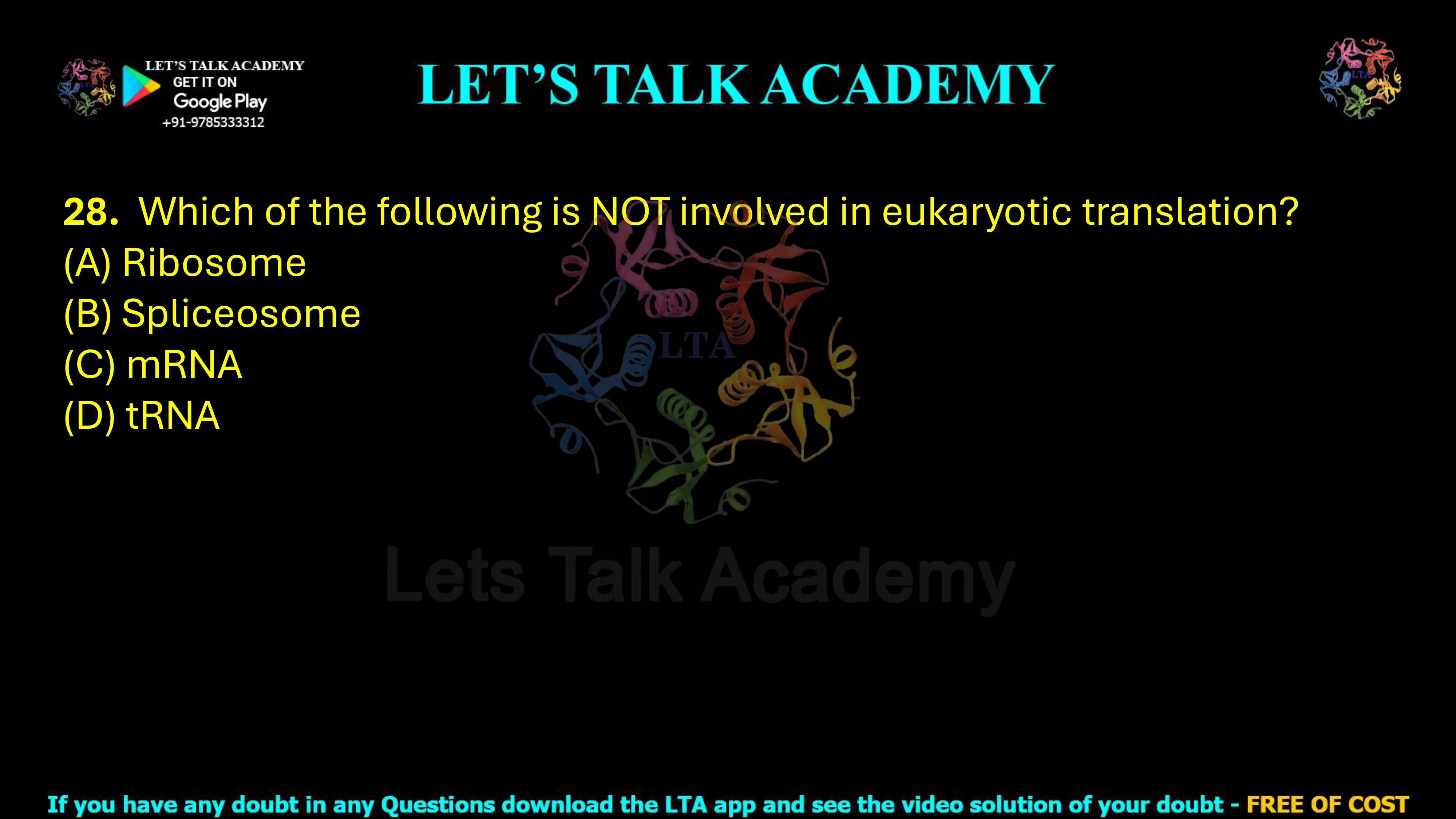
28. Which of the following is NOT involved in eukaryotic translation?
(A) Ribosome
(B) Spliceosome
(C) mRNA
(D) tRNA
Which Component Is Not Involved in Eukaryotic Translation?
Understanding Eukaryotic Translation
Eukaryotic translation is the biological process through which the nucleotide sequence present in messenger RNA, or mRNA, is decoded to synthesize a specific protein. This process occurs mainly on ribosomes located freely in the cytoplasm or attached to the cytosolic surface of the rough endoplasmic reticulum. Translation is one of the central steps of gene expression and converts genetic information from the language of nucleotides into the language of amino acids.
The process of translation requires the coordinated activity of several essential components. These include the ribosome, mRNA, transfer RNA or tRNA, amino acids, aminoacyl-tRNA synthetases, and multiple initiation, elongation, and termination factors. Each component performs a specific role to ensure that the amino acid sequence of the newly synthesized protein corresponds accurately to the codon sequence present in the mRNA.
Among the four components listed in the question, the ribosome, mRNA, and tRNA are directly involved in translation. The spliceosome, however, functions primarily in the processing of precursor mRNA inside the nucleus and is not a component of the eukaryotic translation machinery. Therefore, the correct answer is the spliceosome.
How Does Eukaryotic Translation Produce a Protein?
Before translation begins, genetic information stored in DNA is transcribed into precursor messenger RNA, commonly called pre-mRNA. In eukaryotic cells, this initial RNA transcript generally undergoes several processing events, including 5′ capping, RNA splicing, and 3′ polyadenylation. After processing is completed, the mature mRNA is exported from the nucleus to the cytoplasm.
In the cytoplasm, the mature mRNA associates with ribosomal subunits and translation factors. The ribosome reads the mRNA sequence in groups of three nucleotides called codons. Each codon specifies a particular amino acid or provides a signal for the initiation or termination of protein synthesis.
Transfer RNA molecules act as adaptor molecules during this process. Each tRNA carries a specific amino acid and contains an anticodon that can base-pair with a complementary codon in the mRNA. The ribosome coordinates the interaction between the mRNA and aminoacyl-tRNAs and catalyzes the formation of peptide bonds between successive amino acids.
Thus, ribosomes, mRNA, and tRNA are all central participants in eukaryotic translation. The spliceosome acts earlier during RNA processing and does not directly participate in the decoding of mature mRNA into protein.
Major Stages of Eukaryotic Translation
Eukaryotic translation can be broadly divided into initiation, elongation, termination, and ribosome recycling. During initiation, the small ribosomal subunit is recruited to the mRNA and identifies the appropriate start codon. The initiator tRNA carrying methionine recognizes the start codon, and the large ribosomal subunit subsequently joins to form a functional ribosome.
During elongation, aminoacyl-tRNAs enter the ribosome according to the codon sequence of the mRNA. Correct codon-anticodon pairing ensures that the appropriate amino acid is added to the growing polypeptide chain. Peptide bonds are formed, and the ribosome moves progressively along the mRNA in the 5′ to 3′ direction.
Translation terminates when a stop codon enters the ribosomal decoding site. Because no tRNA has an anticodon complementary to a stop codon, protein release factors recognize the termination signal and promote the release of the completed polypeptide. The ribosomal components can then dissociate and participate in additional rounds of translation.
Why Is the Spliceosome Not Involved in Eukaryotic Translation?
The spliceosome is a large ribonucleoprotein complex involved in RNA processing rather than protein synthesis. Its primary function is to remove introns from pre-mRNA and join the remaining exons together to generate a mature mRNA molecule.
Most eukaryotic genes contain coding or retained sequences called exons that are interrupted by non-retained sequences called introns. After transcription, the initial pre-mRNA contains both introns and exons. Before this RNA can serve as an appropriate template for protein synthesis, many transcripts must undergo splicing.
The spliceosome carries out this splicing process. It is composed of small nuclear ribonucleoprotein particles, commonly called snRNPs, together with numerous associated proteins. Major spliceosomal snRNPs include U1, U2, U4, U5, and U6. These components recognize important sequences in the pre-mRNA and catalyze the removal of introns.
Once splicing and other processing events are completed, mature mRNA can be exported to the cytoplasm and used for translation. Therefore, the spliceosome contributes to the production of mature mRNA but does not directly participate in the translation process itself.
Detailed Analysis of Option (A)
(A) Ribosome
This option is incorrect because the ribosome is directly and essentially involved in eukaryotic translation. The ribosome is the molecular machinery responsible for reading the codon sequence of mRNA and synthesizing the corresponding polypeptide chain.
Eukaryotic cytoplasmic ribosomes are 80S ribosomes composed of a small 40S subunit and a large 60S subunit. The 40S subunit participates mainly in mRNA binding and decoding, whereas the 60S subunit contains the catalytic center responsible for peptide bond formation.
The ribosome provides specific sites for tRNA binding and coordinates the movement of tRNAs and mRNA during protein synthesis. The A site accepts incoming aminoacyl-tRNA, the P site holds the tRNA associated with the growing polypeptide chain, and the E site allows the deacylated tRNA to exit from the ribosome.
Without ribosomes, the genetic information present in mRNA cannot be translated into a protein. Therefore, the ribosome is unquestionably involved in eukaryotic translation.
Hence, option (A) is incorrect.
Detailed Analysis of Option (B)
(B) Spliceosome
This option is correct because the spliceosome is not a component of the eukaryotic translation machinery. Instead, it is involved primarily in pre-mRNA processing within the nucleus.
The spliceosome recognizes splice sites in pre-mRNA, removes introns, and joins exons to generate a continuous mature RNA sequence. This process occurs before the mature mRNA becomes available for translation.
Although RNA splicing is important for the proper expression of many eukaryotic genes, it is a separate process from translation. Translation requires a ribosome, an mRNA template, tRNAs, amino acids, and various translation factors. The spliceosome does not decode mRNA codons, carry amino acids, or catalyze peptide bond formation.
Therefore, among the given options, the spliceosome is the only component that is not directly involved in eukaryotic translation.
Hence, option (B) is the correct answer.
Detailed Analysis of Option (C)
(C) mRNA
This option is incorrect because mRNA is an essential component of eukaryotic translation. Messenger RNA carries the genetic information that determines the amino acid sequence of a protein.
The nucleotide sequence of mRNA is read by the ribosome in groups of three nucleotides called codons. Each codon corresponds to a particular amino acid or acts as a translational signal. The order of codons in the mRNA therefore determines the order of amino acids in the newly synthesized polypeptide.
In eukaryotes, mature mRNA generally contains important features such as a 5′ cap, untranslated regions, a protein-coding region, and a 3′ poly(A) tail. These features contribute to mRNA stability, localization, and efficient translation.
Because mRNA acts as the direct template for protein synthesis, translation cannot proceed without it.
Hence, option (C) is incorrect.
Detailed Analysis of Option (D)
(D) tRNA
This option is incorrect because tRNA is directly involved in eukaryotic translation. Transfer RNA functions as the molecular adaptor that connects the nucleotide language of mRNA with the amino acid language of proteins.
Each tRNA contains an anticodon that recognizes a complementary codon in the mRNA. At the opposite functional end of the molecule, the tRNA carries a specific amino acid. Aminoacyl-tRNA synthetases attach the correct amino acid to the corresponding tRNA before the charged tRNA participates in translation.
During translation, aminoacyl-tRNAs enter the ribosome and pair with the appropriate mRNA codons. The amino acids carried by these tRNAs are then incorporated into the growing polypeptide chain in the correct sequence.
Therefore, tRNA is an essential participant in the decoding process and is directly required for eukaryotic protein synthesis.
Hence, option (D) is incorrect.
Difference Between Splicing and Translation
Splicing and translation are two distinct stages of eukaryotic gene expression. Splicing is an RNA-processing event in which introns are removed from pre-mRNA and exons are joined together. The spliceosome performs this process primarily in the nucleus.
Translation, in contrast, is the process through which the information present in mature mRNA is decoded to synthesize a protein. It occurs on ribosomes and requires the direct participation of mRNA and tRNA.
This distinction explains the answer to the question. The ribosome performs protein synthesis, mRNA provides the genetic template, and tRNA delivers amino acids according to the codon sequence. The spliceosome performs RNA splicing before translation and is therefore not directly involved in eukaryotic translation.
Final Answer
Among the given options, the ribosome, mRNA, and tRNA are all directly involved in eukaryotic translation. The ribosome serves as the site of protein synthesis, mRNA provides the codon sequence that determines the amino acid order, and tRNA carries specific amino acids to the ribosome.
The spliceosome, however, functions in the processing of pre-mRNA by removing introns and joining exons. It acts during RNA splicing and is not a component of the eukaryotic translation machinery.
Correct Option: (B) Spliceosome


