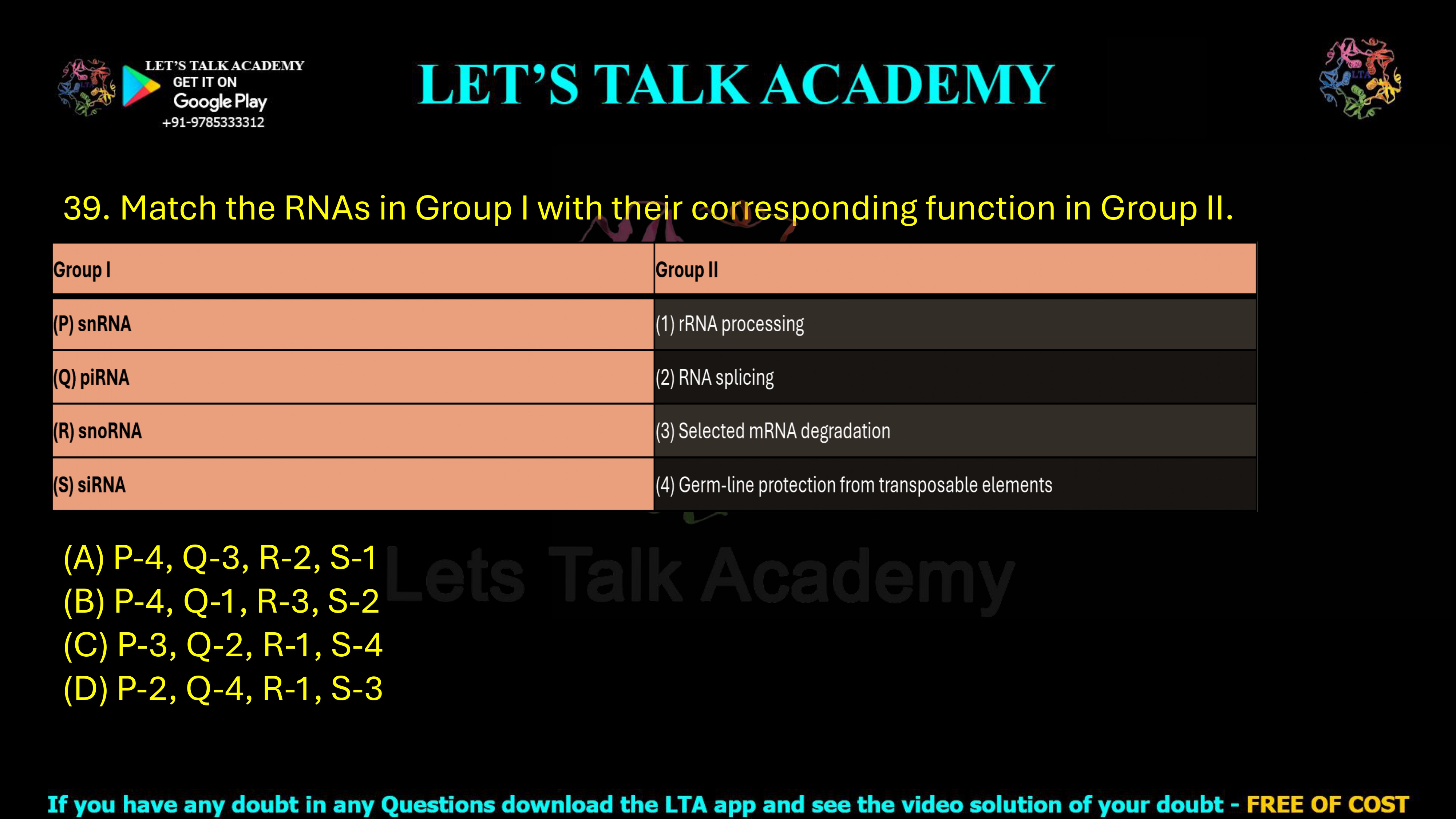
39. Match the RNAs in Group I with their corresponding function in Group II.
| Group I | Group II |
| (P) snRNA | (1) rRNA processing |
| (Q) piRNA | (2) RNA splicing |
| (R) snoRNA | (3) Selected mRNA degradation |
| (S) siRNA | (4) Germ-line protection from transposable elements |
(A) P-4, Q-3, R-2, S-1
(B) P-4, Q-1, R-3, S-2
(C) P-3, Q-2, R-1, S-4
(D) P-2, Q-4, R-1, S-3
Match snRNA, piRNA, snoRNA and siRNA with Their Correct Functions
Understanding the Functions of Small Non-Coding RNAs
Cells contain many RNA molecules that do not function as templates for protein synthesis. These non-coding RNAs perform essential roles in RNA processing, gene regulation, genome defense, chromosome organization, and several other cellular processes.
This question focuses on four important types of small non-coding RNA: small nuclear RNA (snRNA), PIWI-interacting RNA (piRNA), small nucleolar RNA (snoRNA), and small interfering RNA (siRNA). Although their names are similar, each RNA class performs a distinct biological function.
snRNA is primarily associated with RNA splicing. piRNA is strongly associated with protection of the germ line from transposable elements. snoRNA participates mainly in rRNA processing and modification. siRNA guides sequence-specific degradation of selected complementary mRNAs.
Therefore, the correct matching is P-2, Q-4, R-1, S-3, making option (D) the correct answer.
snRNA and RNA Splicing
Why Is snRNA Matched with RNA Splicing?
Small nuclear RNAs, commonly abbreviated as snRNAs, are short non-coding RNA molecules found mainly in the nucleus of eukaryotic cells. Their best-known function is participation in the removal of introns from precursor messenger RNA, or pre-mRNA.
Most eukaryotic protein-coding genes contain exons interrupted by introns. After transcription, the initial pre-mRNA contains both types of sequences. Before the RNA can function as a mature template for translation, many introns must be removed and the exons must be joined together.
snRNAs associate with specific proteins to form small nuclear ribonucleoprotein particles called snRNPs. Major spliceosomal snRNPs contain U1, U2, U4, U5, and U6 snRNAs.
These snRNPs assemble with additional proteins to form the spliceosome. Different snRNAs participate in recognizing splice sites, positioning reactive RNA sequences, and facilitating the catalytic rearrangements required for intron removal.
Therefore, the major function associated with snRNA in this question is RNA splicing.
Thus, snRNA matches with RNA splicing: P-2.
piRNA and Germ-Line Protection from Transposable Elements
Why Is piRNA Matched with Germ-Line Protection?
PIWI-interacting RNAs, abbreviated as piRNAs, are small non-coding RNAs that interact with proteins belonging to the PIWI subfamily of Argonaute proteins. They are especially important in animal germ-line cells.
One of the major functions of the piRNA pathway is to suppress transposable elements. Transposable elements are mobile genetic sequences capable of moving or generating new copies within the genome.
Uncontrolled transposon activity can cause DNA damage, insertional mutations, chromosome rearrangements, and genomic instability. Such damage is particularly dangerous in germ-line cells because genetic alterations in these cells can potentially be transmitted to the next generation.
piRNAs guide PIWI proteins toward transposon-derived sequences. The piRNA pathway can suppress transposable elements through post-transcriptional mechanisms, including cleavage of transposon RNAs, and through transcriptional silencing mechanisms that reduce transposon expression.
Therefore, piRNAs function as an important genome-defense system that helps preserve the integrity of germ-line genomes.
Thus, piRNA matches with germ-line protection from transposable elements: Q-4.
snoRNA and rRNA Processing
Why Is snoRNA Matched with rRNA Processing?
Small nucleolar RNAs, commonly abbreviated as snoRNAs, are non-coding RNA molecules located mainly in the nucleolus. The nucleolus is the major nuclear region involved in ribosomal RNA synthesis, processing, modification, and ribosome assembly.
Many snoRNAs guide the processing and chemical modification of precursor rRNA molecules. They recognize specific sequences in pre-rRNA through complementary base pairing and help direct modification enzymes to precise nucleotide positions.
Two major classes of snoRNAs are the C/D box snoRNAs and H/ACA box snoRNAs. C/D box snoRNAs are mainly associated with 2′-O-methylation of ribose residues, whereas H/ACA box snoRNAs guide the conversion of uridine residues into pseudouridine.
These modifications contribute to the proper folding, stability, and functional maturation of ribosomal RNA. Some snoRNAs also participate directly in cleavage and processing events required to produce mature rRNA molecules.
Therefore, the function associated with snoRNA in this question is rRNA processing.
Thus, snoRNA matches with rRNA processing: R-1.
siRNA and Selected mRNA Degradation
Why Is siRNA Matched with Selected mRNA Degradation?
Small interfering RNAs, abbreviated as siRNAs, are short RNA molecules that participate in RNA interference, commonly called RNAi. One of their major functions is sequence-specific silencing of gene expression.
siRNAs are commonly generated from double-stranded RNA precursors. An RNase III-family enzyme called Dicer processes long double-stranded RNA into short RNA duplexes.
One strand of the siRNA duplex becomes associated with an Argonaute-containing RNA-induced silencing complex, commonly known as RISC. The siRNA strand guides the complex toward an RNA molecule containing a complementary nucleotide sequence.
When extensive complementarity exists between the siRNA and the target mRNA, Argonaute can promote cleavage of the target RNA. The cleaved RNA fragments are then degraded by cellular enzymes.
Because the siRNA sequence determines which complementary RNA is targeted, this process results in selected or sequence-specific mRNA degradation.
Thus, siRNA matches with selected mRNA degradation: S-3.
Complete Correct Matching of RNA Types and Functions
The four RNA classes can now be matched according to their major biological functions. snRNA participates in RNA splicing as a component of spliceosomal snRNPs. piRNA interacts with PIWI proteins and protects the germ line from transposable elements.
snoRNA functions mainly in rRNA processing and modification within the nucleolus. siRNA participates in RNA interference and can guide the sequence-specific degradation of selected complementary mRNAs.
Therefore, the complete correct matching is P-2, Q-4, R-1, S-3.
Detailed Analysis of Option (A)
(A) P-4, Q-3, R-2, S-1
This option is incorrect because all four RNA molecules are assigned to the wrong functions.
snRNA is not primarily responsible for germ-line protection from transposable elements; that function belongs to piRNA. piRNA is not mainly associated with selected mRNA degradation in the context of this question; sequence-specific mRNA degradation is associated with siRNA.
snoRNA is not a major component of the spliceosome. RNA splicing is associated with snRNA. Similarly, siRNA is not primarily responsible for rRNA processing; that function belongs to snoRNA.
Hence, option (A) is incorrect.
Detailed Analysis of Option (B)
(B) P-4, Q-1, R-3, S-2
This option is incorrect because none of the four matches correctly represents the principal functions of these RNA classes.
snRNA should be matched with RNA splicing rather than germ-line protection. piRNA should be matched with protection from transposable elements rather than rRNA processing.
snoRNA should be matched with rRNA processing rather than selected mRNA degradation. siRNA should be matched with selected mRNA degradation rather than RNA splicing.
Hence, option (B) is incorrect.
Detailed Analysis of Option (C)
(C) P-3, Q-2, R-1, S-4
This option is incorrect because only the match R-1 is correct. snoRNA is correctly associated with rRNA processing.
However, snRNA should be matched with RNA splicing, not selected mRNA degradation. piRNA should be matched with germ-line protection from transposable elements, not RNA splicing.
Similarly, siRNA should be matched with selected mRNA degradation, not germ-line protection from transposable elements.
Therefore, although one pair is correct, the overall matching is incorrect.
Hence, option (C) is incorrect.
Detailed Analysis of Option (D)
(D) P-2, Q-4, R-1, S-3
This option is correct because every RNA type is matched with its appropriate major biological function.
snRNA is matched with RNA splicing because snRNAs form essential components of the spliceosome. piRNA is matched with germ-line protection from transposable elements because the PIWI–piRNA pathway suppresses mobile genetic elements.
snoRNA is matched with rRNA processing because snoRNAs guide the processing and modification of ribosomal RNA. siRNA is matched with selected mRNA degradation because siRNA guides sequence-specific RNA silencing through RNA interference.
Therefore, P-2, Q-4, R-1, S-3 is the completely correct matching.
Hence, option (D) is the correct answer.
How These Small RNAs Differ in Cellular Function
Although snRNA, piRNA, snoRNA, and siRNA are all non-coding RNAs, they function in different cellular locations and molecular pathways. snRNAs act mainly in the nucleus as components of the RNA-splicing machinery.
snoRNAs are concentrated primarily in the nucleolus, where they participate in rRNA maturation and modification. piRNAs are strongly associated with PIWI proteins and are particularly important in protecting animal germ-line genomes from transposable elements.
siRNAs function in RNA interference pathways and use sequence complementarity to guide silencing complexes toward selected RNA targets. These differences demonstrate the functional diversity of non-coding RNAs in gene expression and genome regulation.
Final Answer
snRNA participates in RNA splicing as an essential component of the spliceosome. piRNA protects the germ line from transposable elements through the PIWI–piRNA genome-defense pathway.
snoRNA participates mainly in rRNA processing and modification within the nucleolus, while siRNA guides sequence-specific degradation of selected complementary mRNAs through RNA interference.
Therefore, the correct matching is P-2, Q-4, R-1, S-3.
Correct Option: (D)


