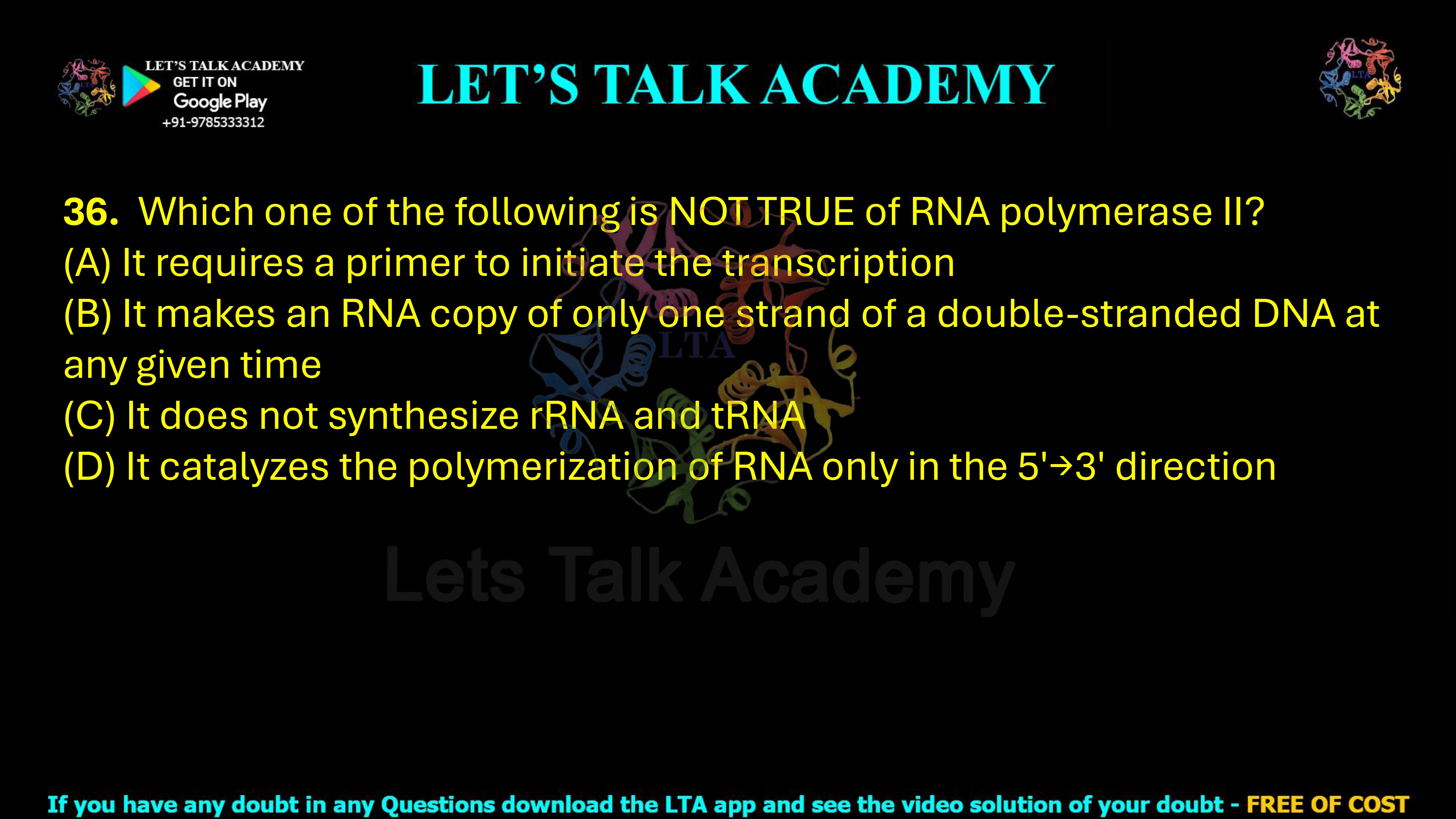
36. Which one of the following is NOT TRUE of RNA polymerase II?
(A) It requires a primer to initiate the transcription
(B) It makes an RNA copy of only one strand of a double-stranded DNA at any given time
(C) It does not synthesize rRNA and tRNA
(D) It catalyzes the polymerization of RNA only in the 5’→3′ direction
Which Statement Is Not True of RNA Polymerase II?
Understanding the Correct Answer
The statement that is NOT TRUE of RNA polymerase II is option (A): “It requires a primer to initiate the transcription.” RNA polymerase II does not require a pre-existing primer to begin RNA synthesis. Like other cellular DNA-dependent RNA polymerases, it can initiate the synthesis of a new RNA molecule de novo.
During transcription initiation, RNA polymerase II is recruited to the promoter with the help of general transcription factors. The DNA is locally unwound, and the polymerase begins joining ribonucleotides complementary to the DNA template strand. The first phosphodiester bond can be formed without a pre-existing RNA or DNA primer.
This property creates an important distinction between RNA polymerases and the major replicative DNA polymerases. DNA polymerases generally require a primer containing a free 3′-OH group before they can extend a nucleic acid chain. RNA polymerase II, in contrast, can start a new RNA chain directly.
Therefore, the claim that RNA polymerase II requires a primer to initiate transcription is false, making option (A) the correct answer to this “NOT TRUE” question.
What Is RNA Polymerase II?
RNA polymerase II, commonly abbreviated as RNA Pol II or Pol II, is one of the major nuclear DNA-dependent RNA polymerases of eukaryotic cells. Its best-known function is the transcription of protein-coding genes to produce precursor messenger RNA, or pre-mRNA.
The initial pre-mRNA transcript can subsequently undergo processing steps such as 5′ capping, RNA splicing and 3′-end processing with polyadenylation. The mature mRNA can then be exported from the nucleus and translated by ribosomes in the cytoplasm.
RNA polymerase II also transcribes several classes of non-coding RNA. However, in the standard functional division of the three major eukaryotic nuclear RNA polymerases, Pol II is primarily associated with pre-mRNA synthesis, whereas RNA polymerase I is mainly responsible for synthesis of the large ribosomal RNA precursor and RNA polymerase III synthesizes tRNAs and 5S rRNA.
Understanding the properties of RNA polymerase II is essential for studying eukaryotic transcription, gene regulation and the flow of genetic information from DNA to RNA.
Why Does RNA Polymerase II Not Require a Primer?
RNA polymerase II can initiate RNA synthesis de novo, meaning that it can begin a completely new RNA chain without extending a previously existing nucleic acid molecule.
During transcription initiation, the polymerase uses the DNA template strand to position the first ribonucleoside triphosphates. The first nucleotide retains its 5′ triphosphate group, and the enzyme forms the first phosphodiester bond between the initiating nucleotides.
No pre-existing primer is needed to provide a free 3′-OH group before the first bond is formed. Once initiation has occurred, the 3′-OH group of the growing RNA chain attacks the α-phosphate of the next incoming ribonucleoside triphosphate, extending the RNA molecule one nucleotide at a time.
Thus, primer independence is a fundamental feature of RNA polymerase II and transcription in general.
How Does RNA Polymerase II Initiate Transcription?
Recognition of the Promoter Region
RNA polymerase II generally does not recognize and initiate transcription from a eukaryotic promoter entirely by itself. General transcription factors help identify the promoter and assemble the transcription machinery.
These factors form a pre-initiation complex together with RNA polymerase II at or near the transcription start site. Depending on the promoter, DNA elements such as the TATA box and other core promoter sequences can contribute to correct positioning of the transcription machinery.
Local Opening of the DNA Double Helix
After the transcription machinery has assembled, a small region of DNA is locally unwound. This exposes the bases of the template strand and creates a transcription bubble.
The exposed DNA template allows incoming ribonucleotides to pair with complementary bases according to normal base-pairing rules.
De Novo Formation of the RNA Chain
RNA polymerase II then begins synthesizing RNA without using a primer. The first nucleotides are joined together directly, and the newly formed RNA chain is extended from its 3′ end.
This primer-independent initiation is why option (A) is the statement that is not true of RNA polymerase II.
RNA Polymerase II and the DNA Template Strand
Double-stranded DNA contains two antiparallel strands, but RNA polymerase II does not copy both strands simultaneously for a single transcription unit. At a particular gene, only one DNA strand serves as the template strand for synthesis of the RNA transcript.
The polymerase reads the template strand in the 3′→5′ direction. The complementary RNA molecule is synthesized in the opposite direction, which is 5′→3′.
The other DNA strand is often called the coding strand or non-template strand. Its nucleotide sequence resembles that of the RNA transcript, except that DNA contains thymine whereas RNA contains uracil.
Therefore, statement (B), which says that RNA polymerase II makes an RNA copy of only one strand of double-stranded DNA at a given transcription unit, is true.
Template Strand and Coding Strand Explained
The Template Strand
The template strand is the DNA strand directly read by RNA polymerase II. The enzyme moves along this strand in the 3′→5′ direction and synthesizes a complementary RNA molecule in the 5′→3′ direction.
For example, if a segment of the DNA template strand is:
3′-TACGGA-5′
The corresponding RNA sequence will be:
5′-AUGCCU-3′
The Coding Strand
The coding strand is not used as the template for that particular RNA transcript. Its sequence is similar to the sequence of the RNA molecule, with one important difference: thymine is present in DNA, whereas uracil is present in RNA.
For the example above, the coding DNA strand would be:
5′-ATGCCT-3′
The corresponding RNA is:
5′-AUGCCU-3′
This illustrates why only one of the two DNA strands is copied for a given transcription unit.
Why Is RNA Synthesized Only in the 5′→3′ Direction?
RNA polymerase II catalyzes the addition of each new ribonucleotide to the 3′-OH end of the growing RNA chain. Because nucleotides are added only to the 3′ end, the RNA molecule necessarily grows in the 5′→3′ direction.
The incoming substrates are ribonucleoside triphosphates: ATP, GTP, CTP and UTP. The 3′-OH group of the terminal nucleotide in the growing RNA chain participates in the formation of a new phosphodiester bond with the incoming nucleotide.
As a consequence, the RNA chain becomes progressively longer at its 3′ end. There is no normal 3′→5′ mode of RNA chain polymerization by RNA polymerase II.
Therefore, statement (D) is a true property of RNA polymerase II.
Relationship Between Template Reading and RNA Synthesis Direction
The two nucleic acid strands involved in transcription are antiparallel. Since RNA polymerase II synthesizes RNA in the 5′→3′ direction, it must read the DNA template in the opposite 3′→5′ direction.
The relationship can be summarized as follows:
DNA template is read: 3′→5′
RNA is synthesized: 5′→3′
This directional relationship is essential for accurate complementary base pairing during transcription.
Functions of the Major Eukaryotic RNA Polymerases
RNA Polymerase I
RNA polymerase I is mainly responsible for synthesizing the large precursor rRNA that is processed to generate the major 18S, 5.8S and 28S ribosomal RNAs in eukaryotic cells.
These rRNAs form major structural and catalytic components of eukaryotic ribosomes.
RNA Polymerase II
RNA polymerase II is primarily responsible for synthesizing pre-mRNAs from protein-coding genes. It also transcribes several classes of regulatory and non-coding RNAs.
In the standard textbook classification, RNA polymerase II is not responsible for the synthesis of the major rRNAs or tRNAs.
RNA Polymerase III
RNA polymerase III transcribes tRNA genes, 5S rRNA and several other small RNA genes.
Thus, the three major eukaryotic nuclear RNA polymerases have distinct but sometimes broader and more complex transcriptional responsibilities.
Detailed Explanation of Each Option
Option (A): It Requires a Primer to Initiate the Transcription
Option (A) is NOT TRUE and is therefore the correct answer. RNA polymerase II does not require a primer to initiate RNA synthesis. It can begin transcription de novo by joining the first ribonucleotides directly.
A primer is a pre-existing nucleic acid segment that provides a free 3′-OH group for chain extension. The major replicative DNA polymerases require such a primer because they cannot normally initiate a new DNA strand from nothing.
RNA polymerase II is different. Although it requires promoter-associated transcription machinery for proper initiation, it does not require a pre-existing RNA or DNA primer.
Therefore, the statement that RNA polymerase II requires a primer is false.
Hence, option (A) is the correct answer to the question.
Option (B): It Makes an RNA Copy of Only One Strand of a Double-Stranded DNA at Any Given Time
Option (B) is true. For a particular transcription unit, only one of the two DNA strands serves as the template for the synthesis of a given RNA molecule.
RNA polymerase II reads the selected template strand in the 3′→5′ direction and synthesizes a complementary RNA strand in the 5′→3′ direction.
The opposite DNA strand is not simultaneously copied into the same RNA transcript. Therefore, the statement correctly describes the transcription process.
Hence, option (B) is true and is not the answer.
Option (C): It Does Not Synthesize rRNA and tRNA
Option (C) is considered true in the standard textbook classification of eukaryotic RNA polymerases. RNA polymerase II primarily synthesizes pre-mRNA and several other non-coding RNAs, whereas the major rRNAs and tRNAs are assigned to other nuclear RNA polymerases.
RNA polymerase I synthesizes the large precursor that gives rise to the major 18S, 5.8S and 28S rRNAs. RNA polymerase III synthesizes tRNAs and 5S rRNA.
Therefore, RNA polymerase II is not regarded as the enzyme responsible for synthesis of the major rRNAs and tRNAs in the conventional classification used for this question.
Hence, option (C) is true and is not the answer.
Option (D): It Catalyzes the Polymerization of RNA Only in the 5′→3′ Direction
Option (D) is true. RNA polymerase II extends an RNA molecule by adding incoming ribonucleotides to the 3′ end of the growing chain.
Because each new nucleotide is added to the 3′-OH group, the RNA chain grows only in the 5′→3′ direction. Correspondingly, the DNA template is read in the 3′→5′ direction.
This directional synthesis is a fundamental property of RNA polymerase II and nucleic acid polymerization.
Hence, option (D) is true and is not the answer.
Difference Between RNA Polymerase and DNA Polymerase
The key concept tested by this question is the difference between transcription and DNA replication. Both RNA polymerase and DNA polymerase use a DNA template and synthesize nucleic acid in the 5′→3′ direction, but their initiation requirements are different.
RNA polymerase can initiate a new RNA molecule de novo. It does not require a pre-existing primer. DNA polymerases, in contrast, generally extend an already existing primer containing a free 3′-OH group.
Therefore:
RNA polymerase II → No primer required
Major replicative DNA polymerases → Primer required
This distinction directly identifies option (A) as the false statement.
Does RNA Polymerase II Need Anything to Start Transcription?
Saying that RNA polymerase II does not require a primer does not mean that it can initiate transcription without any supporting factors. Primer requirement and transcription-factor requirement are completely different concepts.
RNA polymerase II requires the proper assembly of transcription machinery at a promoter. General transcription factors help recruit and position the polymerase, promote formation of the transcription initiation complex and assist in the transition to productive RNA synthesis.
However, none of these proteins functions as a nucleic acid primer. The RNA chain itself is still initiated de novo.
Therefore, RNA polymerase II requires appropriate transcriptional machinery but does not require a primer.
Why the Phrase “NOT TRUE” Is Important
The wording of the question is crucial because three of the statements describe valid properties of RNA polymerase II, while one statement is false.
Statement (B) is true because one DNA strand serves as the template for a particular RNA transcript. Statement (C) is true in the standard textbook division of labor among the major eukaryotic RNA polymerases. Statement (D) is true because RNA is synthesized only in the 5′→3′ direction.
Statement (A) is false because RNA polymerase II initiates RNA synthesis de novo and does not need a primer.
Therefore, the word “NOT” makes option (A) the correct choice.
Final Answer
Correct Answer: (A) It requires a primer to initiate the transcription
RNA polymerase II does not require a primer to begin transcription. It can initiate a new RNA chain de novo after the transcription machinery has assembled at the promoter.
For a given transcription unit, RNA polymerase II copies one DNA template strand, and it synthesizes the RNA molecule only in the 5′→3′ direction. In the standard classification of eukaryotic nuclear RNA polymerases, Pol II primarily synthesizes pre-mRNA, whereas the major rRNAs and tRNAs are synthesized by RNA polymerases I and III.
Therefore, the statement that is NOT TRUE of RNA polymerase II is:
Final Answer: (A) It requires a primer to initiate the transcription


