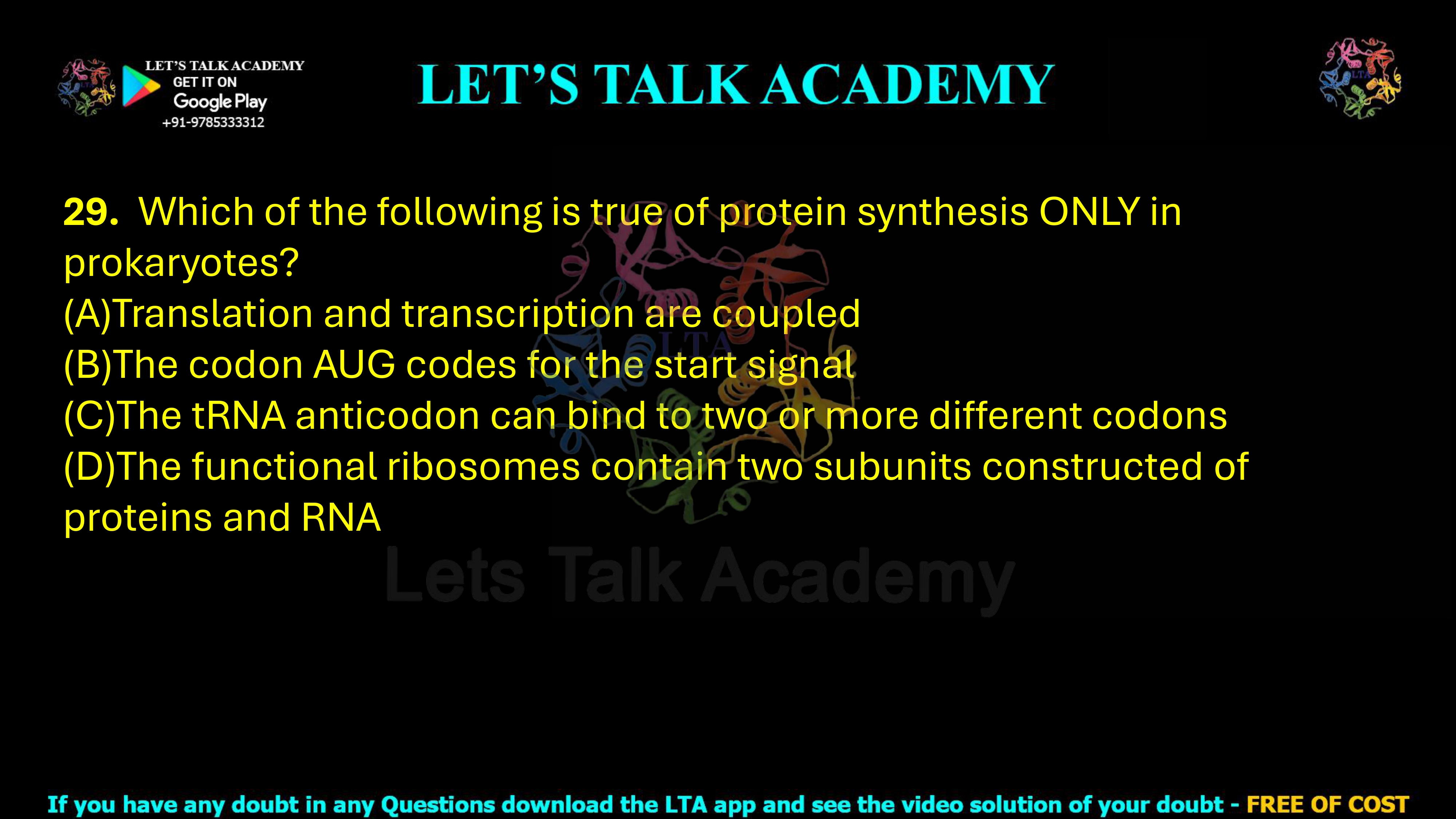
29. Which of the following is true of protein synthesis ONLY in prokaryotes?
(A)Translation and transcription are coupled
(B)The codon AUG codes for the start signal
(C)The tRNA anticodon can bind to two or more different codons
(D)The functional ribosomes contain two subunits constructed of proteins and RNA
Which Feature of Protein Synthesis Occurs Only in Prokaryotes?
Understanding the Correct Answer
The correct answer is (A) Translation and transcription are coupled. Among the four statements, this is the only feature that characteristically distinguishes prokaryotic gene expression from the conventional nuclear gene-expression pathway of eukaryotic cells.
In prokaryotes, there is no nuclear membrane separating the DNA from the cytoplasmic ribosomes. Transcription takes place in the cytoplasm or nucleoid region, and ribosomes can bind to the newly synthesized mRNA while RNA polymerase is still transcribing the same RNA molecule. As a result, translation can begin before transcription has been completed.
This simultaneous occurrence of transcription and translation on the same nascent mRNA is known as coupled transcription and translation or transcription-translation coupling.
The other three statements are not unique to prokaryotes. AUG functions as a common initiation codon in both prokaryotes and eukaryotes, wobble base pairing allows a tRNA to recognize more than one codon in both systems, and functional ribosomes in both groups contain two subunits composed of ribosomal RNA and proteins.
Therefore, only option (A) describes a feature specifically associated with prokaryotic protein synthesis.
What Is Coupled Transcription and Translation?
Coupled transcription and translation means that the synthesis of an mRNA molecule and the translation of that same mRNA can occur at the same time. This is a characteristic feature of prokaryotic cells.
During transcription, RNA polymerase moves along the DNA template and synthesizes an RNA molecule. As soon as a sufficient portion of the 5′ end of the mRNA emerges from RNA polymerase, a ribosome can bind to the mRNA and begin protein synthesis.
Therefore, while RNA polymerase continues synthesizing the downstream region of the mRNA, one or more ribosomes may already be translating the upstream region. The mRNA does not have to be completely synthesized before translation begins.
This close physical and functional relationship between RNA synthesis and protein synthesis allows prokaryotic cells to respond rapidly to changes in their environment.
Why Can Transcription and Translation Be Coupled in Prokaryotes?
The main reason for transcription-translation coupling is the absence of a membrane-bound nucleus in prokaryotic cells. The bacterial chromosome is located in the nucleoid region, but it is not enclosed by a nuclear envelope.
As a result, RNA polymerase and ribosomes operate within the same cellular compartment. The mRNA synthesized by RNA polymerase is immediately accessible to ribosomes.
A bacterial ribosome can therefore associate with the 5′ region of a nascent mRNA while the 3′ region of the same transcript is still being synthesized. Multiple ribosomes may also translate the mRNA simultaneously, forming a polyribosome or polysome.
This spatial organization makes direct coupling between transcription and translation possible in prokaryotes.
Why Are Transcription and Translation Not Normally Coupled in Eukaryotes?
In eukaryotic cells, transcription and cytoplasmic translation are spatially separated. Transcription of nuclear genes occurs inside the nucleus, whereas translation occurs mainly on ribosomes in the cytoplasm or on the cytosolic surface of the rough endoplasmic reticulum.
The nuclear envelope prevents cytoplasmic ribosomes from accessing an mRNA while it is being synthesized by RNA polymerase inside the nucleus. Therefore, a newly synthesized eukaryotic pre-mRNA cannot normally be translated immediately.
Before most eukaryotic mRNAs become available for cytoplasmic translation, they undergo several processing steps. These commonly include addition of the 5′ cap, removal of introns by RNA splicing and formation of the 3′ poly(A) tail.
The mature mRNA is then exported through nuclear pores into the cytoplasm, where ribosomes can initiate translation. Because transcription and translation occur in different cellular compartments, they are not directly coupled in the conventional eukaryotic nuclear gene-expression pathway.
Detailed Explanation of Each Option
Option (A): Translation and Transcription Are Coupled
Option (A) is correct. In prokaryotes, ribosomes can begin translating an mRNA molecule before RNA polymerase has completed its transcription. This is possible because prokaryotic cells lack a membrane-bound nucleus.
RNA polymerase synthesizes the mRNA, and as soon as the ribosome-binding region becomes available, a ribosome can associate with the transcript and initiate translation. Thus, transcription and translation occur simultaneously on the same RNA molecule.
This feature is known as transcription-translation coupling and is a characteristic property of prokaryotic gene expression.
Hence, option (A) is correct.
Option (B): The Codon AUG Codes for the Start Signal
Option (B) is not unique to prokaryotes. AUG is the most common translation initiation codon in both prokaryotic and eukaryotic cells.
In prokaryotes, the initiating AUG is recognized by an initiator tRNA carrying N-formylmethionine (fMet). In eukaryotic cytoplasmic translation, the initiating AUG is recognized by a specialized initiator tRNA carrying methionine (Met).
Therefore, although the chemical form of the initiating amino acid differs between the two systems, the use of AUG as a major start codon is shared by both prokaryotes and eukaryotes.
Because the question asks for a feature that occurs only in prokaryotes, option (B) is not the correct answer.
Hence, option (B) is incorrect.
Option (C): The tRNA Anticodon Can Bind to Two or More Different Codons
Option (C) is not unique to prokaryotes. A single tRNA can often recognize more than one synonymous codon because of flexibility in base pairing at the third position of the codon.
This phenomenon is explained by the wobble hypothesis. The first two positions of a codon usually follow strict Watson-Crick base-pairing rules, whereas the interaction involving the third codon position can be less restrictive.
As a result, one tRNA molecule may recognize multiple codons that specify the same amino acid. Wobble base pairing is a general feature of the genetic code and occurs in both prokaryotic and eukaryotic translation.
Therefore, this property cannot be used to identify a feature that occurs only in prokaryotes.
Hence, option (C) is incorrect.
Option (D): Functional Ribosomes Contain Two Subunits Constructed of Proteins and RNA
Option (D) is not unique to prokaryotes. Ribosomes in both prokaryotic and eukaryotic cells consist of two unequal subunits, and both types of ribosomes contain ribosomal RNA and proteins.
Prokaryotic cells typically contain 70S ribosomes composed of a 30S small subunit and a 50S large subunit. Eukaryotic cytoplasmic ribosomes are typically 80S ribosomes composed of a 40S small subunit and a 60S large subunit.
Although the sizes and molecular compositions of prokaryotic and eukaryotic ribosomes differ, the fundamental organization into two ribonucleoprotein subunits is shared by both groups.
Therefore, option (D) does not describe a feature found only in prokaryotes.
Hence, option (D) is incorrect.
How Does Coupled Gene Expression Occur Step by Step?
RNA Polymerase Begins Transcription
RNA polymerase first binds to a promoter region and begins synthesizing an RNA transcript using one DNA strand as the template. The RNA molecule grows in the 5′ to 3′ direction.
The Ribosome-Binding Region Becomes Available
As transcription proceeds, the 5′ region of the newly synthesized mRNA emerges from RNA polymerase. Once the ribosome-binding sequence and the translation initiation region become accessible, the bacterial translation machinery can interact with the transcript.
A Ribosome Begins Translation
The small ribosomal subunit binds to the mRNA, the initiator tRNA recognizes the start codon, and the complete ribosome assembles. Protein synthesis then begins even though RNA polymerase may still be transcribing the downstream portion of the gene.
Transcription and Translation Continue Simultaneously
RNA polymerase continues moving along the DNA and extending the mRNA, while the ribosome follows behind and translates the newly synthesized RNA sequence. Additional ribosomes may also bind to the same mRNA, allowing several protein molecules to be synthesized from a transcript.
This simultaneous activity is the molecular basis of coupled transcription and translation in prokaryotes.
Role of AUG in Prokaryotic and Eukaryotic Translation
The codon AUG is widely used as the translation initiation signal in both prokaryotic and eukaryotic cells. Therefore, the presence of AUG as a start codon cannot distinguish prokaryotic protein synthesis from eukaryotic protein synthesis.
The major difference lies in the initiator amino acid. In bacteria, the initiator tRNA carries N-formylmethionine, commonly abbreviated as fMet. In eukaryotic cytoplasmic translation, the initiator tRNA carries an unmodified methionine.
Thus, the statement that AUG serves as a start signal is true, but it is not true only for prokaryotes.
Understanding Wobble Base Pairing
The genetic code contains 64 codons, but cells do not require 61 completely different tRNAs to recognize all amino acid-specifying codons. This is possible because some tRNAs can recognize more than one codon.
The flexibility occurs primarily between the first nucleotide of the tRNA anticodon and the third nucleotide of the mRNA codon. This position is called the wobble position.
Because of wobble base pairing, a single tRNA can recognize multiple synonymous codons. This reduces the number of different tRNA species required for translation.
However, wobble is not restricted to prokaryotic cells. It is a general principle of translation found in both prokaryotes and eukaryotes. Therefore, option (C) is not the unique prokaryotic feature asked in the question.
Comparison of Prokaryotic and Eukaryotic Ribosomes
Prokaryotic Ribosomes
Prokaryotic ribosomes are typically 70S particles. They consist of a small 30S subunit and a large 50S subunit. Both subunits contain ribosomal RNA molecules and ribosomal proteins.
Eukaryotic Cytoplasmic Ribosomes
Eukaryotic cytoplasmic ribosomes are typically 80S particles. They consist of a small 40S subunit and a large 60S subunit. Like bacterial ribosomes, they are also composed of ribosomal RNA and proteins.
Therefore, although prokaryotic and eukaryotic ribosomes differ in size and detailed composition, the presence of two subunits made of RNA and proteins is common to both.
Why the Word “ONLY” Is Important in This Question
The most important word in the question is “ONLY.” The question does not ask which statements about protein synthesis are true. Instead, it asks which statement describes a feature specific to prokaryotes.
AUG as a start signal is found in both prokaryotes and eukaryotes. Wobble recognition of multiple codons by one tRNA occurs in both groups. Ribosomes with two RNA-protein subunits are also present in both groups.
Only coupled transcription and translation clearly distinguishes prokaryotic gene expression in the context of the options provided. Therefore, careful attention to the wording of the question directly identifies option (A) as the correct answer.
Final Answer
Correct Answer: (A) Translation and transcription are coupled
In prokaryotic cells, the absence of a membrane-bound nucleus allows ribosomes to access a newly synthesized mRNA while RNA polymerase is still transcribing it. Therefore, translation can begin before transcription has been completed, producing the characteristic phenomenon of coupled transcription and translation.
AUG functions as a common start codon in both prokaryotes and eukaryotes. Wobble base pairing occurs in both groups, and ribosomes in both groups contain two subunits made of RNA and proteins.
Therefore, the only feature listed that is characteristic of protein synthesis in prokaryotes is the coupling of transcription and translation.
Final Answer: (A) Translation and transcription are coupled


