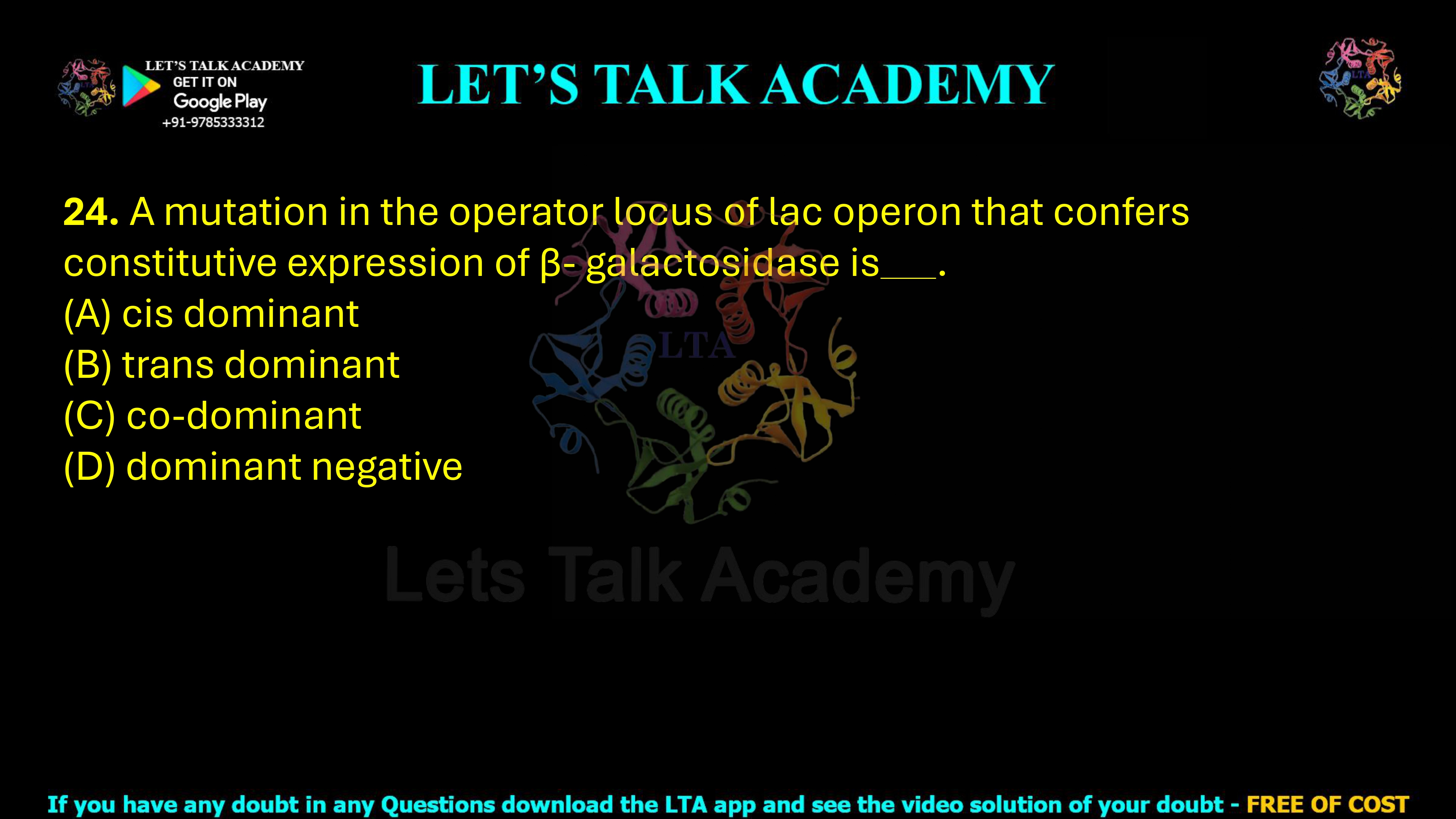
24. A mutation in the operator locus of lac operon that confers constitutive expression of β- galactosidase is .
(A) cis dominant
(B) trans dominant
(C) co-dominant
(D) dominant negative
Why Is a Lac Operator Mutation Causing Constitutive β-Galactosidase Expression Cis Dominant?
Understanding the Correct Answer
The correct answer is (A) cis dominant. A mutation in the operator region of the lac operon that prevents the lac repressor from binding is known as an operator-constitutive mutation and is commonly represented as lacOc. Because the repressor can no longer bind to the mutated operator, transcription of the adjacent structural genes continues even when the inducer is absent.
The most important point is that the lac operator is a DNA regulatory sequence. It does not produce a diffusible protein or RNA molecule that can move through the bacterial cell and regulate another DNA molecule. Therefore, an operator mutation affects only the structural genes physically linked to the same DNA molecule.
This property is called cis dominance. The term cis means that the mutation acts only on genes located on the same DNA molecule, while the term dominant means that the constitutive effect of the mutant operator cannot be corrected by providing a normal operator on another DNA molecule.
Therefore, a lac operator mutation that causes constitutive expression of β-galactosidase is classified as a cis-dominant mutation.
What Is the Lac Operon?
The lac operon is a classic example of inducible gene regulation in bacteria. It allows Escherichia coli to control the expression of genes required for the utilization of lactose. When lactose is unavailable, the operon is normally repressed. When lactose becomes available under suitable conditions, repression is removed and the structural genes can be expressed.
The major components involved in lac operon regulation include the lacI regulatory gene, the promoter, the operator and the three structural genes lacZ, lacY and lacA. Each component has a distinct function in controlling lactose metabolism.
The lacI gene encodes the lac repressor protein. The promoter is the DNA region where RNA polymerase binds to initiate transcription. The operator is the DNA regulatory site recognized by the lac repressor. The structural genes encode proteins involved in lactose uptake and metabolism.
Role of the lacZ Gene and β-Galactosidase
The lacZ gene encodes the enzyme β-galactosidase. This enzyme plays a central role in lactose metabolism by catalyzing the hydrolysis of lactose into glucose and galactose. It also contributes to the formation of allolactose, which acts as the natural inducer of the lac operon.
Under normal non-inducing conditions, the lac repressor binds to the operator and strongly reduces transcription of the lac structural genes. Consequently, β-galactosidase is not produced at a high level.
If the operator is mutated so that the repressor can no longer recognize or bind it, transcription is no longer properly blocked. As a result, the lacZ gene is expressed continuously, leading to constitutive production of β-galactosidase.
How Does the Normal Lac Operator Control Gene Expression?
In the absence of an inducer, the lac repressor binds to the operator region of the lac operon. This interaction prevents efficient transcription of the structural genes by RNA polymerase. Therefore, the operon remains largely switched off when lactose is unavailable.
When an inducer such as allolactose binds to the lac repressor, the repressor undergoes an allosteric conformational change. Its affinity for the operator decreases, allowing the repressor to dissociate from the DNA. RNA polymerase can then transcribe the lac structural genes.
This normal regulatory system depends on a functional operator sequence. The operator must be able to interact with the lac repressor. If the operator sequence is altered by a mutation that destroys repressor binding, repression becomes impossible.
What Is an Operator-Constitutive Mutation?
Meaning of the lacOc Mutation
An operator mutation that causes continuous expression of the lac structural genes is called an operator-constitutive mutation and is represented as lacOc. The superscript “c” indicates the constitutive phenotype.
In a lacOc mutant, the nucleotide sequence of the operator is altered so that the lac repressor cannot bind effectively. Even if a perfectly normal lac repressor is present in the bacterial cell, it cannot repress the genes linked to the mutant operator.
Consequently, the adjacent lacZ gene can continue to produce β-galactosidase even in the absence of an inducer. This is the molecular basis of constitutive expression caused by an operator mutation.
Why Can a Normal Repressor Not Correct the lacOc Mutation?
A normal repressor can move through the cytoplasm and bind to any normal operator sequence that it encounters. However, the problem in a lacOc mutant is not the absence of a functional repressor. The problem is the altered DNA-binding site itself.
Because the mutant operator is no longer properly recognized by the repressor, supplying additional normal repressor cannot restore repression. The structural genes physically linked to the mutant operator therefore remain constitutively expressed.
Why Is the lacOc Mutation Cis Acting?
A cis-acting regulatory element is a DNA sequence that influences the expression of genes physically linked to it on the same DNA molecule. The lac operator is a classic example of a cis-acting regulatory element.
The operator does not encode a diffusible product. It is simply a specific sequence of DNA that serves as a binding site for the lac repressor. Therefore, a mutation in one operator cannot directly alter the expression of structural genes associated with another operator on a separate DNA molecule.
For example, if a bacterial cell contains two copies of the lac operon, one copy with a mutant lacOc operator and another copy with a normal lacO+ operator, the lacOc mutation affects only the genes physically linked to the mutant operator. The genes linked to the normal operator remain normally regulated.
This restriction of the regulatory effect to genes on the same DNA molecule is the defining feature of cis action.
Why Is the lacOc Mutation Cis Dominant?
The lacOc mutation is described as cis dominant because its constitutive effect persists for the genes linked to it even when a normal operator is present elsewhere in the same cell.
A normal lacO+ sequence on another DNA molecule cannot restore repression of genes controlled by the mutant lacOc sequence. This happens because the normal operator does not produce any diffusible product capable of repairing or compensating for the mutant operator.
Therefore, the mutant operator remains constitutive, and the adjacent structural genes continue to be expressed. The mutation is dominant in its local effect but acts only on genes located in cis. Hence, it is classified as cis dominant.
Cis-Acting Elements and Trans-Acting Factors in the Lac Operon
The Operator Is a Cis-Acting Element
The lac operator is a DNA sequence and therefore acts only on the genes physically linked to it. A mutation in the operator affects the expression of nearby structural genes on the same DNA molecule but does not spread its effect to another lac operon located elsewhere.
For this reason, both the lac operator and the lac promoter are generally considered cis-acting regulatory DNA elements.
The Lac Repressor Is a Trans-Acting Factor
In contrast, the lac repressor is a protein encoded by the lacI gene. After synthesis, the repressor can diffuse through the bacterial cytoplasm and interact with operator sequences located on different DNA molecules.
Because the repressor is a diffusible regulatory molecule, the lacI gene product acts in trans. A functional lacI gene can therefore often complement a defective lacI gene present on another DNA molecule.
This difference between the operator and the repressor is fundamental: the operator acts in cis, whereas the lac repressor acts in trans.
Detailed Explanation of Each Option
Option (A): Cis Dominant
Option (A) is correct. A mutation in the lac operator that prevents repressor binding causes constitutive expression of the structural genes physically linked to the mutant operator. Since the operator is a DNA sequence and does not produce a diffusible regulatory molecule, its effect is restricted to genes located on the same DNA molecule.
A normal operator located on another DNA molecule cannot restore repression of the genes controlled by the mutant operator. Therefore, the lacOc mutation is described as cis dominant.
Hence, option (A) is correct.
Option (B): Trans Dominant
Option (B) is incorrect. A trans-acting factor produces a diffusible product, usually a protein or regulatory RNA, that can act on target sequences located on different DNA molecules. The lac repressor is a classic example of a trans-acting regulatory factor because it is a diffusible protein.
The operator, however, is not a diffusible molecule. It is a fixed DNA-binding site. A mutation in one operator cannot travel through the cell and influence structural genes associated with another operator. Therefore, an operator-constitutive mutation is not trans dominant.
Hence, option (B) is incorrect.
Option (C): Co-Dominant
Option (C) is incorrect. Co-dominance generally describes a situation in which two different alleles are both expressed or contribute distinguishable effects in the same organism. This term does not accurately describe the regulatory behavior of an operator-constitutive mutation in the lac operon.
The key feature of lacOc is that it acts only on the structural genes physically linked to it and cannot be complemented by a normal operator on another DNA molecule. Therefore, the appropriate classification is cis dominant rather than co-dominant.
Hence, option (C) is incorrect.
Option (D): Dominant Negative
Option (D) is incorrect. A dominant-negative mutation usually produces an altered gene product that interferes with the function of the normal gene product. This phenomenon is commonly observed when mutant proteins interact with normal proteins and disrupt the activity of a functional protein complex.
An operator mutation does not produce a mutant protein. The operator is a regulatory DNA sequence. Therefore, the constitutive phenotype does not arise because a defective product interferes with a normal product. It arises because the repressor can no longer bind to the mutated DNA sequence.
Hence, option (D) is incorrect.
Understanding the Mutation Through a Partial Diploid
The cis-dominant nature of an operator-constitutive mutation can be clearly demonstrated using a partial diploid or merodiploid bacterium. Such a cell contains two copies of the lac region, allowing researchers to determine whether a regulatory mutation acts in cis or in trans.
Consider a cell containing one lac operon with a lacOc mutation and another lac operon with a normal lacO+ operator. The structural genes linked to lacOc are expressed constitutively because the repressor cannot bind to the mutant operator. In contrast, the genes linked to lacO+ remain responsive to normal repressor-mediated regulation.
This observation demonstrates that the mutant operator controls only the genes physically linked to it. A normal operator elsewhere in the cell cannot suppress the constitutive expression caused by lacOc. Therefore, the mutation is conclusively classified as cis dominant.
Difference Between lacOc and lacI Mutations
Both lacOc mutations and certain lacI mutations can produce constitutive expression of the lac operon, but their genetic behavior is different. Understanding this difference is essential for interpreting lac operon questions.
A lacOc mutation alters the operator DNA sequence. Because the operator acts only on linked genes, the mutation is cis dominant. A normal operator elsewhere cannot repair the mutant operator.
In contrast, the lacI gene encodes a diffusible repressor protein. A functional lacI+ gene can produce repressor molecules that move through the cell and regulate normal operators on different DNA molecules. Therefore, the lacI gene product acts in trans.
The fundamental distinction is that lacO is a DNA-binding site that acts in cis, whereas lacI encodes a diffusible protein that acts in trans.
Final Answer
Correct Answer: (A) cis dominant
A mutation in the operator locus that causes constitutive expression of β-galactosidase is called an operator-constitutive or lacOc mutation. The mutation prevents effective binding of the lac repressor to the operator, causing continuous expression of the adjacent lac structural genes.
Because the operator is a regulatory DNA sequence, its effect is restricted to the genes physically linked to it on the same DNA molecule. A normal operator located elsewhere cannot restore repression of genes linked to the mutant operator. Therefore, the constitutive operator mutation is cis dominant.
Final Answer: (A) cis dominant


