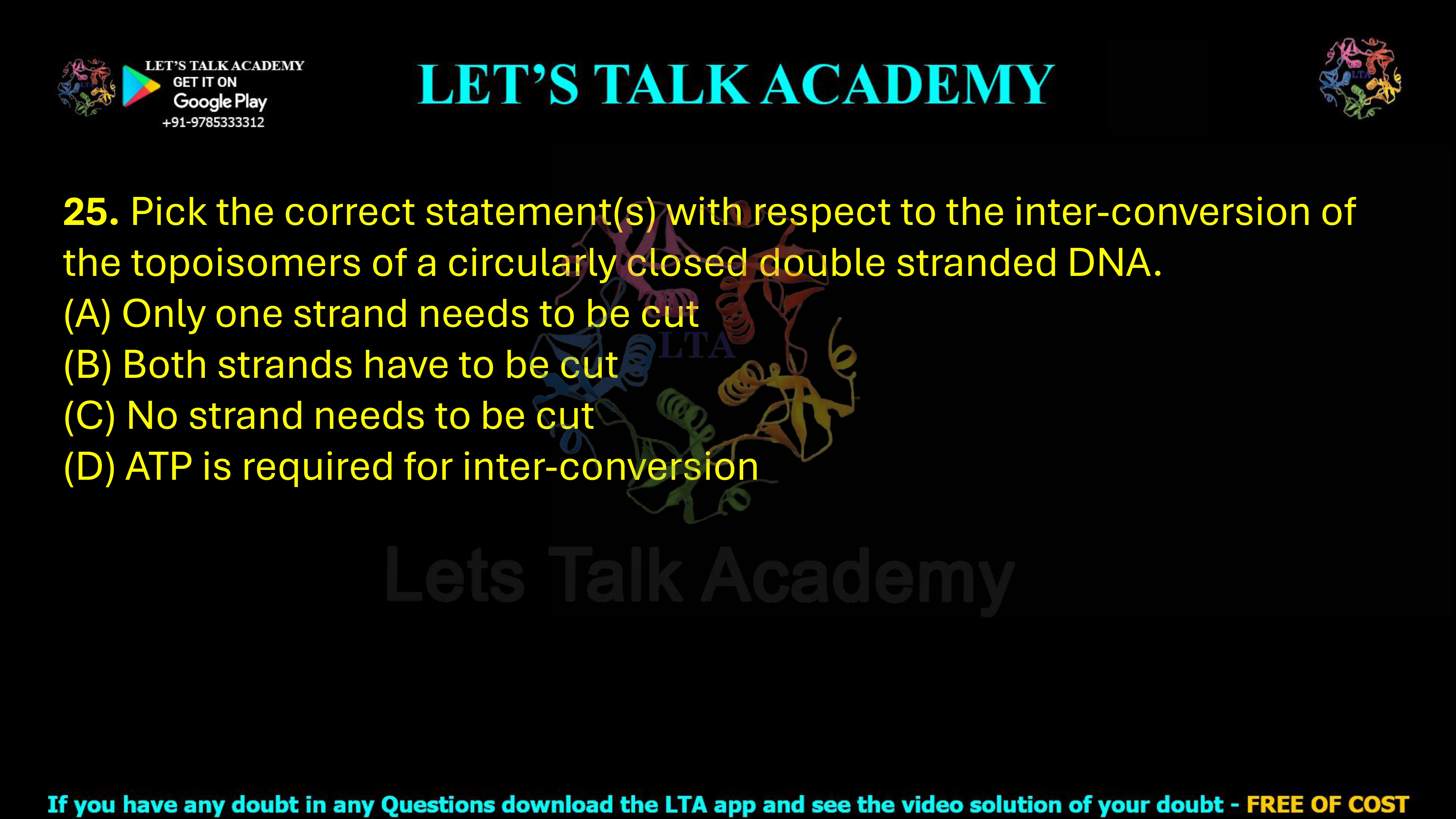
25. Pick the correct statement(s) with respect to the inter-conversion of the topoisomers of a circularly closed double stranded DNA.
(A) Only one strand needs to be cut
(B) Both strands have to be cut
(C) No strand needs to be cut
(D) ATP is required for inter-conversion
Understanding the Correct Answer
The correct answer is (A) Only one strand needs to be cut. The interconversion of topoisomers of a covalently closed circular double-stranded DNA requires a change in the linking number of the DNA molecule. Because linking number is a topological invariant in a completely closed DNA molecule, it cannot change unless the continuity of at least one DNA strand is temporarily broken.
However, it is not necessary to cut both DNA strands. A type I topoisomerase can temporarily cleave only one strand of the double-stranded DNA, allow controlled rotation or strand passage, and then reseal the broken strand. This process changes the linking number and converts one DNA topoisomer into another.
Therefore, the minimum topological requirement for the interconversion of topoisomers is the temporary cleavage of one DNA strand. Both strands do not have to be cut, and ATP is not universally required because type I topoisomerases generally perform this reaction without ATP hydrolysis.
What Are DNA Topoisomers?
DNA topoisomers are different topological forms of a DNA molecule that have the same nucleotide sequence and the same covalent connectivity but differ in their linking number. In other words, the DNA molecules are chemically identical but differ in the way their two strands are topologically intertwined.
This concept is particularly important for covalently closed circular double-stranded DNA. Because neither DNA strand has a free end, the two strands remain topologically linked. The number of times one DNA strand winds around the other cannot change simply by bending, twisting or rotating the intact closed molecule.
Different topoisomers may therefore have different degrees of supercoiling. One DNA molecule may be more negatively supercoiled, another may be relaxed, and another may have a different linking number. Conversion between these forms requires an enzyme capable of temporarily breaking and resealing DNA.
Why Is Circularly Closed DNA Topologically Constrained?
A linear DNA molecule has free ends. Under suitable conditions, these ends can rotate, allowing torsional stress to be released. A covalently closed circular DNA molecule is fundamentally different because it has no free ends.
In circularly closed double-stranded DNA, both strands form continuous covalent circles. As a result, the strands cannot freely separate or rotate around one another. The number of times the two strands are linked becomes a fixed topological property known as the linking number.
As long as both DNA strands remain completely intact, the linking number cannot change. The DNA can alter its shape and redistribute twisting and supercoiling, but it cannot become a different topoisomer without temporary strand cleavage.
This is why a strand break is essential for true topoisomer interconversion. The break removes the topological restriction temporarily, allowing the linking number to change before the DNA is resealed.
What Is the Linking Number of DNA?
The linking number, represented by Lk, describes the total number of times one strand of a closed circular double-stranded DNA molecule is topologically linked with the other strand. It is one of the most important concepts in DNA topology.
For a covalently closed circular DNA molecule, the linking number is always an integer. Different topoisomers of the same DNA molecule possess different linking numbers.
The relationship between the major topological properties of DNA is expressed as:
Lk = Tw + Wr
Here, Lk represents linking number, Tw represents twist and Wr represents writhe.
Twist describes the helical winding of the two DNA strands around each other, whereas writhe describes the coiling of the DNA double helix axis in three-dimensional space. Although twist and writhe can redistribute without strand breakage, the linking number of a covalently closed circular DNA molecule cannot change unless at least one DNA strand is temporarily broken.
Why Must at Least One DNA Strand Be Cut?
Imagine two closed rings that are linked together. As long as both rings remain intact, the number of links between them cannot be changed by ordinary movement. To alter their topological relationship, at least one ring must be temporarily opened.
The same principle applies to the two strands of circularly closed double-stranded DNA. Because both strands are continuous and closed, their linking number remains fixed. To convert one topoisomer into another, the topological constraint must be temporarily removed.
A single-strand break is sufficient for this purpose. A type I topoisomerase can cleave one DNA strand, permit controlled movement of the DNA, alter the linking number and then reseal the strand.
Therefore, the interconversion of topoisomers does not necessarily require double-strand cleavage. The minimum requirement is the temporary breakage of one DNA strand.
Role of Topoisomerases in Topoisomer Interconversion
Topoisomerases are enzymes that alter the topological state of DNA. They solve topological problems that arise during essential cellular processes such as DNA replication, transcription, recombination and chromosome segregation.
These enzymes work by temporarily breaking one or both DNA strands, allowing controlled movement of DNA, and then resealing the break. Because the cleavage reaction is transient and enzyme-controlled, the DNA is not left permanently damaged.
Topoisomerases are broadly divided into type I topoisomerases and type II topoisomerases. The major difference between them is the number of DNA strands cleaved during their catalytic cycle and their energy requirements.
How Does Type I Topoisomerase Interconvert DNA Topoisomers?
Type I Topoisomerase Cuts One DNA Strand
Type I topoisomerases temporarily cleave only one strand of a double-stranded DNA molecule. This single-strand cleavage is sufficient to remove the topological restriction that normally prevents a change in linking number.
After cleavage, the enzyme allows controlled rotation of the DNA or passage of a DNA strand through the temporary break, depending on the particular class of type I topoisomerase. The broken strand is then resealed.
As a result, one DNA topoisomer is converted into another. Therefore, the existence and mechanism of type I topoisomerases directly demonstrate that only one strand needs to be cut for topoisomer interconversion.
Change in Linking Number by Type I Topoisomerase
Type I topoisomerases generally change the linking number in steps of one. A DNA molecule with one linking number can therefore be converted into a neighboring topoisomer by a single catalytic event.
This ability is particularly important for the relaxation of supercoiled DNA. By repeatedly changing the linking number, type I topoisomerases can progressively alter the topological state of the DNA molecule.
Does Type II Topoisomerase Cut Both DNA Strands?
Yes. Type II topoisomerases temporarily cleave both strands of one DNA double helix and pass another double-stranded DNA segment through the resulting transient break. The enzyme then reseals the cleaved DNA.
This mechanism changes the linking number, generally in steps of two. Type II topoisomerases are important for processes such as DNA supercoiling, removal of DNA tangles, decatenation of replicated chromosomes and chromosome segregation.
However, the fact that type II topoisomerases cut both strands does not mean that both strands have to be cut for every interconversion of topoisomers. Type I topoisomerases clearly demonstrate that single-strand cleavage is sufficient.
Therefore, although double-strand cleavage is one possible mechanism used by certain topoisomerases, it is not an absolute requirement for topoisomer interconversion.
Is ATP Required for the Interconversion of DNA Topoisomers?
ATP is not universally required for the interconversion of DNA topoisomers. This is an important distinction between different classes of topoisomerases.
Type I topoisomerases generally do not require ATP hydrolysis for their catalytic activity. The energy required to reseal the DNA strand is conserved through a transient covalent bond formed between the topoisomerase enzyme and the cleaved DNA.
Because a type I topoisomerase can convert one DNA topoisomer into another without ATP, the general statement that ATP is required for interconversion is incorrect.
Many type II topoisomerases do require ATP for their strand-passage cycle. However, this ATP requirement is characteristic of the type II mechanism and is not a universal requirement for all topoisomer interconversion reactions.
How Is DNA Cleaved Without Permanent Damage?
Topoisomerases do not simply cut DNA and release the broken ends. Instead, DNA cleavage is tightly controlled through the formation of a temporary covalent intermediate between the enzyme and DNA.
An active-site tyrosine residue of the topoisomerase attacks a phosphodiester bond in the DNA backbone. This reaction temporarily breaks the DNA strand while forming a covalent phosphotyrosine bond between the enzyme and DNA.
The energy of the original phosphodiester bond is conserved in this enzyme-DNA intermediate. After the required topological change has occurred, the DNA strand is resealed.
This mechanism explains how type I topoisomerases can carry out DNA cleavage and rejoining without requiring ATP as an external energy source.
Detailed Explanation of Each Option
Option (A): Only One Strand Needs to Be Cut
Option (A) is correct. The linking number of a covalently closed circular DNA molecule can be changed by temporarily breaking one DNA strand. Type I topoisomerases use exactly this mechanism.
After making a transient single-strand break, the enzyme permits controlled DNA rotation or strand passage and then reseals the break. The resulting DNA molecule has a different linking number and is therefore a different topoisomer.
Because single-strand cleavage is sufficient for interconversion, both DNA strands do not have to be cut.
Hence, option (A) is correct.
Option (B): Both Strands Have to Be Cut
Option (B) is incorrect. Type II topoisomerases do temporarily cut both strands of DNA, but double-strand cleavage is not an essential requirement for all topoisomer interconversion reactions.
The wording “have to be cut” makes this statement incorrect. Type I topoisomerases can successfully alter the linking number by cutting only one strand. Therefore, both strands do not have to be cleaved.
It is important to distinguish between saying that both strands can be cut and saying that both strands have to be cut. Type II topoisomerases can use double-strand cleavage, but single-strand cleavage by type I topoisomerases is sufficient for interconversion.
Hence, option (B) is incorrect.
Option (C): No Strand Needs to Be Cut
Option (C) is incorrect. In a covalently closed circular double-stranded DNA molecule, the linking number is topologically fixed as long as both strands remain completely intact.
The DNA molecule can change its three-dimensional shape, and twist can be redistributed into writhe or vice versa, but these conformational changes do not alter the linking number. Since different topoisomers have different linking numbers, conversion between them requires temporary strand breakage.
Therefore, at least one DNA strand must be cut to achieve true interconversion between topoisomers.
Hence, option (C) is incorrect.
Option (D): ATP Is Required for Interconversion
Option (D) is incorrect. ATP is not required for all topoisomer interconversion reactions. Type I topoisomerases generally alter DNA topology without ATP hydrolysis.
Although many type II topoisomerases use ATP during their catalytic cycle, this does not establish ATP as a universal requirement for topoisomer interconversion. Since interconversion can occur through the ATP-independent action of type I topoisomerases, the statement is incorrect as a general rule.
Hence, option (D) is incorrect.
Difference Between Type I and Type II Topoisomerases
Type I Topoisomerases
Type I topoisomerases make a transient break in one DNA strand. They generally change the linking number in steps of one and usually do not require ATP hydrolysis. Their mechanism demonstrates that a single-strand break is sufficient to interconvert DNA topoisomers.
Type II Topoisomerases
Type II topoisomerases make a transient break in both DNA strands. They pass another double-stranded DNA segment through this break and generally change the linking number in steps of two. These enzymes commonly require ATP for their catalytic cycle.
Both types of enzymes can alter DNA topology, but the minimum requirement for changing the topological state of a covalently closed circular DNA molecule is temporary cleavage of at least one strand.
Why Is the Wording of the Question Important?
The question asks what is required for the interconversion of topoisomers. It does not ask specifically about the mechanism of a type II topoisomerase.
Because type I topoisomerases can interconvert topoisomers by cutting only one strand, single-strand cleavage is sufficient. Therefore, statement (A) correctly identifies the minimum requirement.
Statement (B) incorrectly claims that both strands have to be cut, while statement (D) incorrectly presents ATP as an absolute requirement. Both of these claims are disproved by the activity of type I topoisomerases.
Final Answer
Correct Answer: (A) Only one strand needs to be cut
Topoisomers of a covalently closed circular double-stranded DNA molecule differ in their linking number. Since linking number cannot change while both DNA strands remain completely intact, at least one strand must be temporarily broken.
A type I topoisomerase can achieve topoisomer interconversion by cutting only one DNA strand, allowing controlled DNA movement and then resealing the break. Therefore, both strands do not have to be cut.
ATP is also not universally required because type I topoisomerases generally perform topoisomer interconversion without ATP hydrolysis.
Final Answer: (A) Only one strand needs to be cut


