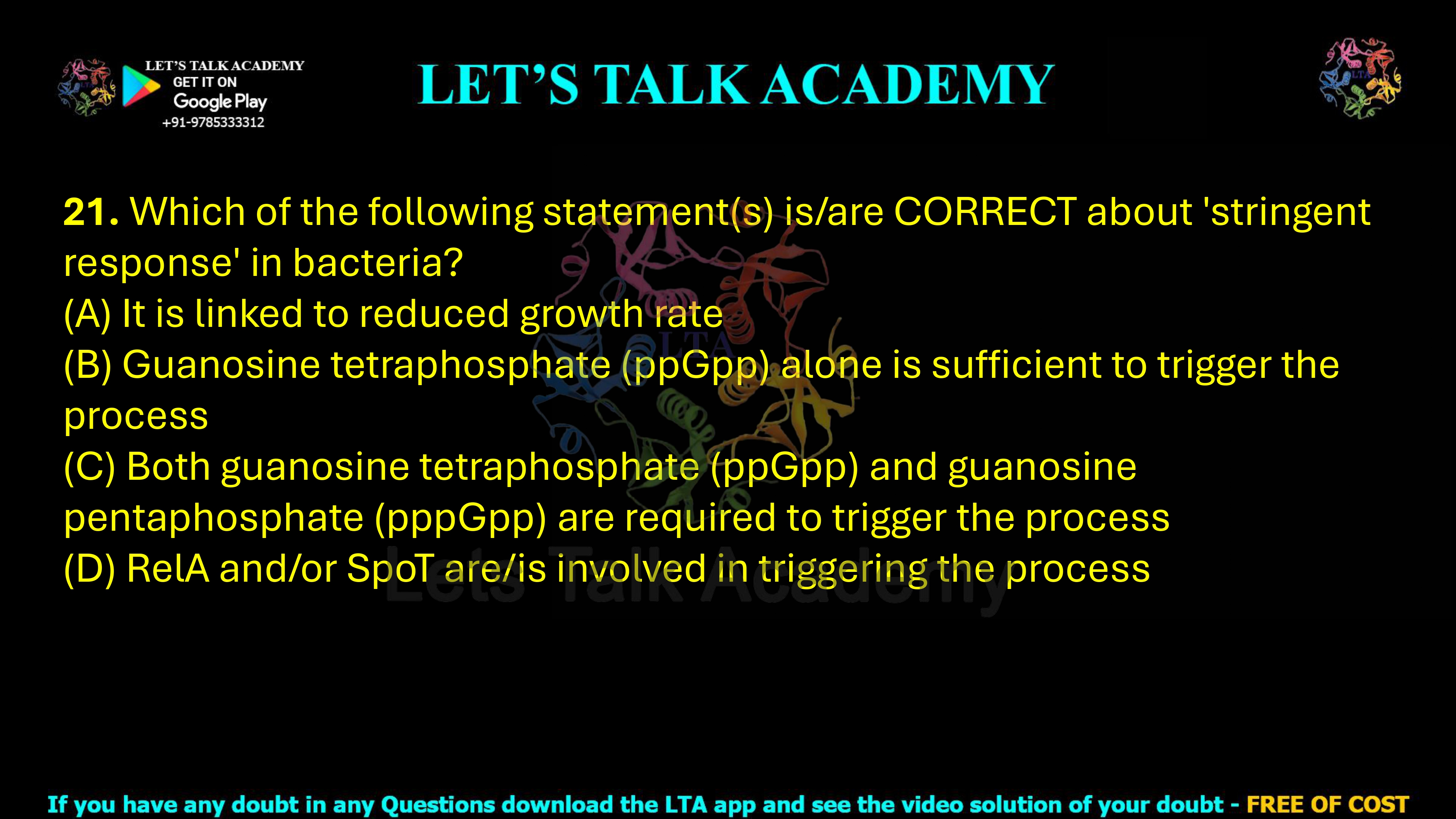
21. Which of the following statement(s) is/are CORRECT about ‘stringent response’ in bacteria?
(A) It is linked to reduced growth rate
(B) Guanosine tetraphosphate (ppGpp) alone is sufficient to trigger the process
(C) Both guanosine tetraphosphate (ppGpp) and guanosine pentaphosphate (pppGpp) are required to trigger the process
(D) RelA and/or SpoT are/is involved in triggering the process
Stringent Response in Bacteria: Which Statements Are Correct?
What Is the Stringent Response in Bacteria?
The stringent response is a major stress-response mechanism that allows bacteria to survive when nutrients become limited or environmental conditions become unfavorable. Instead of continuing rapid growth and consuming valuable cellular resources, bacterial cells reorganize their metabolism and gene expression so that survival becomes more important than growth.
This response is particularly well known in bacteria experiencing amino acid starvation. When an essential amino acid becomes unavailable, the corresponding aminoacyl-tRNA cannot be produced efficiently. As a result, uncharged tRNA accumulates and enters the A site of a translating ribosome. This starvation signal activates the stringent-response machinery and promotes the accumulation of unusual guanine nucleotides known as alarmones.
The major alarmones associated with the bacterial stringent response are guanosine tetraphosphate (ppGpp) and guanosine pentaphosphate (pppGpp). These molecules are collectively written as (p)ppGpp. Their accumulation causes extensive changes in bacterial transcription, translation, metabolism and growth.
Therefore, the stringent response can be understood as a global cellular adaptation that redirects bacterial resources away from rapid growth and toward maintenance, stress resistance and survival.
Why Does the Stringent Response Reduce Bacterial Growth?
Rapidly growing bacterial cells invest a large proportion of their energy and cellular resources in the synthesis of ribosomes, ribosomal RNA, transfer RNA and proteins. When nutrients are abundant, this strategy supports rapid cell division. However, when nutrients become limited, continuing this expensive biosynthetic activity would be inefficient.
During the stringent response, increased levels of (p)ppGpp alter the expression of numerous genes. The synthesis of stable RNAs, particularly ribosomal RNA and transfer RNA, is reduced. Ribosome production decreases, protein synthesis slows and the bacterial growth rate falls.
At the same time, the cell activates genes and metabolic pathways that improve its ability to survive nutrient limitation. Therefore, a reduced growth rate is not simply an accidental consequence of the stringent response. It is an important component of the bacterial survival strategy.
Role of ppGpp and pppGpp in the Stringent Response
What Is ppGpp?
ppGpp stands for guanosine tetraphosphate and is one of the major regulatory alarmones involved in the bacterial stringent response. Its concentration increases when bacterial cells experience nutritional or environmental stress.
ppGpp influences gene expression and cellular metabolism so that the cell reduces growth-related activities and increases survival-related activities. It is therefore a central regulatory molecule in bacterial stress adaptation.
What Is pppGpp?
pppGpp stands for guanosine pentaphosphate. Like ppGpp, it belongs to the alarmone family associated with the stringent response. ppGpp and pppGpp are structurally related regulatory nucleotides and are commonly represented together by the notation (p)ppGpp.
The bacterial stringent response is therefore classically associated with the accumulation of the alarmones ppGpp and pppGpp. Together, these molecules coordinate major changes in transcription, translation, metabolism and cellular growth.
Why Are ppGpp and pppGpp Called Alarmones?
The term alarmone refers to a small intracellular signaling molecule that communicates a state of physiological stress. When bacterial cells detect starvation or another unfavorable condition, the levels of these molecules change rapidly and signal the cell to reorganize its activities.
In the stringent response, ppGpp and pppGpp function as intracellular alarm signals. Their accumulation informs the bacterial cell that resources are insufficient for normal rapid growth. The cell consequently reduces energy-intensive processes and activates pathways that improve adaptation and survival.
Role of RelA and SpoT in the Bacterial Stringent Response
RelA Detects Amino Acid Starvation
RelA is a major enzyme involved in triggering the stringent response, particularly during amino acid starvation. When amino acids are limited, uncharged tRNAs accumulate because they cannot be loaded with their corresponding amino acids.
During translation, an uncharged tRNA can enter the A site of the ribosome. Ribosome-associated RelA senses this starvation condition and becomes activated. Activated RelA promotes the synthesis of stringent-response alarmones, leading to the accumulation of (p)ppGpp.
The increase in alarmone concentration changes bacterial gene expression and reduces cellular processes associated with rapid growth. Thus, RelA connects amino acid availability with global regulation of bacterial physiology.
SpoT Regulates the Cellular Alarmone Pool
SpoT is another important protein involved in the stringent response. It plays a major role in controlling the intracellular concentration of (p)ppGpp and can participate in responses to several types of nutritional stress.
SpoT is especially important because it helps regulate the balance between alarmone synthesis and degradation. This allows the bacterial cell to increase the stringent-response signal when stress occurs and reduce the signal when favorable growth conditions return.
Therefore, depending on the bacterial species and the type of stress involved, RelA and/or SpoT participate in the regulation and triggering of the stringent response.
Detailed Explanation of Each Option
Option (A): It Is Linked to Reduced Growth Rate
Option (A) is correct. The stringent response is strongly associated with a reduction in bacterial growth rate. When nutrients are scarce, the accumulation of (p)ppGpp reduces the synthesis of components required for rapid cellular growth, particularly ribosomal RNA and other parts of the protein-synthesis machinery.
As ribosome production and biosynthetic activity decrease, bacterial growth slows. This allows the cell to conserve energy and redirect resources toward stress adaptation and survival. Therefore, the stringent response is clearly linked to a reduced growth rate.
Hence, statement (A) is correct.
Option (B): Guanosine Tetraphosphate (ppGpp) Alone Is Sufficient to Trigger the Process
Option (B) is incorrect in the context of this question. The bacterial stringent response is classically described in terms of the alarmone family collectively represented as (p)ppGpp, which includes both guanosine tetraphosphate (ppGpp) and guanosine pentaphosphate (pppGpp).
The statement specifically claims that ppGpp alone is sufficient. However, the stringent response is associated with the coordinated production and action of the related alarmones ppGpp and pppGpp. Therefore, the exclusive emphasis on ppGpp alone makes this statement incorrect for the expected answer to this question.
Hence, statement (B) is incorrect.
Option (C): Both ppGpp and pppGpp Are Required to Trigger the Process
Option (C) is correct according to the expected framework of this question. The stringent response is regulated by the alarmones ppGpp and pppGpp, which are collectively represented by the term (p)ppGpp.
These unusual guanine nucleotides accumulate under stress conditions and produce extensive changes in bacterial gene expression, metabolism and growth. Their action suppresses growth-related activities and promotes cellular adaptation to nutrient limitation.
Because the stringent response is conventionally associated with both forms of the alarmone system, statement (C) is considered correct in this question.
Hence, statement (C) is correct.
Option (D): RelA and/or SpoT Are/Is Involved in Triggering the Process
Option (D) is correct. RelA and SpoT are central proteins involved in controlling the stringent response. RelA is particularly important during amino acid starvation and is activated through its association with starved ribosomes containing uncharged tRNA.
SpoT also regulates the cellular (p)ppGpp pool and participates in the response to various forms of nutrient limitation and stress. Depending on the bacterial organism and the physiological condition, RelA, SpoT or related proteins may be involved in generating and regulating the stringent-response signal.
Hence, statement (D) is correct.
How Amino Acid Starvation Triggers the Stringent Response
One of the best-understood triggers of the stringent response is amino acid starvation. Under normal conditions, amino acids are attached to their corresponding tRNAs by aminoacyl-tRNA synthetases. These charged tRNAs then participate in protein synthesis.
When a particular amino acid becomes scarce, its corresponding tRNA remains uncharged. The uncharged tRNA enters the A site of an actively translating ribosome. This situation acts as a direct signal that the bacterial cell does not have enough amino acids to continue normal protein synthesis.
Ribosome-associated RelA detects this condition and promotes the production of stringent-response alarmones. As the concentration of (p)ppGpp increases, the bacterial cell changes its transcriptional and metabolic program. The production of ribosomes and other growth-related components decreases, while pathways required for adaptation and survival become more important.
This sequence of events demonstrates how bacteria can rapidly connect nutrient availability with global control of growth and metabolism.
Major Cellular Effects of the Stringent Response
The stringent response produces widespread changes throughout the bacterial cell. One of its most important effects is the reduction of ribosomal RNA synthesis. Because ribosome production requires a large amount of cellular energy, reducing rRNA synthesis is an effective way to conserve resources during starvation.
The response also modifies the expression of genes involved in amino acid biosynthesis, nutrient acquisition, stress resistance and metabolism. The exact changes depend on the bacterial species and the type of environmental stress.
The overall outcome is a shift from a growth-oriented physiological state to a survival-oriented physiological state. This is why the stringent response is one of the most important mechanisms by which bacteria adapt to rapidly changing environmental conditions.
Difference Between Normal Bacterial Growth and the Stringent Response
Under nutrient-rich conditions, bacterial cells prioritize rapid growth. They actively synthesize ribosomal RNA, ribosomal proteins, transfer RNAs and other components required for efficient protein synthesis and cell division.
Under starvation conditions, this strategy changes. The accumulation of (p)ppGpp signals that rapid growth is no longer sustainable. The cell reduces the synthesis of growth-related components and redirects its metabolic resources toward adaptation and survival.
Thus, the stringent response represents a fundamental switch in bacterial physiology. The cell moves from rapid proliferation toward resource conservation and stress tolerance.
Final Answer
Correct Statements: (A), (C) and (D)
Statement (A) is correct because the stringent response is associated with reduced bacterial growth rate and decreased synthesis of growth-related cellular components.
Statement (B) is incorrect in the context of this question because the stringent response is classically associated with the alarmones collectively called (p)ppGpp rather than ppGpp alone.
Statement (C) is correct according to the expected answer framework because both ppGpp and pppGpp are associated with the stringent-response alarmone system.
Statement (D) is correct because RelA and/or SpoT are central proteins involved in the synthesis, regulation and control of the alarmones responsible for the stringent response.
Therefore, the correct answer is (A), (C) and (D).


