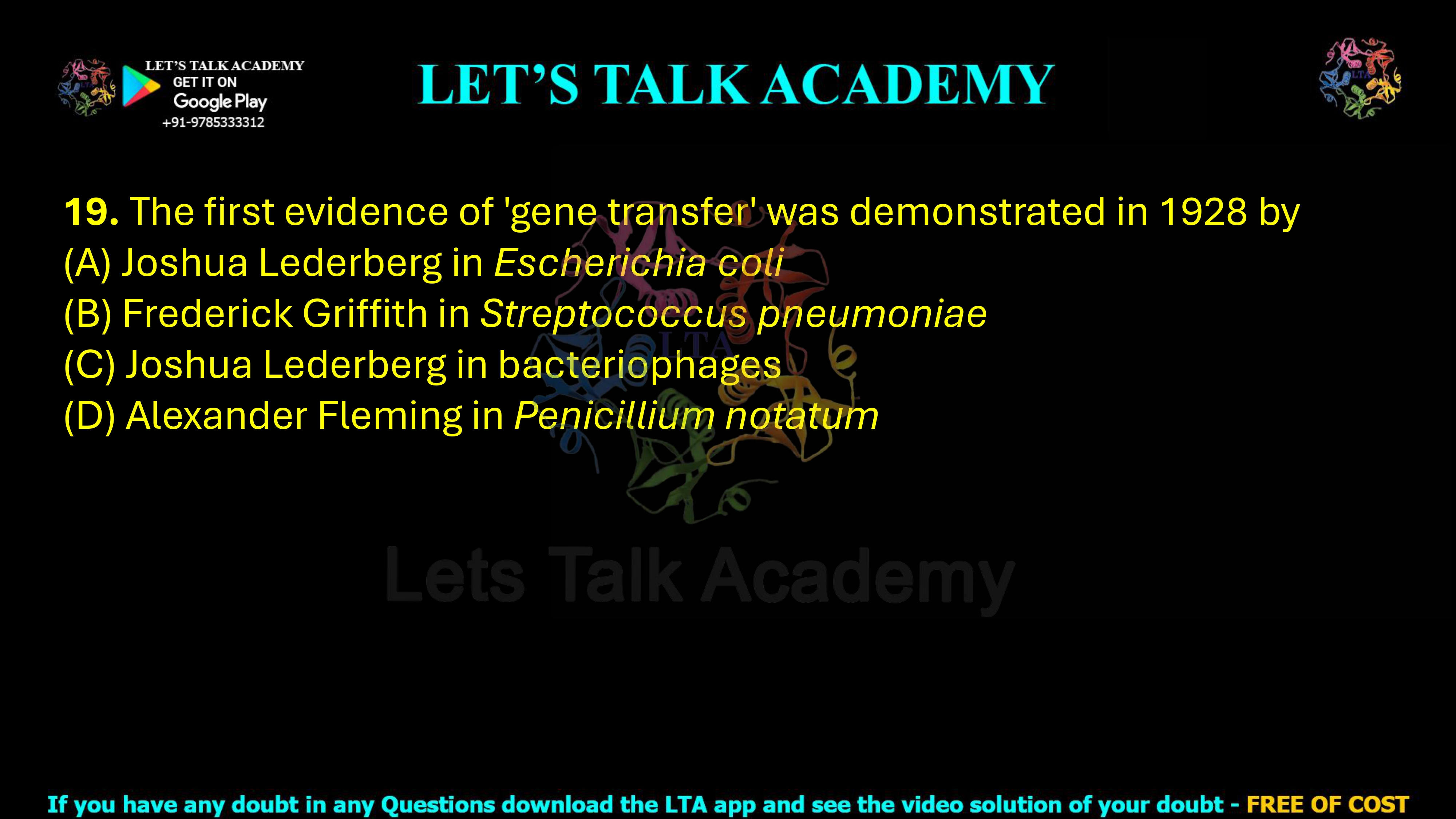
19. The first evidence of ‘gene transfer’ was demonstrated in 1928 by
(A) Joshua Lederberg in Escherichia coli
(B) Frederick Griffith in Streptococcus pneumoniae
(C) Joshua Lederberg in bacteriophages
(D) Alexander Fleming in Penicillium notatum
First Evidence of Gene Transfer in 1928: Frederick Griffith’s Transformation Experiment Explained
Introduction
The discovery that genetic information can be transferred from one bacterial cell to another was one of the most important turning points in the history of genetics and molecular biology. The first experimental evidence for such gene transfer was obtained in 1928 by Frederick Griffith while studying the bacterium Streptococcus pneumoniae. His observations revealed that a heritable characteristic could pass from dead bacterial cells to living bacterial cells and permanently alter their phenotype.
Griffith did not know the chemical nature of the substance responsible for this change. He called the phenomenon transformation and proposed the existence of a mysterious transforming principle. Years later, further experiments established that the transforming principle was DNA. Thus, Griffith’s experiment became a foundation for the modern understanding of genetic material and horizontal gene transfer.
Among the given options, the correct answer is Frederick Griffith in Streptococcus pneumoniae. Joshua Lederberg’s work on bacterial genetic recombination came later, while Alexander Fleming’s famous 1928 discovery concerned penicillin rather than gene transfer.
Correct Answer
Correct Answer: (B) Frederick Griffith in Streptococcus pneumoniae
Detailed Explanation
In 1928, British bacteriologist Frederick Griffith was investigating Streptococcus pneumoniae, a bacterium associated with pneumonia. He worked with two different forms of the bacterium: the S strain and the R strain.
The S strain formed smooth colonies because the bacterial cells possessed a polysaccharide capsule. This capsule protected the bacteria from the host immune system and made the strain virulent. In contrast, the R strain lacked the protective capsule, formed rough colonies, and was non-virulent.
Griffith discovered something remarkable when he mixed living non-virulent R bacteria with heat-killed virulent S bacteria. Although the S bacteria had been killed, the mixture caused disease, and living virulent S bacteria were recovered from the dead experimental animals. This result indicated that some stable biological material had passed from the dead S bacteria into the living R bacteria and transformed them into virulent S-type bacteria.
This was the first clear experimental evidence that genetic information could be transferred from one bacterial cell to another. The phenomenon became known as bacterial transformation.
Frederick Griffith’s Transformation Experiment
Experiment 1: Living S Strain
When living S strain bacteria were introduced into mice, the mice died. The S strain was virulent because its cells possessed a protective polysaccharide capsule that helped them escape destruction by the host immune system.
Living S strain → Mouse dies
Experiment 2: Living R Strain
When living R strain bacteria were introduced into mice, the mice survived. The R strain lacked the protective capsule and was therefore unable to cause lethal infection under the experimental conditions.
Living R strain → Mouse survives
Experiment 3: Heat-Killed S Strain
When heat-killed S strain bacteria were introduced into mice, the mice survived. Heating had killed the virulent bacterial cells, so the dead cells alone could not produce an active infection.
Heat-killed S strain → Mouse survives
Experiment 4: Living R Strain Mixed with Heat-Killed S Strain
The most important result occurred when living R strain bacteria were mixed with heat-killed S strain bacteria. The mice died, and living virulent S strain bacteria were recovered from their bodies.
Living R strain + Heat-killed S strain → Mouse dies → Living S strain recovered
This observation demonstrated that a stable substance from the dead S cells had entered the living R cells and converted them into virulent S cells. Because the transformed bacteria maintained the new characteristic and transmitted it to their descendants, the change was genetic and heritable.
Summary of Griffith’s Experimental Results
| Experimental Material | Nature of Bacteria | Result |
|---|---|---|
| Living S strain | Virulent and capsulated | Mouse dies |
| Living R strain | Non-virulent and non-capsulated | Mouse survives |
| Heat-killed S strain | Dead virulent bacteria | Mouse survives |
| Living R strain + Heat-killed S strain | Transformation occurs | Mouse dies and living S bacteria are recovered |
Why Was Griffith’s Experiment Evidence of Gene Transfer?
The significance of Griffith’s experiment lies in the permanent conversion of one bacterial phenotype into another. The living R bacteria initially lacked the capsule and were non-virulent. After exposure to material from dead S bacteria, some R cells acquired the ability to synthesize a capsule and became virulent.
This change was not temporary. The transformed S-type bacteria reproduced and passed the newly acquired characteristic to their descendants. Therefore, the transferred material must have carried heritable biological information.
In modern terminology, Griffith had demonstrated horizontal gene transfer by transformation. DNA released from dead bacterial cells can be taken up by competent living bacteria and incorporated into their genetic material, resulting in a stable change in genotype and phenotype.
What Was the Transforming Principle?
Griffith demonstrated transformation but did not identify the chemical substance responsible for it. He concluded only that some factor from the heat-killed S cells was capable of transforming living R cells.
This unknown factor became known as the transforming principle. The discovery immediately raised an important biological question: what molecule carries the genetic information responsible for transformation?
At that time, many scientists believed that proteins were more likely than DNA to serve as genetic material because proteins appeared chemically more complex. The identity of the transforming principle was established later through further experimentation.
Avery, MacLeod and McCarty Extended Griffith’s Discovery
In 1944, Oswald Avery, Colin MacLeod, and Maclyn McCarty investigated the chemical nature of Griffith’s transforming principle. They prepared extracts from virulent S-type bacteria and treated the extracts with enzymes that destroyed different classes of biological molecules.
When proteins were destroyed, transformation still occurred. When RNA was destroyed, transformation also continued. However, when DNA was destroyed using DNase, transformation was prevented. This demonstrated that DNA was the substance responsible for the genetic transformation.
The relationship between the two major discoveries can therefore be summarized as:
1928: Griffith demonstrated bacterial transformation
1944: Avery, MacLeod and McCarty identified DNA as the transforming principle
Explanation of Option (A): Joshua Lederberg in Escherichia coli
This option is incorrect.
Joshua Lederberg made major contributions to bacterial genetics and helped demonstrate genetic recombination in Escherichia coli. His work established that bacteria could exchange genetic information through processes associated with bacterial conjugation and recombination.
However, this work was performed after Griffith’s 1928 transformation experiment. Therefore, although Lederberg’s research was extremely important for understanding bacterial gene transfer, it was not the first evidence of gene transfer.
The earliest evidence in the context of this question came from Griffith’s transformation experiment in Streptococcus pneumoniae.
Explanation of Option (B): Frederick Griffith in Streptococcus pneumoniae
This option is correct.
Frederick Griffith demonstrated bacterial transformation in 1928 using virulent S and non-virulent R strains of Streptococcus pneumoniae. His experiment showed that genetic information from heat-killed S bacteria could transform living R bacteria into virulent S-type bacteria.
This was the first experimental evidence that a heritable characteristic could be transferred between bacterial cells. Therefore, option (B) is the correct answer.
Explanation of Option (C): Joshua Lederberg in Bacteriophages
This option is incorrect.
Joshua Lederberg is strongly associated with bacterial genetics, genetic recombination, and discoveries related to gene transfer. However, he did not provide the first evidence of gene transfer in 1928 through experiments with bacteriophages.
The transfer of bacterial genes by bacteriophages is known as transduction. This phenomenon was discovered later through studies involving bacterial systems and bacteriophages. Therefore, option (C) does not match either the scientist, the organism, or the historical event described in the question.
Explanation of Option (D): Alexander Fleming in Penicillium notatum
This option is incorrect.
Alexander Fleming made a major discovery in 1928, the same year associated with Griffith’s transformation experiment. Fleming observed that a mold, traditionally identified as Penicillium notatum, produced a substance capable of inhibiting the growth of certain bacteria. This observation led to the discovery of penicillin.
Although Fleming’s discovery occurred in 1928, it was related to antibiotics and antimicrobial activity, not gene transfer. The similarity in dates can make this option appear confusing, but the biological discoveries were completely different.
Summary of All Options
| Option | Scientist and System | Major Contribution | Correct/Incorrect |
|---|---|---|---|
| (A) | Joshua Lederberg in Escherichia coli | Bacterial genetic recombination and conjugation | Incorrect |
| (B) | Frederick Griffith in Streptococcus pneumoniae | First evidence of transformation and gene transfer | Correct |
| (C) | Joshua Lederberg in bacteriophages | Does not represent the 1928 discovery | Incorrect |
| (D) | Alexander Fleming in Penicillium notatum | Discovery of penicillin | Incorrect |
What Is Bacterial Transformation?
Bacterial transformation is a form of horizontal gene transfer in which a bacterial cell takes up free or naked DNA from its environment. If the acquired DNA is maintained or incorporated into the recipient genome, the bacterium may develop a new heritable characteristic.
In Griffith’s experiment, DNA released from the heat-killed S bacteria was taken up by living R bacteria. Genetic information associated with capsule formation transformed the non-capsulated R cells into capsulated, virulent S-type cells.
Transformation is now recognized as one of the major mechanisms of horizontal gene transfer in bacteria, along with conjugation and transduction.
Major Mechanisms of Horizontal Gene Transfer
| Mechanism | Basic Process | Important Feature |
|---|---|---|
| Transformation | Uptake of free DNA from the environment | Demonstrated by Griffith’s experiment |
| Conjugation | Direct transfer of DNA between bacterial cells | Usually requires cell-to-cell contact |
| Transduction | Transfer of bacterial DNA by bacteriophages | Virus-mediated gene transfer |
Difference Between Transformation, Conjugation and Transduction
Transformation involves the uptake of free DNA from the environment and does not require direct contact between donor and recipient cells. Conjugation generally requires direct cell-to-cell interaction and transfers DNA through specialized bacterial transfer systems. Transduction uses a bacteriophage as the vehicle for transferring bacterial genes from one cell to another.
Griffith’s experiment is specifically associated with transformation. The genetic material responsible for the transformation was later shown to be DNA.
Why Was Streptococcus pneumoniae Suitable for Griffith’s Experiment?
The S and R forms of Streptococcus pneumoniae showed clear differences in colony appearance and virulence. The capsulated S strain produced smooth colonies and was virulent, whereas the non-capsulated R strain produced rough colonies and was non-virulent.
These easily distinguishable characteristics allowed Griffith to observe a clear transformation from one phenotype to another. The recovery of living S-type bacteria after exposure of R cells to heat-killed S cells provided strong evidence that heritable information had been transferred.
Historical Importance of the 1928 Experiment
Griffith’s work was important because it challenged the idea that the characteristics of bacterial cells were permanently fixed. His experiment showed that biological information could move from one cell to another and produce a stable inherited change.
The discovery opened the way for later experiments aimed at identifying the chemical basis of heredity. The work of Avery, MacLeod, and McCarty subsequently connected Griffith’s transformation phenomenon directly to DNA, helping establish DNA as the genetic material.
Final Answer
The first experimental evidence of gene transfer was obtained in 1928 when Frederick Griffith demonstrated the transformation of non-virulent R strain bacteria into virulent S strain bacteria in Streptococcus pneumoniae.
1928 → Frederick Griffith → Streptococcus pneumoniae → Bacterial transformation
Correct Answer: (B) Frederick Griffith in Streptococcus pneumoniae


