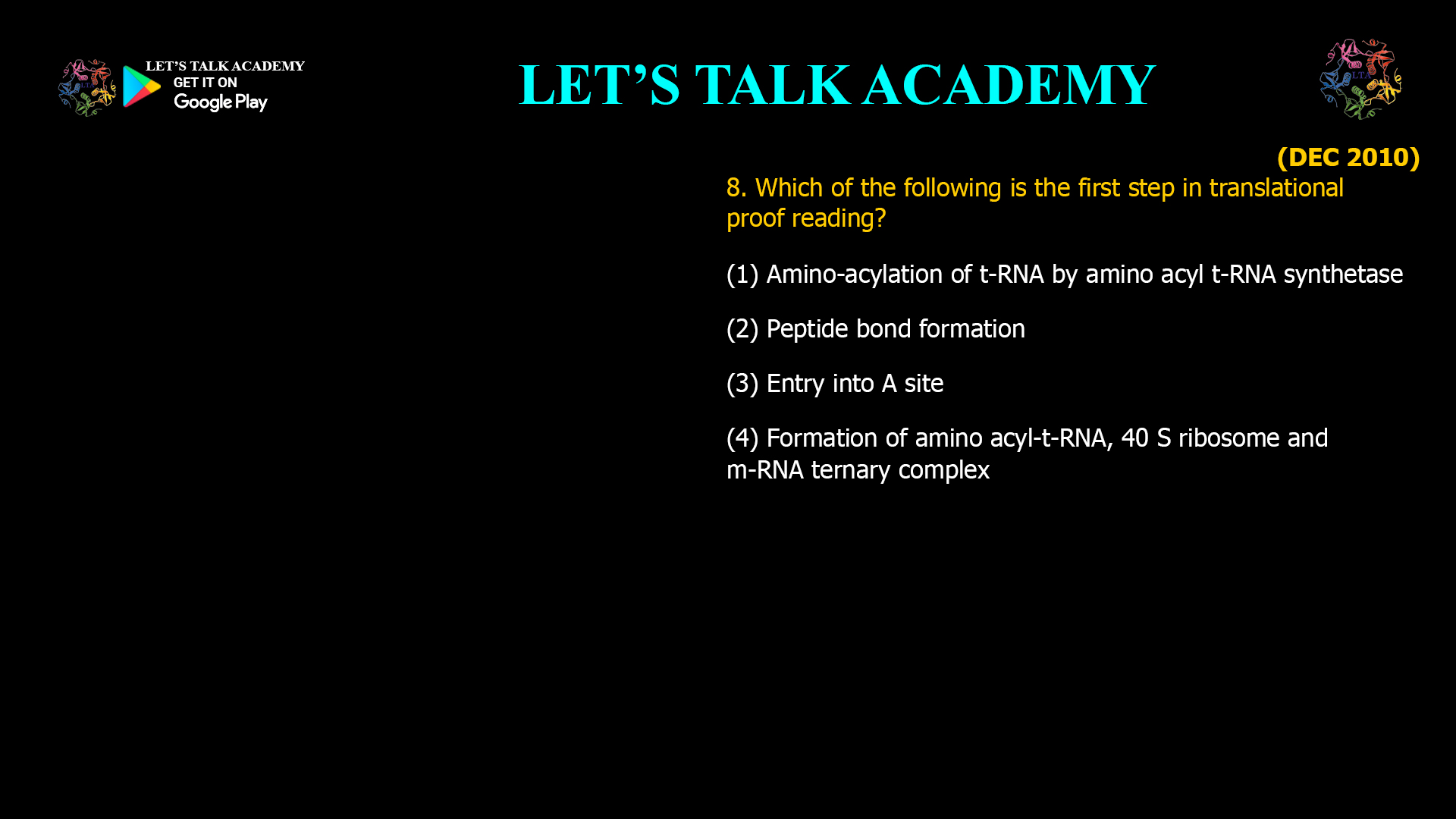
- Which of the following is the first step in translational proof reading?
(1) Amino-acylation of t-RNA by amino acyl t-RNA synthetase
(2) Peptide bond formation
(3) Entry into A site
(4) Formation of amino acyl-t-RNA, 40 S ribosome and m-RNA ternary complex
write a seo freindly artical with appropriate slug and title meta description with in 1000 words without giving refrence link also use all keyword realted to this artical and give the correct answerThe First Step in Translational Proofreading: Aminoacylation of tRNA by Aminoacyl-tRNA Synthetase
Translational proofreading is a critical process that ensures the accuracy of protein synthesis by minimizing errors during the translation of mRNA into polypeptides. The fidelity of translation depends on several quality control steps, with the first and crucial step being the aminoacylation of tRNA by aminoacyl-tRNA synthetase.
Understanding Translational Proofreading
-
Translational proofreading refers to the mechanisms that verify the correct matching of amino acids to their corresponding tRNAs and the accurate decoding of mRNA codons by the ribosome.
-
Errors in translation can lead to incorporation of incorrect amino acids, potentially resulting in dysfunctional proteins.
-
Proofreading occurs at multiple stages: aminoacylation, codon-anticodon recognition, and peptide bond formation.
The First Step: Aminoacylation of tRNA
-
Aminoacyl-tRNA synthetases (aaRS) are enzymes that charge tRNAs with their cognate amino acids, forming aminoacyl-tRNAs (aa-tRNAs).
-
This aminoacylation is the first critical checkpoint in translational proofreading.
-
aaRS enzymes have editing functions that hydrolyze incorrectly attached amino acids, ensuring high fidelity.
-
Correct aminoacylation ensures that the tRNA carries the right amino acid corresponding to its anticodon.
Why Other Options Are Not the First Step
-
Peptide bond formation (Option 2): Occurs later during elongation after the correct aa-tRNA has been delivered to the ribosome.
-
Entry into A site (Option 3): The aa-tRNA enters the ribosomal A site after aminoacylation but is not the initial proofreading step.
-
Formation of aminoacyl-tRNA, 40S ribosome, and mRNA ternary complex (Option 4): This is part of the initiation or elongation process but follows aminoacylation.
Keywords for SEO Optimization
-
Translational proofreading
-
Aminoacyl-tRNA synthetase accuracy
-
Aminoacylation of tRNA
-
Protein synthesis fidelity
-
Ribosome A site decoding
-
tRNA charging mechanism
-
Translation accuracy checkpoints
-
Amino acid-tRNA matching
-
Translation initiation complex
-
Peptide bond formation
Conclusion
The initial and most critical step in translational proofreading is the aminoacylation of tRNA by aminoacyl-tRNA synthetase. This process ensures that each tRNA is charged with the correct amino acid, setting the stage for accurate decoding and protein synthesis. Subsequent steps like entry into the ribosomal A site and peptide bond formation occur after this essential quality control checkpoint.
Correct answer: (1) Amino-acylation of t-RNA by amino acyl t-RNA synthetase
-


7 Comments
Santosh Saini
November 3, 2025First and crucial step being the amino acylation of t-RNA by aminoacyl t RNA synthetase
Divya rani
November 3, 2025The initial and important step in translation proofreading is the aminoacylation of t RNA by aminoacyl t RNA synthetase this process ensure that each tRNA charged with correct amino acid.
anjani sharma
November 3, 2025The correct selection and attachment of the amino acid to its corresponding tRNA by aminoacyl-tRNA synthetase (aminoacylation) is the first and most critical step in translational proofreading to ensure a high-fidelity polypeptide chain.
Priya khandal
November 3, 20251 is right
Pooja
November 4, 2025Amino-acylation of t-RNA by amino acyl t-RNA synthetase
Heena Mahlawat
November 5, 2025Amino acylation of tRNA by – amino acyl tRNA Synthetase
Sakshi Kanwar
November 8, 2025Amino-acylation of t-RNA by amino acyl t-RNA synthetase