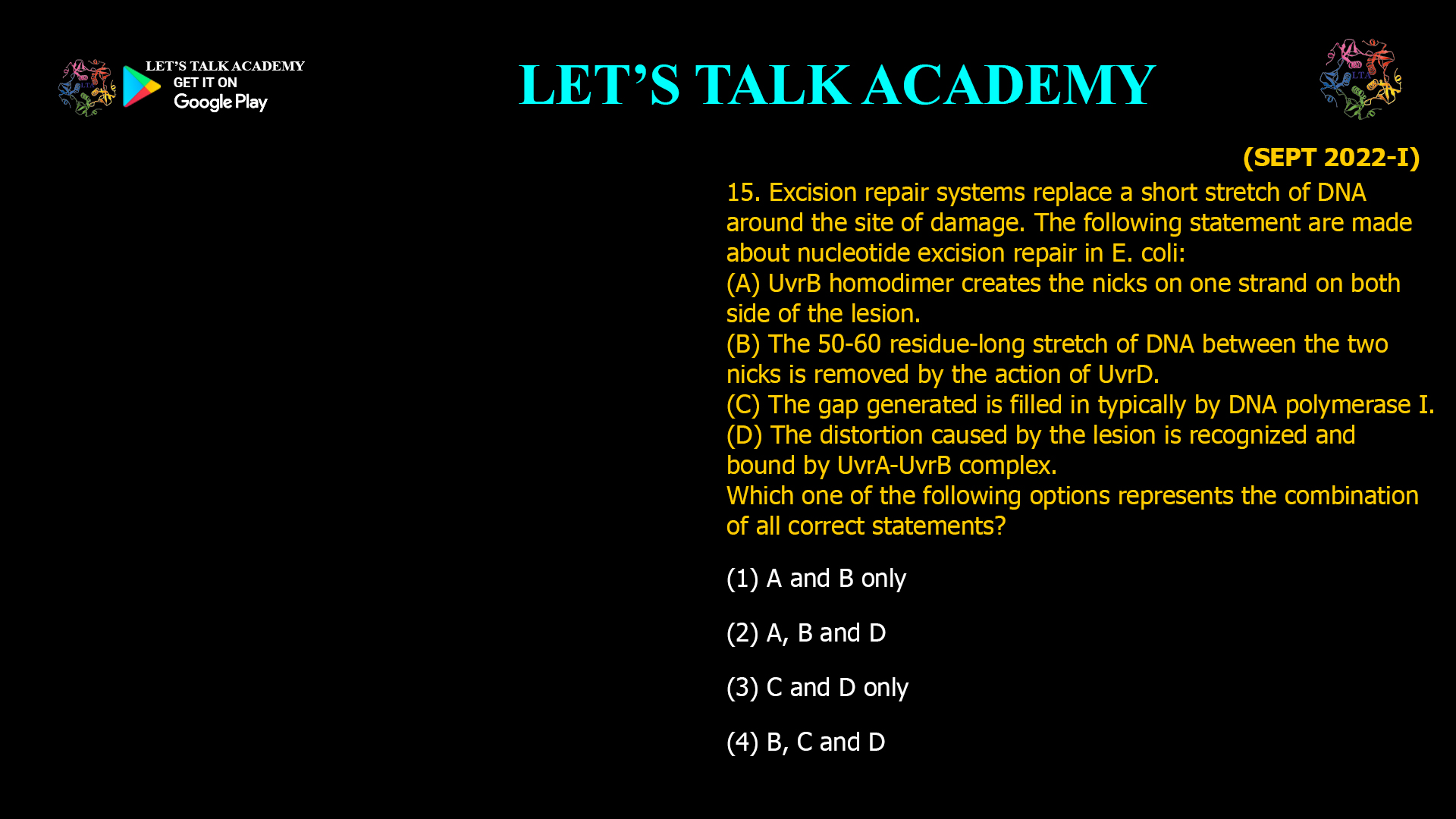
- Excision repair systems replace a short stretch of DNA around the site of damage. The following statement are made about nucleotide excision repair in E. coli:
(A) UvrB homodimer creates the nicks on one strand on both side of the lesion.
(B) The 50-60 residue-long stretch of DNA between the two nicks is removed by the action of UvrD.
(C) The gap generated is filled in typically by DNA polymerase I.
(D) The distortion caused by the lesion is recognized and bound by UvrA-UvrB complex.
Which one of the following options represents the combination of all correct statements?
(1) A and B only (2) A, B and D
(3) C and D only (4) B, C and DUnderstanding Nucleotide Excision Repair in E. coli: Roles of Uvr Proteins and DNA Polymerase I
Nucleotide excision repair (NER) is a crucial DNA repair pathway that removes bulky DNA lesions causing helix distortions, such as UV-induced pyrimidine dimers and chemical adducts. In Escherichia coli, this process is mediated by the UvrABC endonuclease complex along with other proteins like UvrD helicase and DNA polymerase I.
Key Statements About NER in E. coli
Let’s analyze the provided statements related to NER:
-
(A) UvrB homodimer creates the nicks on one strand on both sides of the lesion.
-
Incorrect. UvrB functions as a monomer bound to DNA at the lesion site. The dual incisions are made by UvrB and UvrC, not by a UvrB homodimer. Specifically, UvrB cuts the phosphodiester bond 4–5 nucleotides downstream (3′ side) of the lesion, while UvrC cuts 8 nucleotides upstream (5′ side).
-
-
(B) The 50-60 residue-long stretch of DNA between the two nicks is removed by the action of UvrD.
-
Correct. UvrD (DNA helicase II) unwinds and removes the damaged oligonucleotide segment (~12–13 nucleotides), facilitating excision of the lesion-containing strand.
-
-
(C) The gap generated is filled in typically by DNA polymerase I.
-
Correct. DNA polymerase I synthesizes new DNA to fill the gap using the undamaged strand as a template.
-
-
(D) The distortion caused by the lesion is recognized and bound by UvrA-UvrB complex.
-
Correct. The UvrA dimer, in complex with UvrB, scans the DNA and recognizes helix-distorting lesions. Upon recognition, UvrA dissociates, leaving UvrB bound at the damage site.
-
Summary of the NER Process in E. coli
-
Damage Recognition:
The UvrA-UvrB complex identifies the distorted DNA site caused by damage. -
Damage Verification and Incision:
UvrA leaves, and UvrC joins UvrB. UvrB and UvrC make dual incisions flanking the lesion. -
Excision:
UvrD helicase removes the excised oligonucleotide containing the lesion. -
Repair Synthesis:
DNA polymerase I fills in the gap. -
Ligation:
DNA ligase seals the nick, restoring DNA integrity.
Correct Combination of Statements
Based on the above:
-
(A) is incorrect.
-
(B), (C), and (D) are correct.
Therefore, the correct option is:
(4) B, C, and D
Related Keywords for SEO Optimization
-
Nucleotide excision repair E. coli
-
UvrABC endonuclease complex
-
UvrA, UvrB, UvrC proteins
-
UvrD helicase function
-
DNA polymerase I in repair
-
DNA damage recognition
-
Pyrimidine dimer repair
-
DNA excision repair mechanism
-
UV-induced DNA damage repair
-
DNA lesion excision
-
DNA repair synthesis
-
Bacterial DNA repair pathways
Conclusion
In E. coli nucleotide excision repair:
-
The UvrA-UvrB complex recognizes DNA damage (D).
-
The damaged strand is incised by UvrB and UvrC (not UvrB homodimer, so A is incorrect).
-
The excised segment (~12 nucleotides) is removed by UvrD helicase (B).
-
The gap is filled by DNA polymerase I (C).
Hence, the correct combination of true statements is B, C, and D, corresponding to option (4)
-


7 Comments
Roopal Sharma
November 7, 2025B,C and D is correct statement
Kirti Agarwal
November 8, 2025Statement B, C, D is correct
Mohd juber Ali
November 8, 2025Statement b c d correct
Anisha Beniwal
November 9, 2025B,Cand D are correct
priti khandal
November 9, 2025b c d
Heena Mahlawat
November 9, 2025Option 4
Neeraj Sharma
November 12, 2025B,C and D are correct