
1. Introduction
RNA synthesis and processing are not the final stages of RNA metabolism. In eukaryotic cells, many RNA molecules are synthesized and processed inside the nucleus, while their functional activities may occur in the cytoplasm or in specific cellular compartments.
Therefore, RNA must be transported from one cellular location to another.
The movement of RNA molecules between cellular compartments is known as RNA transport.
For many eukaryotic RNAs, the most important transport pathway is movement from the nucleus to the cytoplasm.
A simplified pathway is:
DNA
↓
Transcription
↓
Primary RNA
↓
RNA Processing
↓
RNA Quality Control
↓
Nuclear Export
↓
Cytoplasm
↓
Translation / RNA Function
RNA transport is a highly regulated process. The cell does not simply allow every RNA molecule to leave the nucleus. Instead, RNA is usually associated with specific proteins and transported as a ribonucleoprotein complex.
2. Definition of RNA Transport
2.1 Basic Definition
RNA transport is the regulated movement of RNA molecules from one cellular compartment to another through specialized transport pathways.
In eukaryotic cells, this commonly involves:
Nucleus → Cytoplasm
However, RNA can also be transported:
- within the nucleus,
- from nucleus to cytoplasm,
- from cytoplasm to specific cellular regions,
- into organelles,
- between different cellular compartments.
3. Importance of RNA Transport
RNA transport is essential because different RNA molecules perform different functions at different cellular locations.
For example:
- mRNA must reach the cytoplasm for translation.
- tRNA must reach the cytoplasm to participate in translation.
- rRNA must be incorporated into ribosomal subunits.
- Some RNAs must remain inside the nucleus.
- Some RNAs are transported to mitochondria or other specific locations.
- Certain mRNAs are transported to particular regions of the cytoplasm.
Therefore, RNA transport contributes directly to the spatial regulation of gene expression.
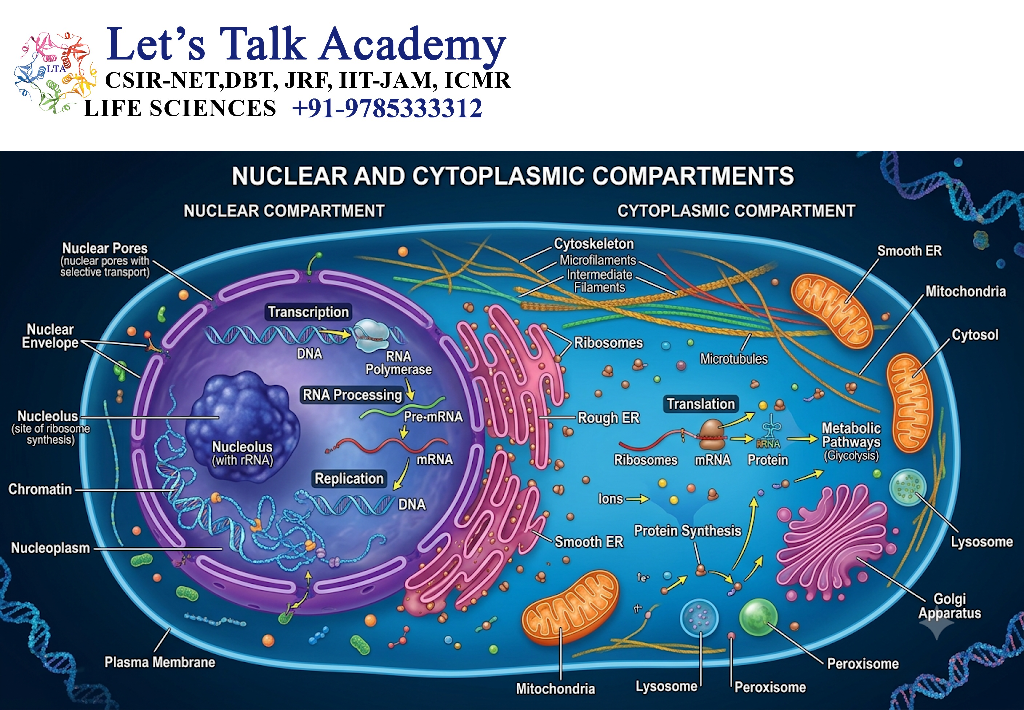
4. Nuclear and Cytoplasmic Compartments
4.1 Nucleus
The nucleus contains:
- DNA,
- transcription machinery,
- RNA-processing machinery,
- nuclear RNA-binding proteins,
- nuclear bodies.
Many RNA molecules are synthesized and initially processed here.
4.2 Cytoplasm
The cytoplasm contains:
- ribosomes,
- translation machinery,
- RNA degradation machinery,
- many RNA-binding proteins.
Protein-coding mRNAs generally need to reach the cytoplasm to be translated.
5. Nuclear Export
5.1 Definition
Nuclear export is the process by which RNA molecules are transported from the nucleus to the cytoplasm through the nuclear pore complexes.
This is a selective and regulated process.
The general pathway is:
Processed RNA
↓
RNA-protein complex formation
↓
Export factor binding
↓
Nuclear pore complex
↓
Cytoplasm
6. Nuclear Pore Complex
6.1 Definition
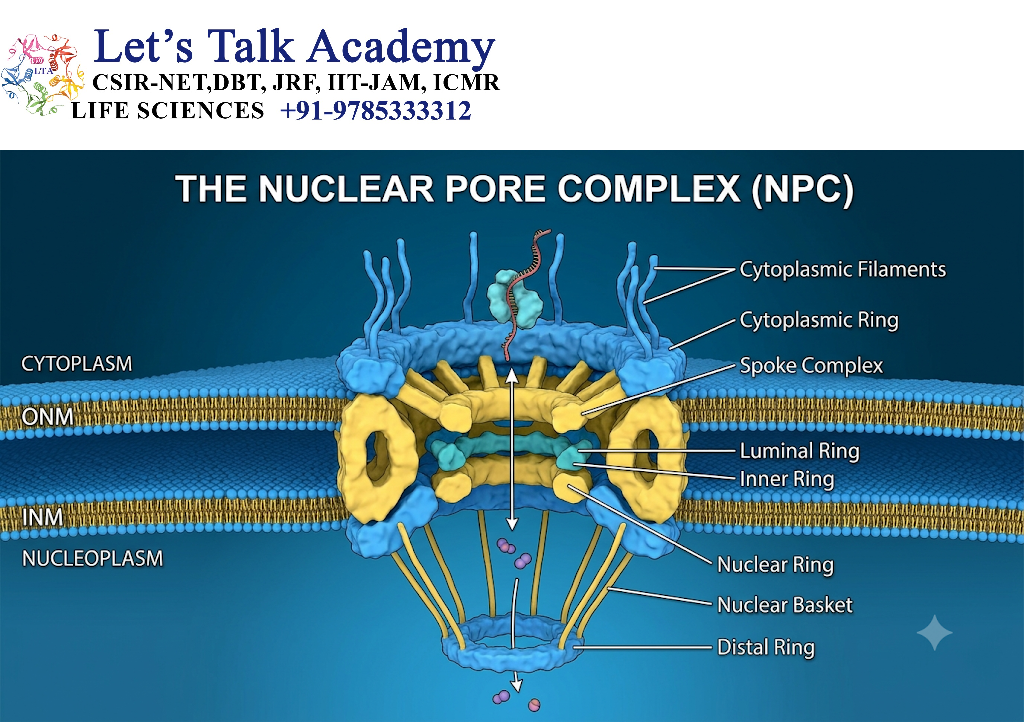
The nuclear pore complex (NPC) is a large protein assembly embedded in the nuclear envelope.
It provides a controlled pathway for movement between:
- nucleus,
- cytoplasm.
6.2 Structure
The nuclear pore complex is composed of proteins called:
nucleoporins
These proteins form a selective channel through the nuclear envelope.
6.3 Functions
The NPC controls the movement of:
- proteins,
- RNA,
- ribonucleoprotein complexes,
- other macromolecules.
Small molecules may pass relatively freely, whereas large macromolecules generally require regulated transport mechanisms.
7. RNA as a Ribonucleoprotein Complex
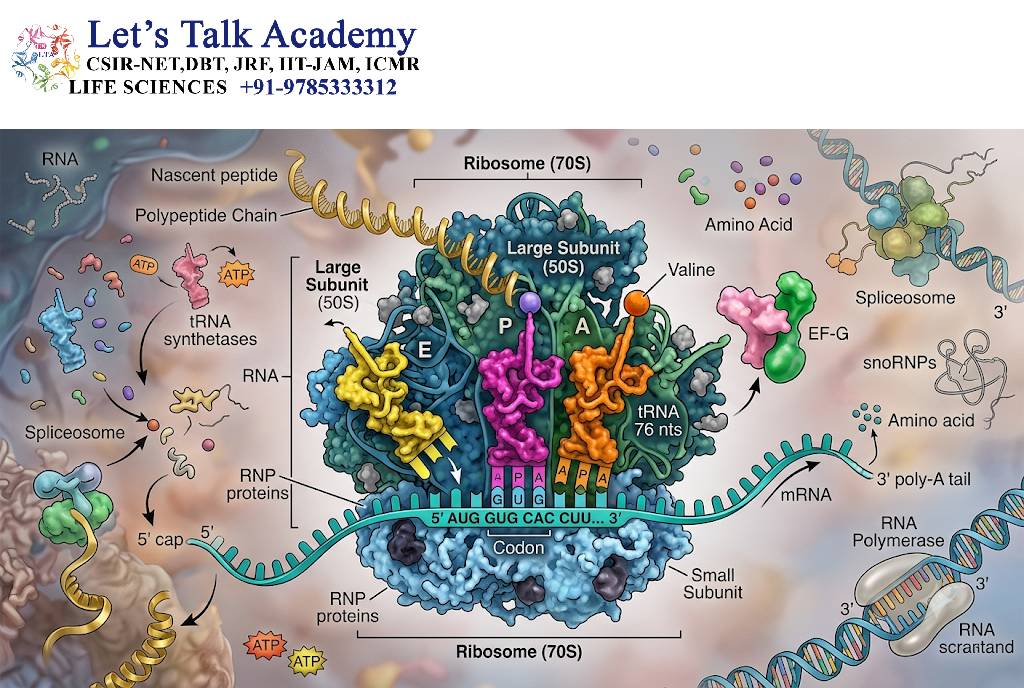
RNA molecules rarely travel alone through the nuclear export pathway.
Instead, RNA associates with proteins to form:
Ribonucleoprotein complexes (RNPs)
These proteins can:
- protect RNA,
- determine RNA localization,
- recruit export machinery,
- regulate RNA stability,
- participate in quality control.
Thus:
RNA + proteins → RNP → transport
8. mRNA Transport
8.1 Formation of Mature mRNA
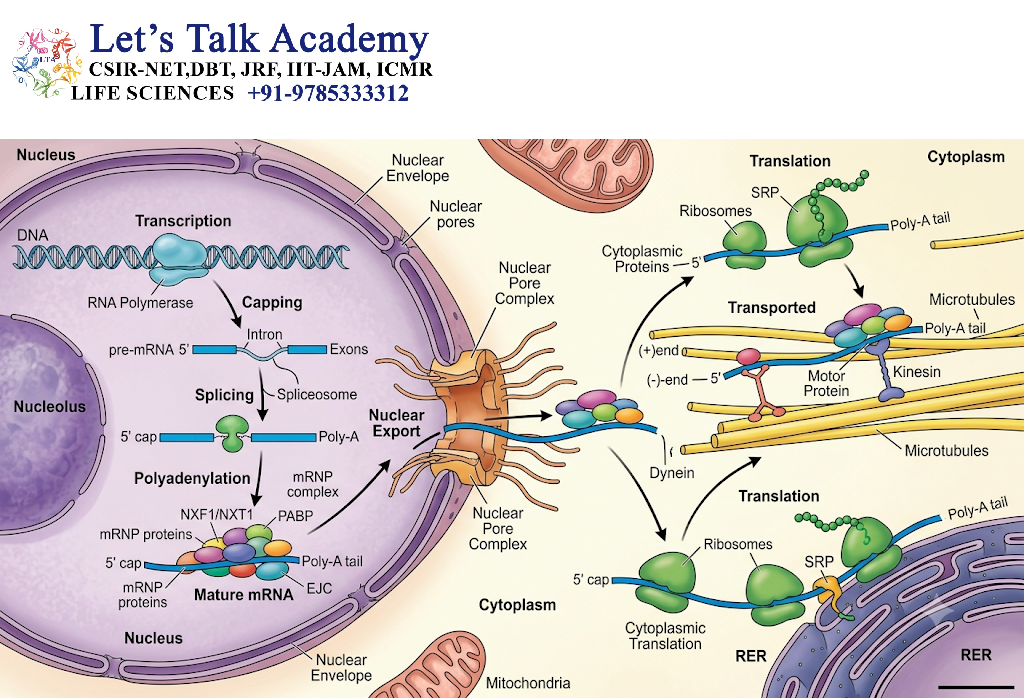
A typical eukaryotic mRNA undergoes:
- 5′ capping,
- splicing,
- 3′ end processing,
- polyadenylation,
- additional modifications.
After proper processing, it can be assembled into a messenger ribonucleoprotein complex, or mRNP.
8.2 Export of mRNA
Mature mRNPs interact with nuclear export machinery and pass through the nuclear pore complex.
The general pathway is:
Pre-mRNA
↓
Processing
↓
Mature mRNA
↓
mRNP formation
↓
Nuclear export
↓
Cytoplasm
↓
Translation
9. mRNA Export Receptor
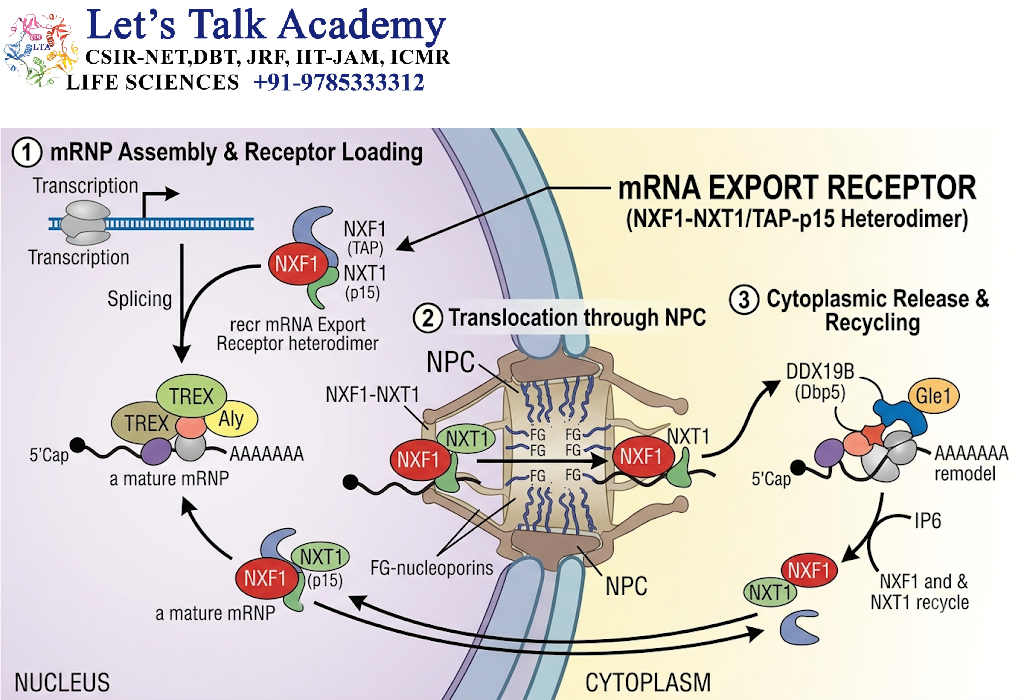
A major conserved mRNA export pathway involves the heterodimeric export receptor:
NXF1–NXT1
In mammals, NXF1 is also known as TAP.
This export receptor interacts with components of the nuclear pore complex and helps transport mature mRNPs from the nucleus to the cytoplasm.
10. Role of TREX Complex
10.1 Definition
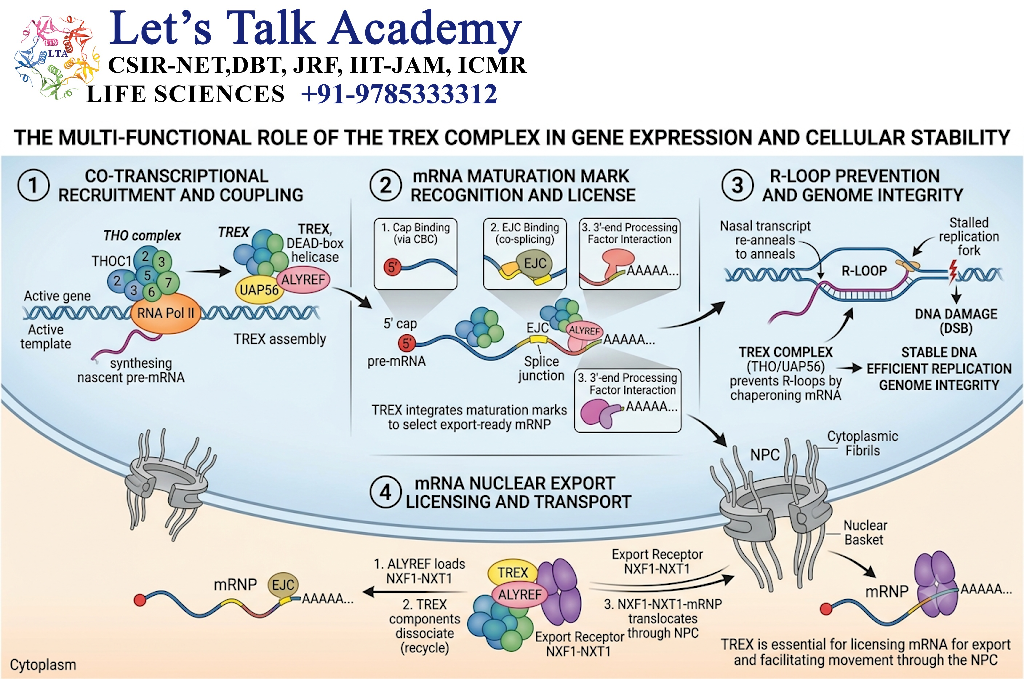
The TREX complex is an important factor in coupling transcription, RNA processing, and mRNA export.
TREX stands for:
Transcription-Export complex
10.2 Function
TREX-associated proteins help connect properly processed mRNA with export machinery.
Thus:
Transcription
↓
RNA Processing
↓
TREX Recruitment
↓
Export Factor Recruitment
↓
Nuclear Export
This coupling increases the efficiency and accuracy of mRNA transport.
11. Importance of mRNA Processing Before Export
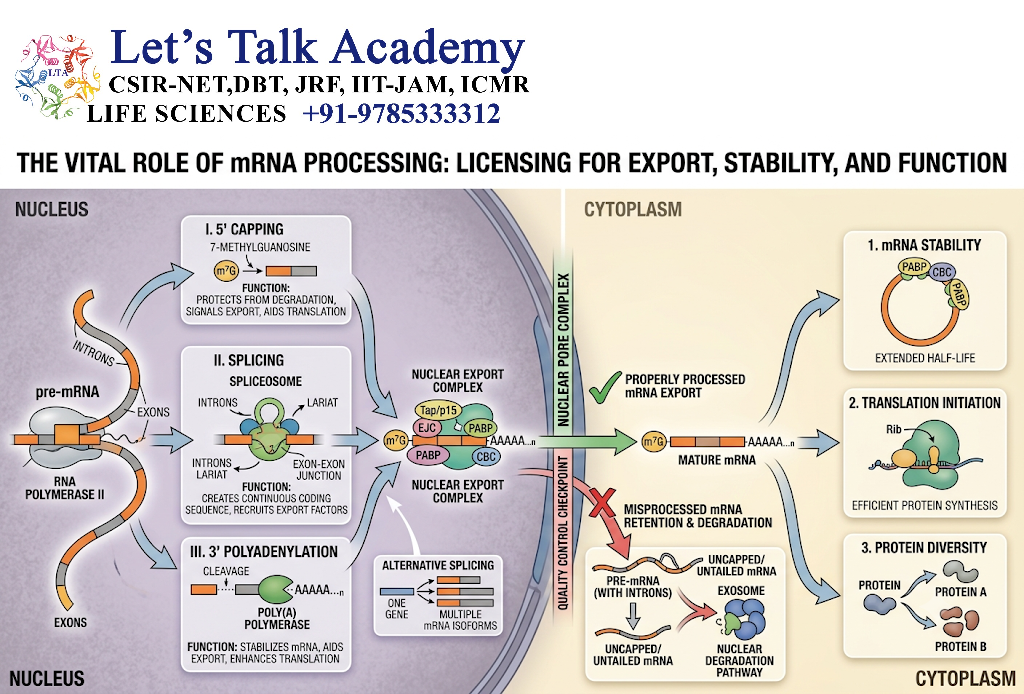
The nucleus contains quality-control mechanisms that help ensure that only appropriately processed RNA molecules are exported efficiently.
A mature mRNA generally has:
- a proper 5′ cap,
- correctly processed intron-exon structure,
- an appropriate 3′ end,
- associated RNA-binding proteins.
Improperly processed RNA may be retained in the nucleus and degraded.
12. RNA Export and Quality Control
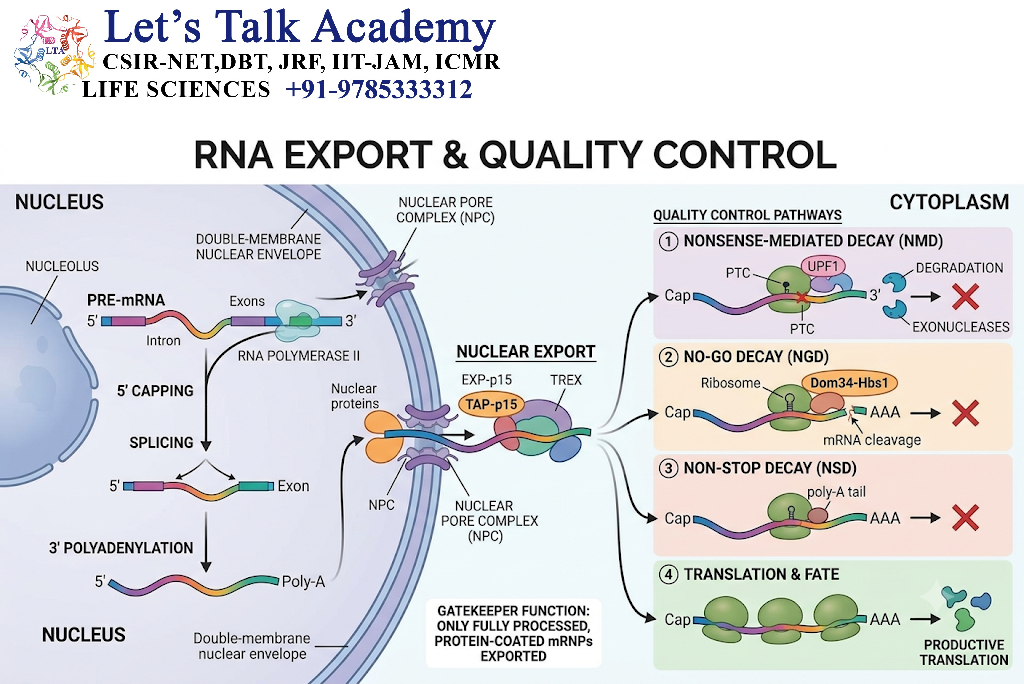
RNA export is therefore not simply a transportation process.
It is also connected to RNA quality control.
The cell can use RNA-processing status as an indication of whether a transcript is ready for export.
The simplified principle is:
Correctly processed RNA → efficient export
Defective RNA → nuclear retention and degradation
13. Role of the 5′ Cap in RNA Transport
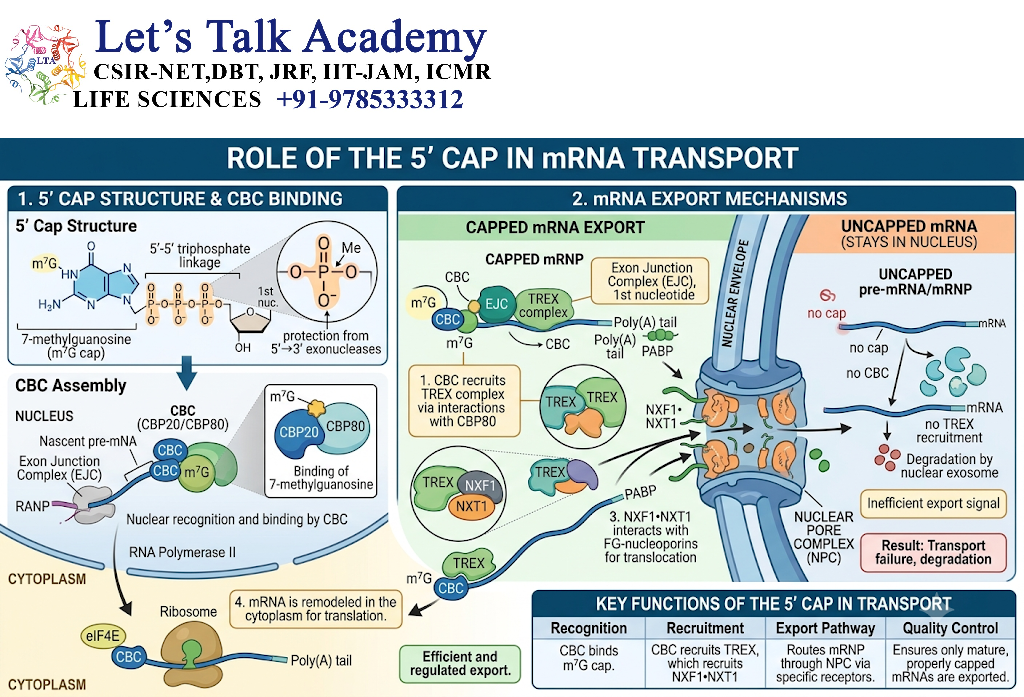
The 5′ cap is important for the maturation and transport of many eukaryotic mRNAs.
Cap-binding proteins recognize the 5′ cap and participate in nuclear RNA processing and export pathways.
In the nucleus, the cap is recognized by the:
Cap-Binding Complex (CBC)
The CBC interacts with other proteins involved in RNA maturation and export.
14. Role of Splicing in mRNA Export
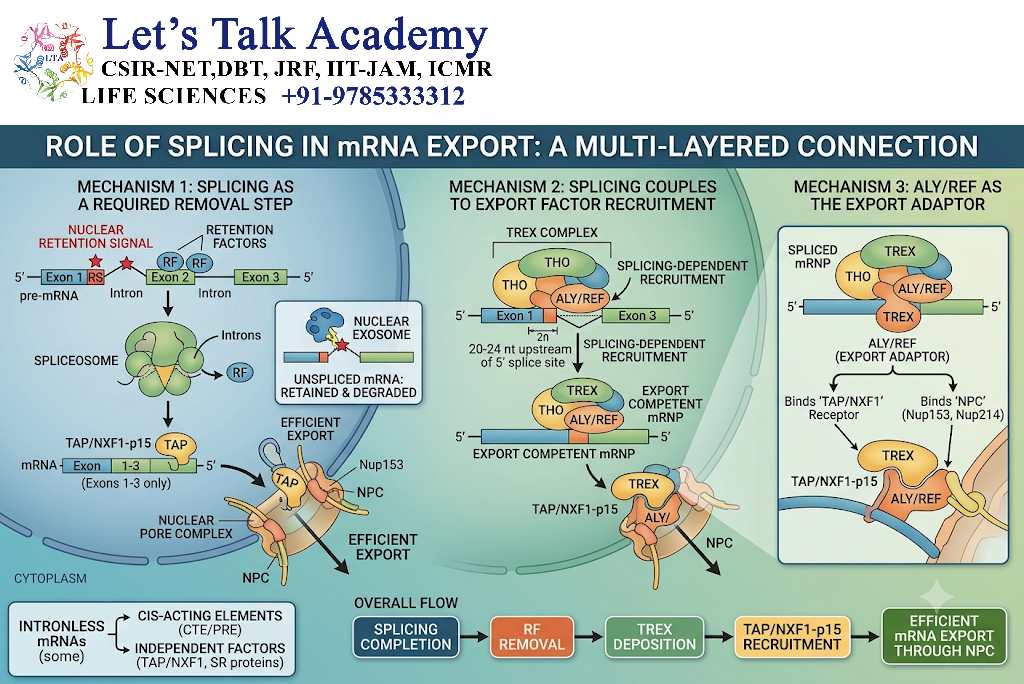
Correct splicing can promote the assembly of export-competent mRNPs.
Splicing factors can recruit or help organize proteins that contribute to mRNA export.
Therefore, RNA splicing and export are functionally interconnected.
15. Exon Junction Complex
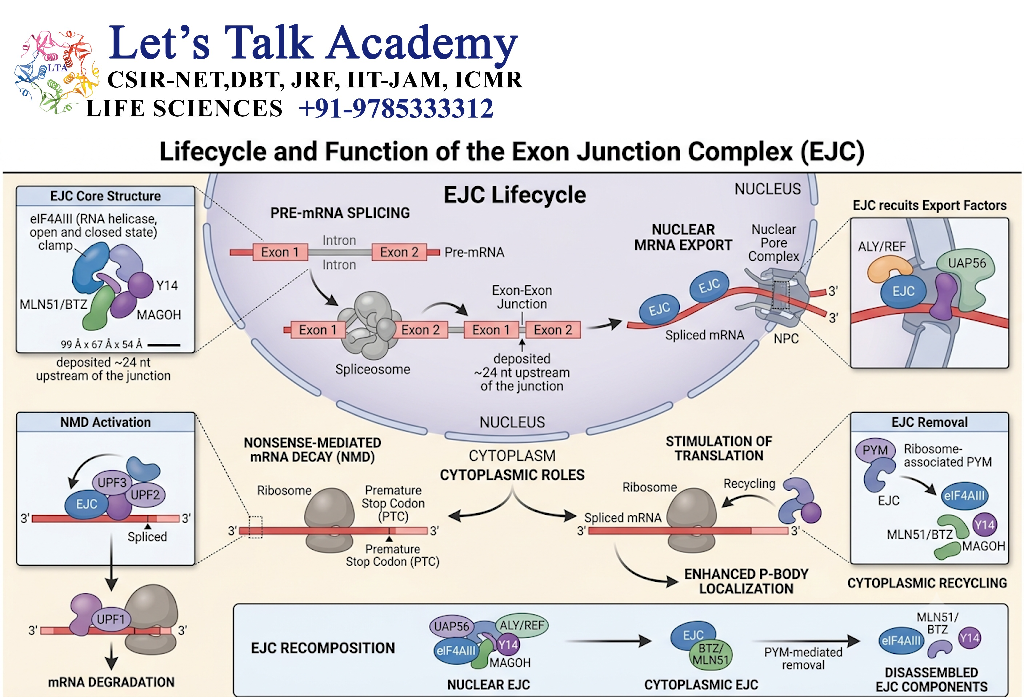
15.1 Definition
The exon junction complex (EJC) is a multiprotein complex deposited near exon-exon junctions during pre-mRNA splicing.
15.2 Functions
The EJC can participate in:
- mRNA export,
- mRNA localization,
- translation regulation,
- RNA surveillance.
Thus, splicing leaves molecular markers on mRNA that can influence its later fate.
16. Export of tRNA
tRNA molecules are synthesized and processed in the nucleus in eukaryotic cells.
Mature tRNAs are then exported to the cytoplasm.
The cytoplasmic tRNA participates in translation by delivering amino acids to the ribosome.
A simplified pathway is:
tRNA gene
↓
Pre-tRNA
↓
tRNA processing
↓
Mature tRNA
↓
Nuclear export
↓
Cytoplasm
↓
Translation
17. tRNA Export Factors
Different organisms use different export systems.
In mammals, the major tRNA export receptor is:
Exportin-t
Exportin-t recognizes properly processed tRNA and facilitates its transport through the nuclear pore complex.
The transport process is linked to the Ran GTPase system.
18. Ran GTPase System
18.1 Definition
Ran is a small GTP-binding protein that provides directionality to many nuclear transport reactions.
It exists primarily in two nucleotide-bound states:
- Ran-GTP,
- Ran-GDP.
18.2 Ran Gradient
A high concentration of Ran-GTP is maintained in the nucleus, while Ran-GDP predominates in the cytoplasm.
This gradient contributes to the directionality of nuclear transport.
19. Import and Export Directionality
The Ran system can be summarized as:
Nucleus → high Ran-GTP
Cytoplasm → high Ran-GDP
This difference helps transport receptors determine whether cargo should be:
- imported,
- exported.
For certain RNA export pathways, including Exportin-mediated transport, Ran-GTP contributes to formation of export complexes.
20. Export of rRNA
rRNA processing is closely associated with ribosome biogenesis.
In eukaryotic cells, most ribosomal RNA is produced and processed in the nucleolus.
rRNA associates with ribosomal proteins to form ribosomal subunits.
The resulting ribosomal subunits are exported through the nuclear pore complex into the cytoplasm.
The pathway is:
rRNA synthesis
↓
rRNA processing
↓
Ribosomal protein association
↓
Ribosomal subunit assembly
↓
Nuclear export
↓
Cytoplasmic maturation
↓
Functional ribosome
21. Nucleolus and RNA Transport
The nucleolus is the major site of:
- rRNA synthesis,
- rRNA processing,
- ribosome assembly.
It is not surrounded by a membrane, but it forms a specialized nuclear compartment.
Ribosomal subunits must eventually leave the nucleolus, pass through the nucleoplasm, and exit the nucleus.
22. Export of Small Nuclear and Small Nucleolar RNAs
Different small RNAs have specialized transport pathways.
These include:
- snRNAs,
- snoRNAs,
- other regulatory RNAs.
Some snRNAs undergo unusual transport cycles in which they are exported to the cytoplasm for maturation and then imported back into the nucleus.
23. snRNA Transport
Certain spliceosomal snRNAs are synthesized in the nucleus but undergo a cytoplasmic phase during their maturation.
A simplified pathway is:
snRNA synthesis
↓
Nuclear processing
↓
Cytoplasmic export
↓
Protein assembly
↓
Nuclear re-import
↓
snRNP formation/function
This illustrates that RNA transport can involve multiple rounds of movement between compartments.
24. RNA Import Into the Nucleus
RNA transport is not restricted to nuclear export.
Some RNAs can also move:
Cytoplasm → Nucleus
This is known as RNA nuclear import.
Examples include certain:
- tRNAs,
- small RNAs,
- viral RNAs,
- regulatory RNAs.
The mechanisms depend on the particular RNA and organism.
25. RNA Localization
RNA transport can also refer to movement of RNA to specific regions within a cell.
This is called:
RNA localization
Rather than being distributed randomly throughout the cytoplasm, certain RNAs are transported to precise cellular locations.
26. Importance of RNA Localization
RNA localization allows proteins to be synthesized where they are needed.
This provides spatial control over gene expression.
For example:
RNA transport → localized mRNA → local translation → localized protein
This is particularly important in:
- neurons,
- developing embryos,
- polarized cells,
- migrating cells.
27. Cis-Acting Localization Elements
RNA localization is often controlled by specific sequences or structural elements within the RNA itself.
These are called:
cis-acting localization elements
They can be present in:
- 3′ untranslated regions,
- 5′ untranslated regions,
- coding regions.
These sequences are recognized by RNA-binding proteins.
28. Trans-Acting Factors
Proteins that recognize RNA localization elements are called:
trans-acting factors
They can bind specific RNA sequences and recruit transport machinery.
Therefore:
RNA localization element + RNA-binding protein → transport complex
29. RNA Transport Along the Cytoskeleton
Long-distance transport within the cytoplasm often depends on the cytoskeleton.
Major cytoskeletal components include:
- microtubules,
- actin filaments.
Motor proteins can transport RNA-protein complexes along these structures.
30. Motor Proteins
Important motor protein families include:
- kinesins,
- dyneins,
- myosins.
Different motors move cargo along different cytoskeletal tracks.
For example:
Kinesin → generally moves toward the plus end of microtubules
Dynein → generally moves toward the minus end
Myosin → moves along actin filaments
The exact direction and biological role depend on the specific motor and cellular context.
31. RNA Transport in Neurons
Neurons provide an important example of RNA localization.
Neurons contain:
- cell bodies,
- dendrites,
- axons.
Some mRNAs are transported from the neuronal cell body into dendrites or axons.
Local translation can then produce proteins near the site where they are required.
This is important for:
- synaptic function,
- neuronal plasticity,
- axonal maintenance,
- local cellular responses.
32. RNA Transport and Local Translation
A localized mRNA can remain translationally repressed during transport.
After reaching its destination, regulatory signals may activate translation.
The general principle is:
mRNA synthesis
↓
Transport
↓
Localization
↓
Translation activation
↓
Local protein synthesis
This provides precise spatial control over protein production.
33. RNA Granules
Some RNA molecules are transported in specialized non-membrane-bound assemblies known as:
RNA granules
Examples include:
- processing bodies,
- stress granules,
- neuronal RNA granules.
These structures can contain:
- mRNA,
- RNA-binding proteins,
- translation factors,
- RNA decay proteins.
34. Stress Granules
During cellular stress, some untranslated mRNAs can be temporarily stored in stress granules.
These granules may contain:
- untranslated mRNAs,
- RNA-binding proteins,
- translation-associated factors.
They can contribute to temporary redistribution of mRNAs during stress.
35. Processing Bodies
Processing bodies (P-bodies) are cytoplasmic structures associated with mRNA storage and decay.
They can contain proteins involved in:
- deadenylation,
- decapping,
- RNA degradation.
P-bodies therefore participate in the regulation of mRNA fate after transport to the cytoplasm.
36. RNA Transport and Translation
Once mature mRNA reaches the cytoplasm, it can interact with translation machinery.
The basic pathway is:
Nuclear transcription
↓
RNA processing
↓
Nuclear export
↓
Cytoplasmic localization
↓
Translation
The efficiency of translation can depend on where the RNA is localized and which proteins are associated with it.
37. RNA Export Receptors
Different classes of RNA use different transport receptors.
| RNA type | Important transport system |
|---|---|
| mRNA | NXF1–NXT1 pathway |
| tRNA | Exportin-t and related pathways |
| Some other structured RNAs | Exportin-dependent pathways |
| Ribosomal subunits | Multiple export factors |
The exact mechanism can differ according to RNA type and organism.
38. Nuclear Export and Exportins
Exportins are members of the karyopherin family of nuclear transport receptors.
They recognize specific cargoes and help transport them through the nuclear pore complex.
Many Exportin-mediated pathways depend on:
Ran-GTP
The cargo specificity differs among exportins.
39. Exportin-5
Exportin-5 is an important nuclear export receptor for certain structured RNAs.
It is particularly associated with the export of precursor microRNAs from the nucleus to the cytoplasm.
The simplified pathway is:
pri-miRNA
↓
Nuclear processing
↓
pre-miRNA
↓
Exportin-5
↓
Cytoplasm
↓
Dicer processing
↓
Mature miRNA
40. miRNA Transport
MicroRNA biogenesis provides a clear example of coordinated RNA processing and transport.
The pathway is:
miRNA gene
↓
pri-miRNA
↓
Drosha processing
↓
pre-miRNA
↓
Exportin-5-mediated export
↓
Cytoplasm
↓
Dicer processing
↓
Mature miRNA
↓
RISC
↓
Target RNA regulation
41. RNA Transport and Quality Control
RNA transport is closely connected with surveillance mechanisms.
The cell must distinguish:
functional RNA
from
defective RNA
before export.
Defective transcripts may be:
- retained in the nucleus,
- processed further,
- returned to processing pathways,
- degraded.
42. Nuclear Retention
Some RNAs are intentionally retained in the nucleus.
Nuclear retention can occur because of:
- RNA structure,
- RNA-binding proteins,
- specific sequence elements,
- incomplete processing,
- regulatory mechanisms.
Therefore, lack of export is not always a defect; it can also be a regulated cellular function.
43. Nuclear RNA Retention as Regulation
Certain long non-coding RNAs remain in the nucleus and regulate:
- chromatin,
- transcription,
- nuclear organization,
- gene expression.
Thus:
RNA retention → nuclear localization → specific regulatory function
44. Long Non-Coding RNA Transport
Long non-coding RNAs (lncRNAs) can be localized to:
- nucleus,
- cytoplasm,
- specific organelles,
- particular cellular regions.
Their localization often determines their function.
44.1 Nuclear lncRNAs
Nuclear lncRNAs can influence:
- chromatin organization,
- transcription,
- RNA processing.
44.2 Cytoplasmic lncRNAs
Cytoplasmic lncRNAs can influence:
- mRNA stability,
- translation,
- signaling pathways,
- RNA-protein interactions.
45. RNA Transport Into Organelles
Some RNA molecules are transported into cellular organelles.
Important examples include transport to:
- mitochondria,
- chloroplasts in plants.
The mechanisms differ substantially from nuclear export and depend on RNA sequence, structure, and RNA-binding proteins.
46. Mitochondrial RNA Transport
Mitochondria contain their own genome and produce their own RNA molecules.
However, many mitochondrial proteins are encoded by nuclear genes.
RNA or RNA-processing factors may therefore need to be targeted to mitochondria depending on the organism and pathway.
Some specialized RNA import mechanisms have also evolved in particular organisms.
47. RNA Transport and Gene Regulation
RNA transport can regulate gene expression by determining where an RNA molecule is available.
The cell can control:
- RNA export,
- RNA localization,
- translation,
- RNA storage,
- RNA degradation.
Thus, RNA transport represents an important post-transcriptional regulatory mechanism.
48. Regulation of RNA Transport
RNA transport is controlled by several factors.
These include:
- RNA sequence,
- RNA secondary structure,
- RNA modifications,
- RNA-binding proteins,
- export receptors,
- cellular signaling,
- nuclear pore components,
- RNA processing status.
49. RNA-Binding Proteins
RNA-binding proteins are central regulators of RNA transport.
They can:
- recognize RNA sequences,
- recognize RNA structures,
- recruit transport receptors,
- protect RNA,
- control translation,
- determine RNA localization.
An RNA molecule can therefore acquire different destinations depending on the proteins associated with it.
50. RNA Modifications and Transport
Chemical modifications of RNA can influence its interaction with proteins.
These modifications may therefore affect:
- RNA stability,
- localization,
- export,
- translation.
For example, certain modifications can alter the recognition of RNA by RNA-binding proteins.
Thus:
RNA modification → altered protein interaction → altered transport or localization
51. Coupling of RNA Processing and Transport
RNA processing and transport are strongly connected.
The sequence can be represented as:
Transcription
↓
5′ Capping
↓
Splicing
↓
3′ End Processing
↓
mRNP Assembly
↓
Quality Control
↓
Nuclear Export
↓
Cytoplasmic Localization
↓
Translation
This coupling ensures that RNA is transported only after appropriate maturation.
52. RNA Transport and mRNP Remodeling
RNA-protein complexes change their composition as they move between the nucleus and cytoplasm.
During nuclear export:
Nuclear proteins → export-associated proteins
After reaching the cytoplasm:
Export proteins are released or exchanged → cytoplasmic RNA-binding proteins associate
This process is called mRNP remodeling.
It helps prepare the RNA for its next stage of function.
53. Directionality of RNA Transport
RNA transport is directional and regulated.
For nuclear export:
Nucleus → Cytoplasm
For some import pathways:
Cytoplasm → Nucleus
For intracellular localization:
Cellular source → specific target region
Directionality is achieved through:
- transport receptors,
- Ran GTPase system,
- molecular motors,
- RNA localization signals.
54. RNA Transport and Cellular Organization
RNA transport allows cells to organize gene expression spatially.
Instead of producing every protein everywhere, cells can:
- synthesize an mRNA,
- transport it to a specific location,
- activate translation there,
- produce the protein locally.
This is particularly useful in large and highly polarized cells.
55. RNA Transport During Development
During development, RNA localization can establish spatial differences in gene expression.
Localized mRNAs can produce proteins at specific regions of developing cells.
This can contribute to:
- cell polarity,
- differentiation,
- developmental patterning,
- tissue formation.
56. RNA Transport During Cellular Stress
Cellular stress can change RNA distribution.
Stress can alter:
- nuclear export,
- translation,
- RNA storage,
- RNA degradation,
- RNA granule formation.
These changes allow cells to rapidly reorganize gene expression.
57. Defects in RNA Transport
Abnormal RNA transport can disrupt gene expression.
Potential consequences include:
- nuclear accumulation of mRNA,
- reduced protein synthesis,
- abnormal RNA localization,
- altered RNA stability,
- defective cellular signaling.
Because RNA transport affects many cellular processes, defects can have widespread effects.
58. RNA Transport and Disease
Alterations in RNA transport and localization have been studied in several disease contexts.
Abnormalities may involve:
- nuclear pore proteins,
- RNA-binding proteins,
- export factors,
- RNA localization machinery,
- RNA degradation pathways.
These defects can affect neuronal function, development, cellular stress responses, and other biological processes.
59. Comparison of Nuclear Export Pathways
| Feature | mRNA Export | tRNA Export | pre-miRNA Export |
|---|---|---|---|
| Major cargo | Mature mRNA | Mature tRNA | pre-miRNA |
| Major factor | NXF1–NXT1 | Exportin-t | Exportin-5 |
| NPC involvement | Yes | Yes | Yes |
| Ran-GTP dependence | NXF1 pathway is distinct from classical Ran-dependent export | Important | Important |
| Main destination | Cytoplasm | Cytoplasm | Cytoplasm |
| Major next function | Translation | Translation | Further miRNA processing |
60. Nuclear Export Versus RNA Localization
| Feature | Nuclear Export | RNA Localization |
|---|---|---|
| Main movement | Nucleus → Cytoplasm | Within cytoplasm/cell |
| Major machinery | Nuclear pore complex and export factors | Cytoskeleton, motors, RNA-binding proteins |
| Main purpose | Deliver RNA to cytoplasm | Deliver RNA to specific cellular region |
| Major examples | mRNA, tRNA, pre-miRNA | Neuronal and developmental mRNAs |
61. Major Transport Machinery
| Component | Major function |
|---|---|
| Nuclear pore complex | Gateway between nucleus and cytoplasm |
| Nucleoporins | Structural and transport components of NPC |
| NXF1–NXT1 | Major mRNA export receptor |
| Exportin-t | tRNA export |
| Exportin-5 | Export of certain structured RNAs, including pre-miRNA |
| Ran GTPase | Directionality of many nuclear transport pathways |
| TREX complex | Coupling transcription/RNA processing to mRNA export |
| RNA-binding proteins | Cargo recognition and localization |
| Kinesins | Cytoplasmic RNA transport along microtubules |
| Dyneins | Cytoplasmic transport toward microtubule minus ends |
| Myosins | Transport along actin filaments |


