
Principles of Mechanism of Enzyme Catalysis
Enzymes are highly specialized biological catalysts that accelerate chemical reactions under the relatively mild conditions found inside living cells. Almost every important biochemical process depends on enzyme-mediated catalysis. Reactions involved in metabolism, DNA replication, RNA synthesis, protein synthesis, cellular respiration, photosynthesis, signal transduction, lipid metabolism, carbohydrate metabolism, and degradation of biomolecules would generally proceed far too slowly to sustain life without enzymes.
The catalytic activity of an enzyme arises from its three-dimensional structure. When a polypeptide folds into its functional conformation, amino acid residues that may be widely separated in the primary sequence can come together to form a specialized region called the active site. This region provides a highly organized chemical environment in which substrate recognition, binding, orientation, chemical transformation, and product release can occur.
The mechanism of enzyme catalysis is much more sophisticated than simple substrate binding. An enzyme does not merely hold a substrate in place. It uses a combination of molecular recognition, proximity, orientation, electrostatic interactions, hydrogen bonding, acid-base chemistry, covalent interactions, metal-ion coordination, substrate distortion, and transition-state stabilization to provide a reaction pathway with a lower activation barrier.
The fundamental principle of enzyme catalysis is that an enzyme increases the rate of a reaction by lowering the activation free energy required to reach the transition state. It does not alter the overall standard Gibbs free-energy change of the reaction and does not change the equilibrium constant.
For a general reversible reaction:
S ⇌ P
the standard Gibbs free-energy change is related to the equilibrium constant by:
ΔG° = −RT ln Kₑq
An enzyme does not change Kₑq. Instead, it lowers the activation free energy required for the conversion of substrate into product.
The catalytic effect can therefore be represented as:
ΔG‡₍enzyme₎ < ΔG‡₍uncatalyzed₎
This apparently simple principle explains the enormous catalytic power of enzymes.
1. Introduction to Enzyme Catalysis
A chemical reaction requires reactant molecules to pass through one or more high-energy configurations before products can be formed. Even when a reaction is thermodynamically favorable, it may occur extremely slowly because the reactants must overcome a substantial activation barrier.
A simplified reaction pathway can be written as:
Substrate → Transition state → Product
The transition state represents a high-energy arrangement in which bonds are partially broken, partially formed, or undergoing significant changes in geometry and charge distribution. Because the transition state is highly unstable, the probability that molecules will spontaneously reach this state can be very low.
An enzyme increases the probability of productive reaction by providing an alternative pathway.
The basic catalytic cycle can be represented as:
E + S ⇌ ES → EP → E + P
Here, E represents the enzyme, S represents the substrate, ES represents the enzyme-substrate complex, EP represents the enzyme-product complex, and P represents the product.
The enzyme participates in the reaction but is regenerated at the end of the catalytic cycle. Consequently, a single enzyme molecule can catalyze many successive reactions.
The ability of enzymes to recognize particular substrates is based on the chemical and structural complementarity between the substrate and active site. However, binding alone is not sufficient for catalysis. Productive binding requires the substrate to adopt an appropriate orientation and conformation so that the catalytic residues can interact with the reactive groups.
Thus, enzyme catalysis involves two closely connected processes: molecular recognition and chemical transformation.
2. Thermodynamic Basis of Enzyme Catalysis
Thermodynamics and kinetics describe different aspects of a chemical reaction.
Thermodynamics determines the energetic relationship between reactants and products and therefore determines the equilibrium position. Kinetics describes the rate at which the reaction approaches equilibrium.
For a reversible reaction:
S ⇌ P
the equilibrium constant is related to the standard Gibbs free-energy change:
ΔG° = −RT ln Kₑq
If Kₑq is large, products are favored under standard conditions. If Kₑq is small, reactants are favored.
An enzyme cannot change this equilibrium relationship.
Instead, an enzyme changes the pathway through which the reaction occurs. It lowers the activation free-energy barrier for the forward reaction and, because the reverse reaction follows a corresponding catalyzed pathway, it also lowers the barrier for the reverse reaction.
Therefore, the enzyme accelerates the approach to equilibrium but does not move the equilibrium position.
This distinction is extremely important when analyzing biochemical reactions. A reaction that is thermodynamically unfavorable under a particular set of conditions cannot simply become thermodynamically favorable because an enzyme is added. A favorable reaction can be made faster, but its overall Gibbs free-energy change is not altered by the catalyst.
The catalytic effect is primarily kinetic rather than thermodynamic.
3. Activation Free Energy
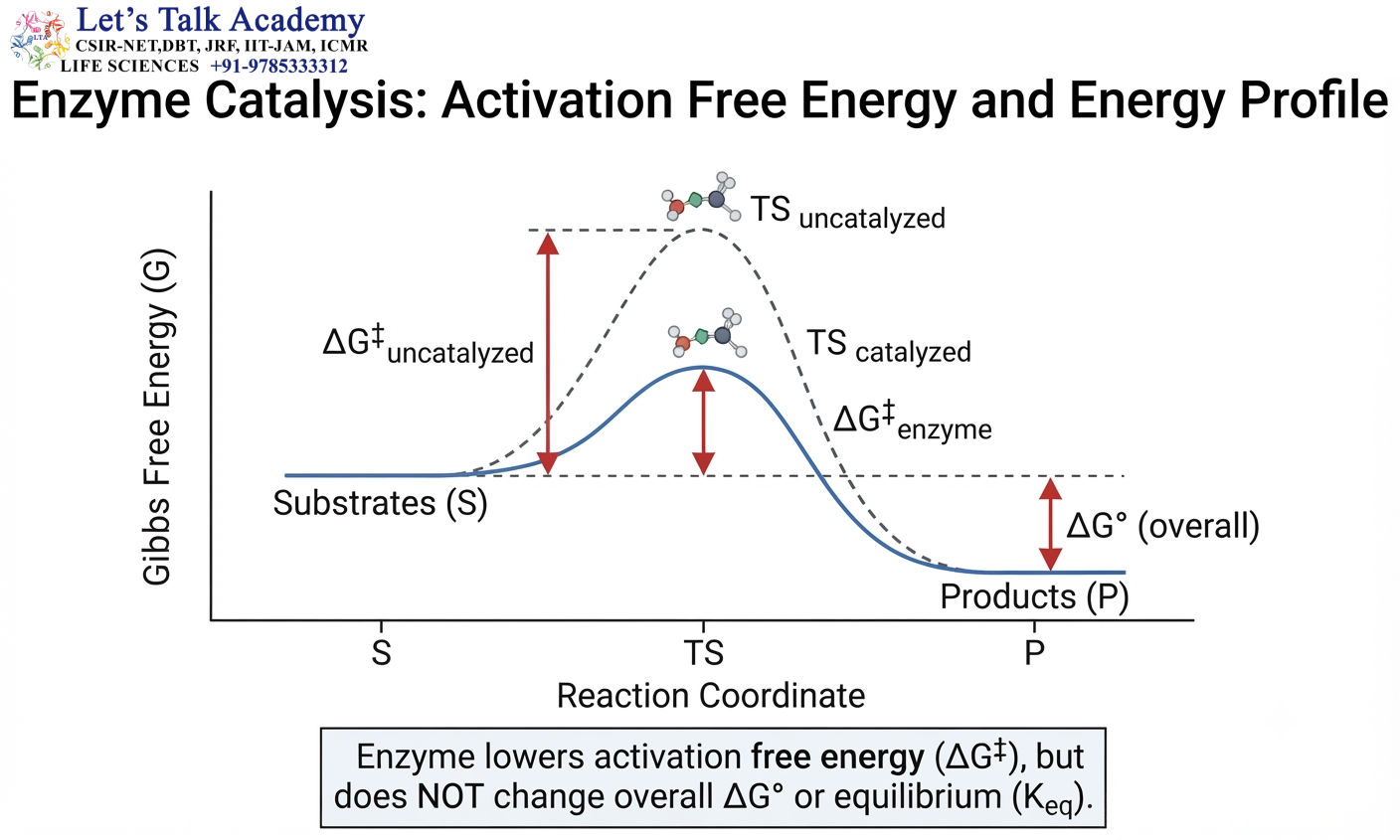
The activation free energy is the energetic barrier that separates the reactant state from the transition state.
It can be represented as:
ΔG‡ = Gₜₛ − Gᵣ
where Gₜₛ represents the Gibbs free energy of the transition state and Gᵣ represents the Gibbs free energy of the reactant state.
A reaction with a large ΔG‡ proceeds slowly because relatively few molecules possess sufficient energy to reach the transition state at any given moment.
Enzymes lower this barrier by stabilizing the transition state and by providing an alternative series of molecular events.
The rate constant is strongly dependent on the activation free energy. A simplified transition-state relationship is:
k = (kᴮT ÷ h) × e⁻ΔG‡/RT
Here, k is the rate constant, kᴮ is the Boltzmann constant, T is absolute temperature, h is Planck’s constant, R is the gas constant, and ΔG‡ is the activation free energy.
Because ΔG‡ appears in an exponential term, even a modest reduction in activation free energy can cause a very large increase in reaction rate.
This is one of the major reasons why enzymes can accelerate reactions by factors ranging from thousands to many millions or more, depending on the reaction and enzyme.
4. The Transition State
The transition state is a high-energy configuration through which reactant molecules must pass before becoming products.
A simplified representation is:
S → [S]‡ → P
Here, [S]‡ represents the transition state.
The transition state is not necessarily a stable molecular species. It is better understood as a particular arrangement of atoms corresponding to the highest-energy point along a specific reaction pathway.
During this state, chemical bonds may be partially formed or broken, and the electronic distribution of the molecule may differ substantially from that of the starting substrate.
An enzyme can recognize and stabilize these transient characteristics.
For example, if a reaction produces a developing negative charge on oxygen, the enzyme may contain positively charged residues or hydrogen-bond donors positioned near that oxygen. If a positive charge develops elsewhere, negatively charged residues may provide stabilization.
This means that the enzyme active site is often more complementary to the transition state than to the unreacted substrate.
The difference between stabilization of the ground state and stabilization of the transition state is central to catalytic power.
5. Transition-State Stabilization
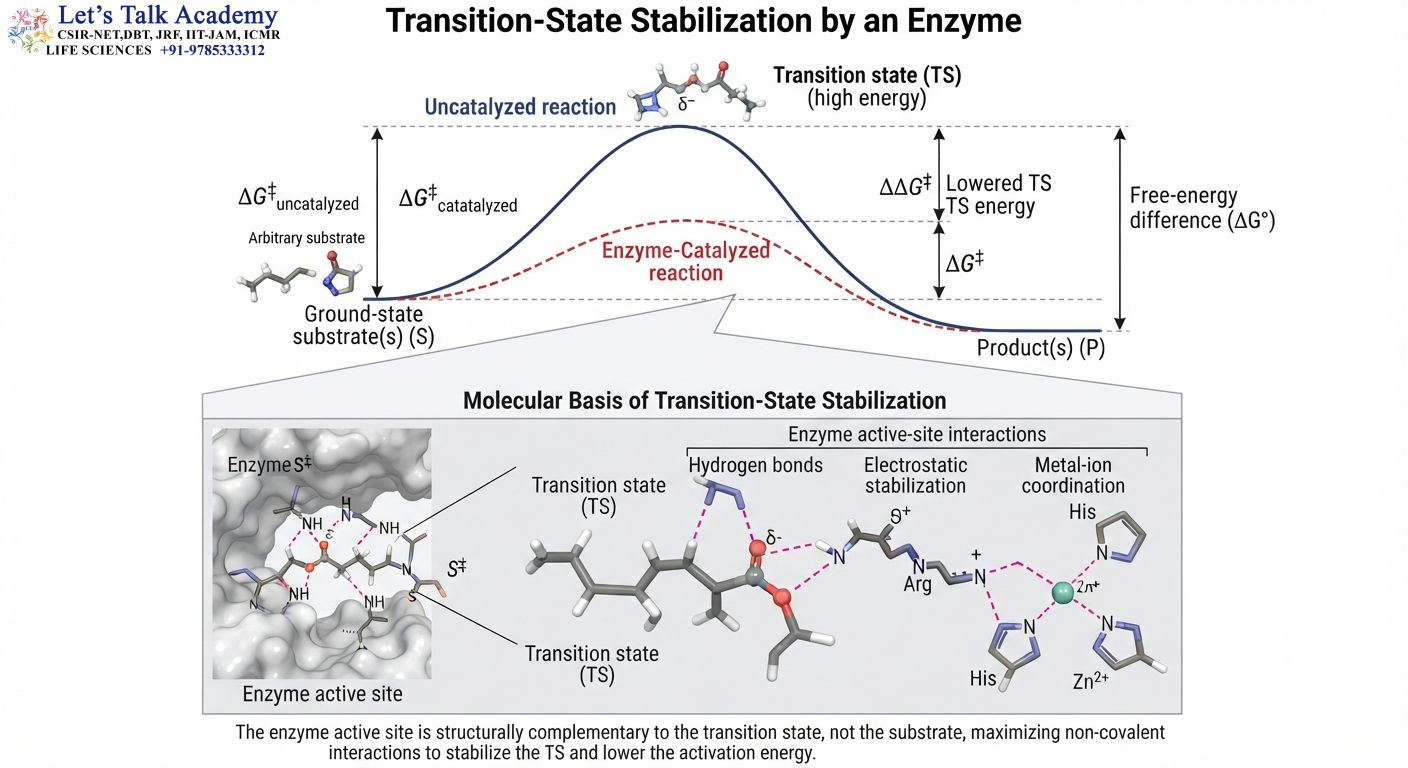
Transition-state stabilization is one of the most important principles of enzyme catalysis.
An enzyme can stabilize the transition state through hydrogen bonding, electrostatic interactions, metal-ion coordination, dipole interactions, and other favorable interactions.
The reduction in activation free energy can be expressed as:
ΔΔG‡ = ΔG‡₍uncatalyzed₎ − ΔG‡₍catalyzed₎
A larger positive value of ΔΔG‡ corresponds to a greater catalytic reduction in the activation barrier.
The active site is therefore designed not merely to recognize the substrate but to stabilize the chemical features that appear during the transition from substrate to product.
Suppose a substrate contains a carbonyl group:
R−C=O
During catalysis, the carbonyl oxygen may acquire additional negative charge:
R−C−O⁻
The enzyme may stabilize this developing charge through hydrogen bonds.
Several hydrogen bonds acting simultaneously can substantially reduce the energy of the transition state.
This concept also explains why transition-state analogues can bind extremely tightly to enzymes. If a stable molecule resembles the geometry and charge distribution of the transition state, the active site may recognize it strongly even though the analogue cannot undergo the normal reaction.
6. The Active Site
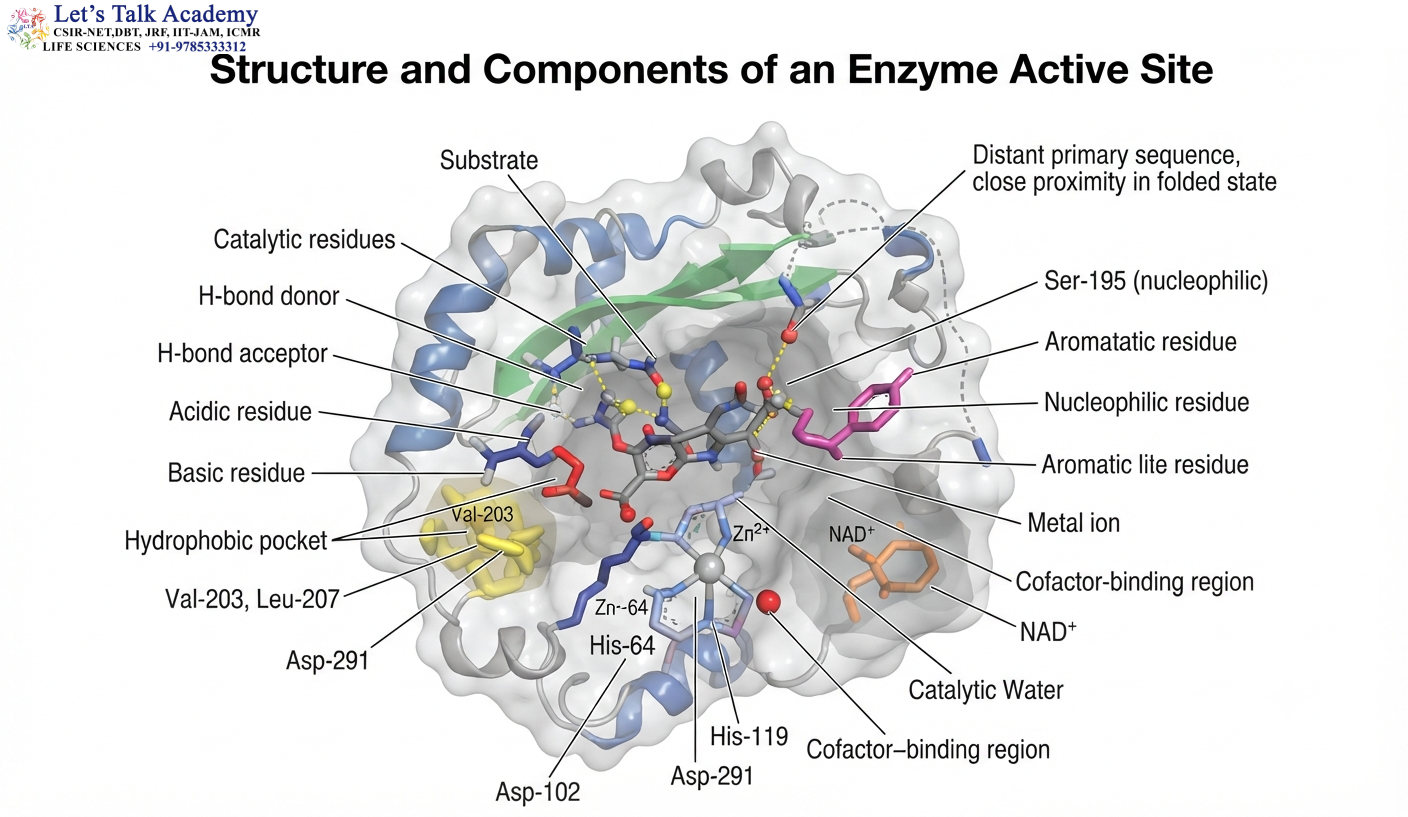
The active site is the specialized three-dimensional region of an enzyme where substrate binding and chemical catalysis occur.
Although the active site may represent only a small fraction of the total protein structure, it contains a precisely arranged collection of amino acid residues.
Some residues contribute mainly to substrate recognition, whereas others directly participate in catalysis. In many enzymes, the same residue can contribute to both binding and catalytic chemistry.
The active site may contain:
Hydrogen-bond donors and acceptors.
Charged groups.
Hydrophobic surfaces.
Aromatic residues.
Nucleophilic residues.
Acidic and basic residues.
Metal-binding residues.
Cofactor-binding regions.
The exact combination depends on the reaction catalyzed by the enzyme.
The active site also excludes or permits water in a controlled manner. Some reactions require water to be positioned directly at the reaction center, whereas other reactions require exclusion of water so that a reactive intermediate can survive long enough to undergo the next catalytic step.
Thus, the active site is a chemically specialized microenvironment.
7. Molecular Recognition of the Substrate
Before catalysis can occur, the enzyme must recognize the correct substrate.
Recognition depends on the shape, size, charge, polarity, stereochemistry, and chemical groups of the substrate.
A simplified binding reaction is:
E + S ⇌ ES
The enzyme-substrate complex is stabilized by numerous noncovalent interactions.
Hydrogen bonds can recognize polar groups.
Ionic interactions can recognize charged groups.
Hydrophobic interactions can stabilize nonpolar regions.
Van der Waals interactions can provide close structural complementarity.
These interactions are individually relatively weak, but their combined effect can produce strong and highly specific binding.
The specificity of an enzyme does not depend on one single interaction. Instead, several interactions must be simultaneously satisfied.
This explains why a small modification in a substrate can sometimes dramatically reduce its ability to bind productively.
8. Lock-and-Key Model
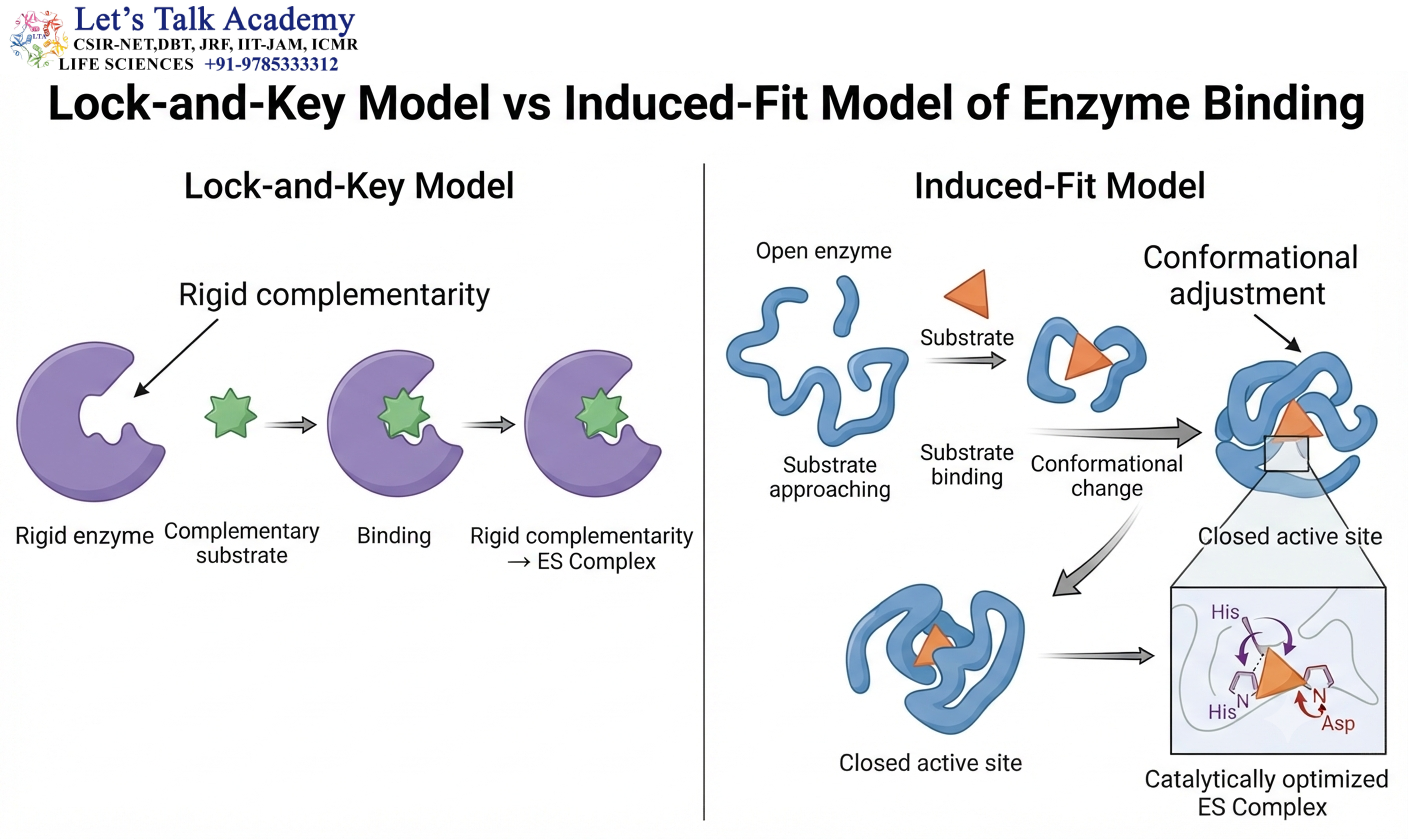
The classical lock-and-key model describes the enzyme active site as being structurally complementary to the substrate.
In this model, the substrate fits into the active site similarly to the way a key fits into a lock.
The model is useful because it explains the concept of substrate specificity and molecular complementarity.
However, enzymes are not rigid molecular structures.
Their atoms undergo continuous motion, and substrate binding can cause changes in the relative positions of different regions of the protein.
Therefore, the lock-and-key model provides a simplified description of recognition but does not completely describe the dynamic nature of catalysis.
9. Induced-Fit Model
The induced-fit model provides a more dynamic description of enzyme-substrate interactions.
According to this model, substrate binding induces a conformational change in the enzyme.
The process can be represented as:
E + S ⇌ ES ⇌ E*S
E*S represents a conformation of the enzyme-substrate complex that is particularly suitable for catalysis.
The conformational change can move catalytic residues into the correct positions, close the active site around the substrate, exclude water, increase substrate strain, and improve transition-state stabilization.
Induced fit can also contribute to product release. After the chemical transformation occurs, the product may no longer provide the interactions necessary to maintain the closed conformation. The enzyme can therefore return toward a more open state and release the product.
This dynamic cycle is a fundamental feature of many enzymes.
10. Proximity Effect
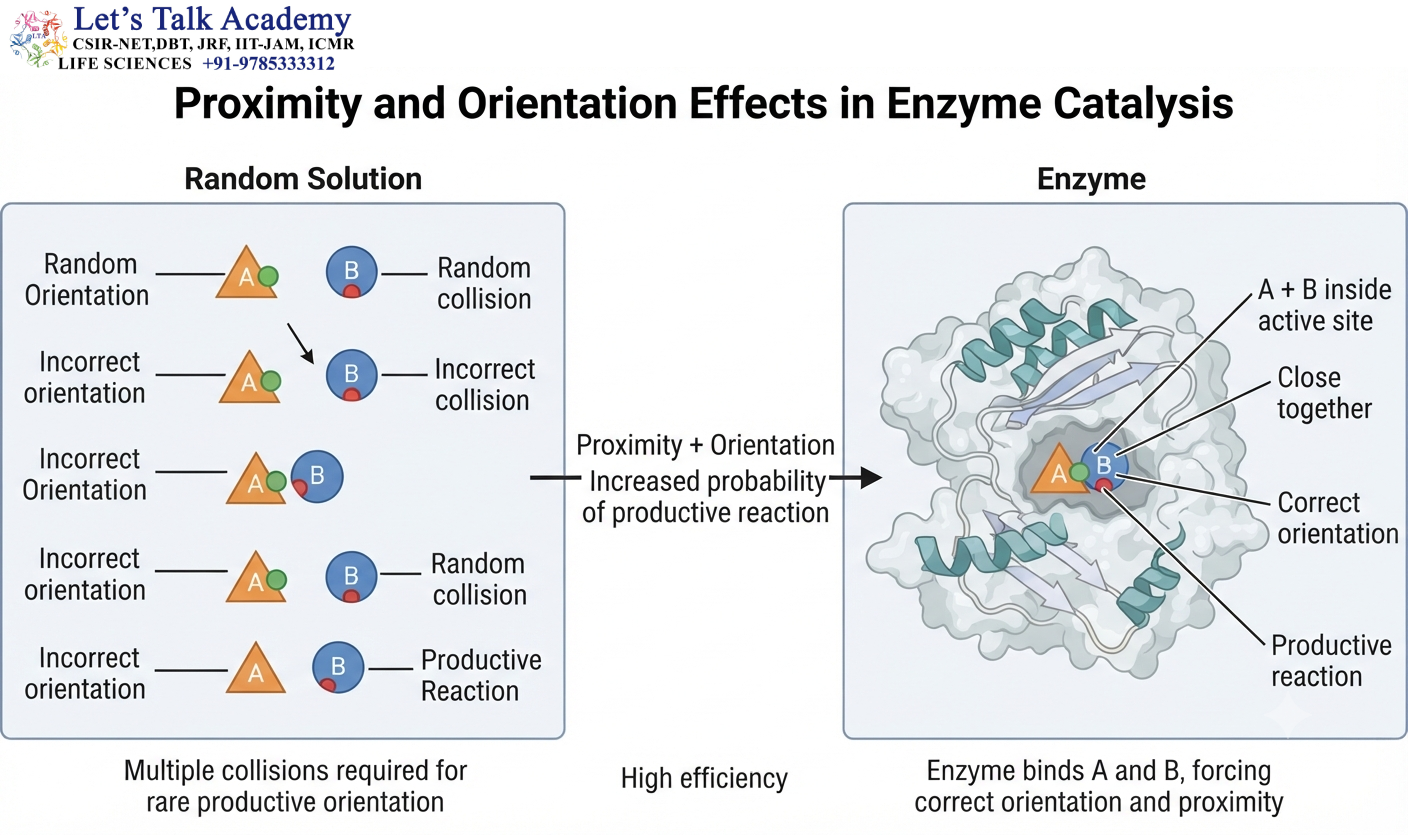
The proximity effect refers to the ability of an enzyme to bring reacting groups close together.
Consider a bimolecular reaction:
A + B → P
For the reaction to occur, A and B must collide.
However, random collisions in solution are not necessarily productive. The molecules must meet with appropriate orientation and sufficient energy.
An enzyme can bind both molecules:
E + A + B ⇌ EAB
Within the EAB complex, the reactive groups are held close together.
This increases their effective local concentration and greatly improves the probability of productive interaction.
The enzyme therefore converts a random intermolecular process into a highly organized molecular event.
Proximity is particularly important in reactions involving two substrates that must interact with one another.
11. Orientation Effect
Proximity alone is not sufficient.
Two reactive groups can be close together but still fail to react if they are incorrectly oriented.
The orientation effect allows an enzyme to arrange the reacting groups in a geometry favorable for bond formation or bond cleavage.
For example, a nucleophile may need to approach an electrophilic carbon from a specific direction.
The active site can hold both groups in the appropriate spatial arrangement.
The enzyme therefore reduces the number of possible molecular orientations and selectively favors the orientation that leads to productive catalysis.
The combined effects can be summarized as:
Proximity + Orientation → Increased probability of productive reaction
This is one reason why enzyme active sites are highly organized three-dimensional structures.
12. Electrostatic Catalysis
Electrostatic catalysis occurs when the enzyme stabilizes charged groups or developing charges during the reaction.
Many biochemical reactions involve significant changes in charge distribution.
For example:
R−C=O → R−C−O⁻
The developing negative charge can be stabilized by positively charged amino acid residues, metal ions, or hydrogen-bond donors.
Similarly, positively charged intermediates can be stabilized by negatively charged residues.
The effect of electrostatic stabilization depends strongly on distance and orientation.
A charged residue positioned precisely within the active site can have a much greater effect than the same residue located farther away.
This illustrates the direct connection between protein structure and catalytic function.
13. Hydrogen-Bond Catalysis
Hydrogen bonds are important in both substrate recognition and transition-state stabilization.
A hydrogen bond can be represented conceptually as:
D−H ··· A
where D−H is the hydrogen-bond donor and A is the acceptor.
The active site can position hydrogen-bond donors and acceptors around the substrate.
During catalysis, the strengths and geometry of these interactions can change as the substrate moves toward the transition state.
The enzyme may therefore form stronger or more favorable hydrogen bonds with the transition state than with the ground-state substrate.
This contributes to transition-state stabilization.
Hydrogen bonding is particularly important in enzymes that stabilize oxyanions or other charged intermediates.
14. General Acid-Base Catalysis
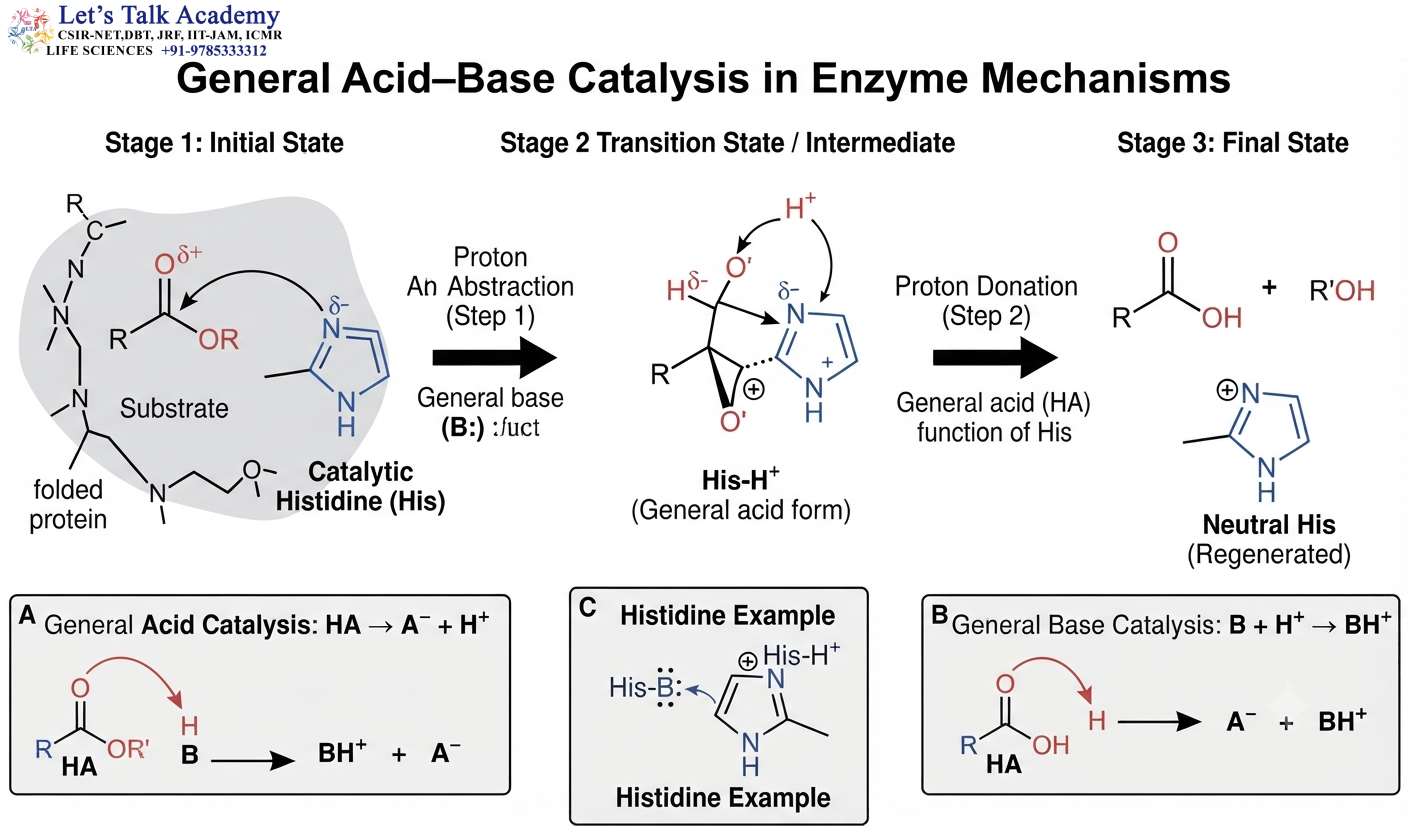
General acid-base catalysis involves proton transfer between the substrate, enzyme, and sometimes water.
A general acid donates a proton:
HA → A⁻ + H⁺
A general base accepts a proton:
B + H⁺ → BH⁺
Enzymes commonly use amino acid side chains as general acids or bases.
Histidine is especially versatile because its side chain can often switch between protonated and unprotonated states under biologically relevant conditions.
Aspartate and glutamate can donate or accept protons depending on their local environment.
Lysine can function as a proton donor or acceptor and can also participate in covalent catalysis.
Cysteine and tyrosine can participate in proton-transfer reactions under appropriate conditions.
The effectiveness of an acid or base inside an enzyme depends on its microenvironment.
Amino acid residues do not necessarily retain exactly the same pKₐ values that they would have in free solution.
The surrounding residues, electrostatic environment, hydrogen bonds, and solvent accessibility can all alter protonation behavior.
15. Specific Acid-Base and General Acid-Base Catalysis
It is important to distinguish specific acid-base catalysis from general acid-base catalysis.
In specific acid catalysis, the reaction rate is primarily influenced by hydronium ions:
H₃O⁺
In general acid catalysis, a molecule other than hydronium directly donates a proton to the reacting species.
Similarly, in specific base catalysis, hydroxide ions are primarily responsible for proton abstraction.
In general base catalysis, another molecular species accepts the proton.
Enzyme active sites frequently employ general acid-base catalysis because catalytic residues can be positioned precisely near the reacting groups.
16. Covalent Catalysis
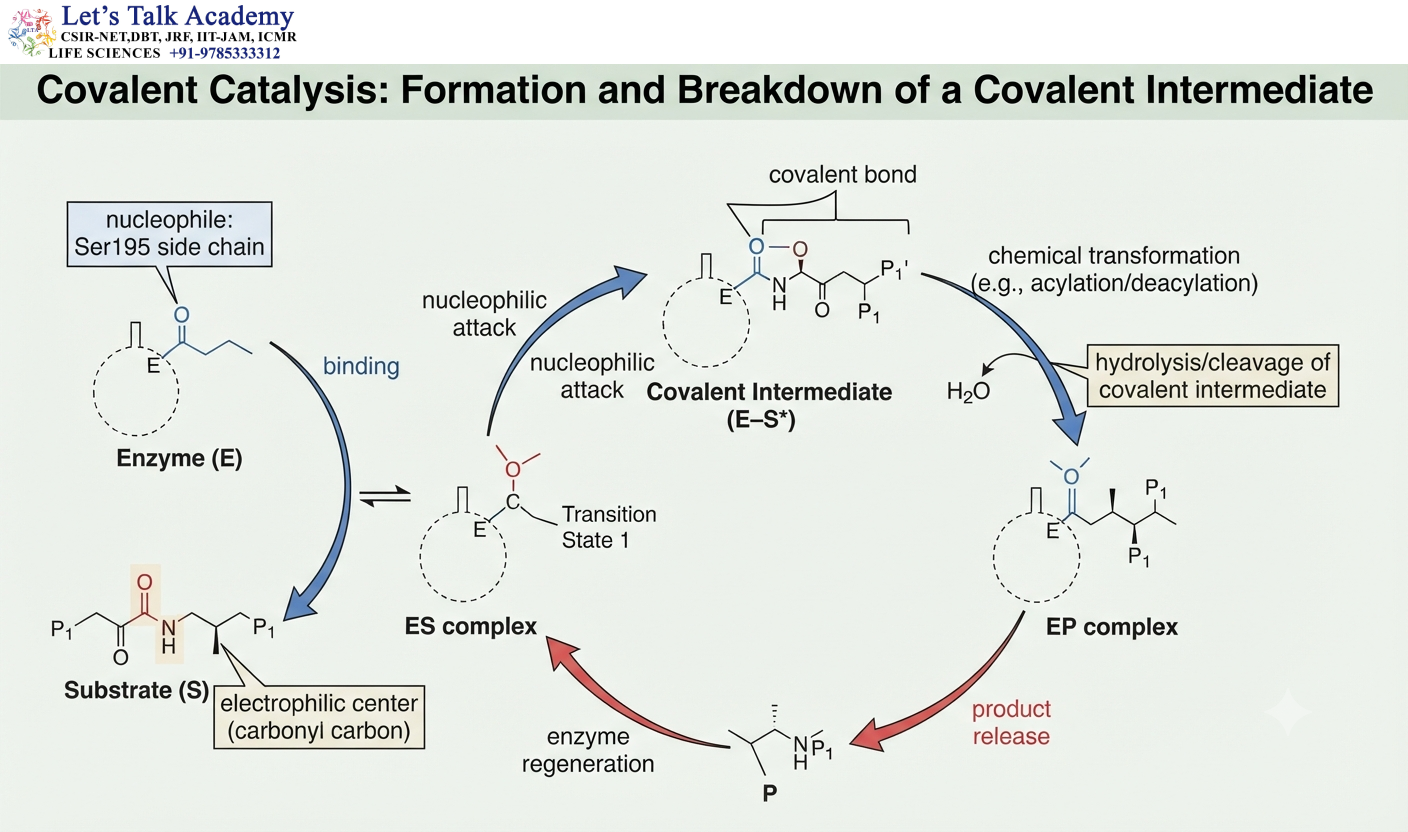
Covalent catalysis involves the temporary formation of a covalent bond between an enzyme and its substrate.
The general mechanism can be represented as:
E + S ⇌ ES → E−S → EP → E + P*
E−S* represents a transient covalent intermediate.
The enzyme uses this intermediate to create an alternative reaction pathway.
Instead of forcing the substrate to undergo a difficult transformation in a single step, the enzyme divides the process into several steps with lower individual activation barriers.
Common catalytic nucleophiles include serine, cysteine, and lysine.
For example:
Ser−OH → Ser−O⁻
The activated serine can attack an electrophilic center of the substrate and form a temporary covalent bond.
The covalent intermediate is subsequently broken down, releasing the product and regenerating the enzyme.
17. Nucleophilic Catalysis
A nucleophile is an electron-rich species capable of donating an electron pair to an electrophilic center.
Common biological nucleophiles include:
OH⁻
H₂O
Ser−O⁻
Cys−S⁻
Lys−NH₂
A general nucleophilic attack can be represented as:
Nu: + R−C=O → Nu−C−O⁻
The enzyme increases the efficiency of this reaction by positioning the nucleophile close to the electrophilic center and by stabilizing the developing negative charge.
This is particularly important in hydrolysis and proteolysis.
18. Metal-Ion Catalysis
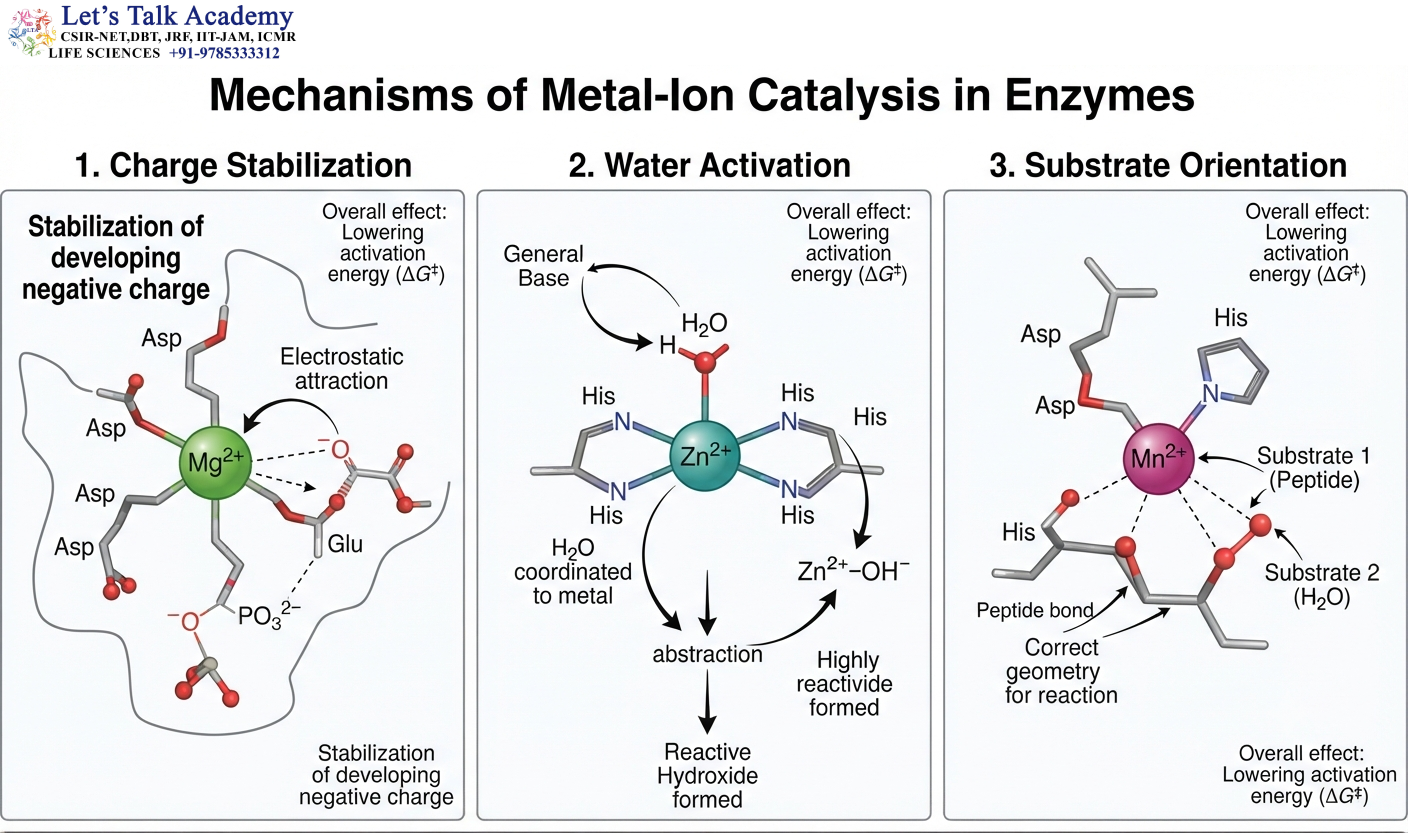
Metal ions participate in the catalytic mechanisms of many enzymes.
Common catalytic metal ions include:
Mg²⁺, Zn²⁺, Mn²⁺, Ca²⁺, Fe²⁺, Fe³⁺, and Cu²⁺
Metal ions can stabilize negative charges, activate water, orient substrates, participate in redox reactions, and help organize catalytic residues.
For example:
O⁻ ··· Mg²⁺
The positively charged metal ion can stabilize the negatively charged oxygen.
Metal ions are particularly important in reactions involving phosphate groups because phosphate-containing molecules can carry substantial negative charge.
Magnesium ions are frequently associated with ATP and other nucleotide phosphates.
A metal ion can also activate water by altering its electronic environment:
M²⁺ + H₂O ⇌ M²⁺−OH₂
This can facilitate formation of a more reactive hydroxide species.
19. Metalloenzymes and Metal-Activated Enzymes
A metalloenzyme contains a metal ion that is closely associated with the enzyme and is required for its biological activity.
The metal may be permanently or tightly bound as part of the enzyme structure.
In other enzymes, metal ions may associate more reversibly and act as activators.
The distinction depends on the nature and strength of the metal-enzyme interaction.
Metals can also participate directly in electron-transfer reactions.
Iron-containing enzymes, for example, can switch between oxidation states:
Fe²⁺ ⇌ Fe³⁺ + e⁻
This makes iron particularly useful in redox chemistry.
20. Catalysis by Strain and Distortion
Enzymes can increase reaction rates by distorting the substrate toward a conformation that resembles the transition state.
A substrate in solution generally adopts conformations based on its energy landscape.
The enzyme may preferentially bind a higher-energy conformation because that conformation is more reactive.
The process can be represented as:
S → S → TS → P*
where S* represents a strained or distorted substrate configuration.
The enzyme uses binding interactions to compensate for some of the energetic cost associated with substrate distortion.
As a result, the substrate is placed closer to the geometry required for the chemical reaction.
This mechanism is especially important in enzymes that catalyze reactions involving cyclic molecules, carbohydrate structures, and bond rearrangements.
21. Desolvation
Water strongly interacts with polar and charged molecules.
When a substrate enters an enzyme active site, some water molecules surrounding the substrate may be displaced.
This is called desolvation.
Desolvation can be favorable when the enzyme replaces water-mediated interactions with stronger or more appropriately positioned interactions.
For example, a substrate oxygen atom may initially form hydrogen bonds with water. After binding, that oxygen may instead form direct hydrogen bonds with active-site residues.
The active site may also exclude water from hydrophobic regions.
This creates a specialized environment that can alter electrostatic interactions and the reactivity of functional groups.
22. Hydrophobic Effects in Catalysis
Hydrophobic interactions contribute to substrate binding and active-site organization.
Nonpolar regions of a substrate tend to associate with nonpolar regions of the enzyme.
This can exclude water from the reaction center.
Hydrophobic pockets can therefore help position substrates and create a local environment with different properties from bulk aqueous solution.
However, hydrophobic interactions are not simply a mechanism for increasing binding affinity. Their catalytic significance depends on how they alter substrate orientation, conformational flexibility, solvent accessibility, and transition-state stabilization.
23. Catalytic Microenvironment
The active site creates a microenvironment that can be chemically very different from the surrounding cellular solution.
The local environment can influence:
pKₐ
Polarity
Charge distribution
Hydrogen-bond strength
Electrostatic interactions
Water accessibility
Substrate conformation
Metal-ion coordination
For example, a histidine residue surrounded by particular charged groups may have a different protonation behavior from histidine exposed to water.
Similarly, an acidic residue placed in a hydrophobic region may experience an altered tendency to remain protonated.
These changes allow enzymes to use ordinary amino acid side chains for chemical reactions that would otherwise be difficult under physiological conditions.
24. Catalytic Strategies Acting Together
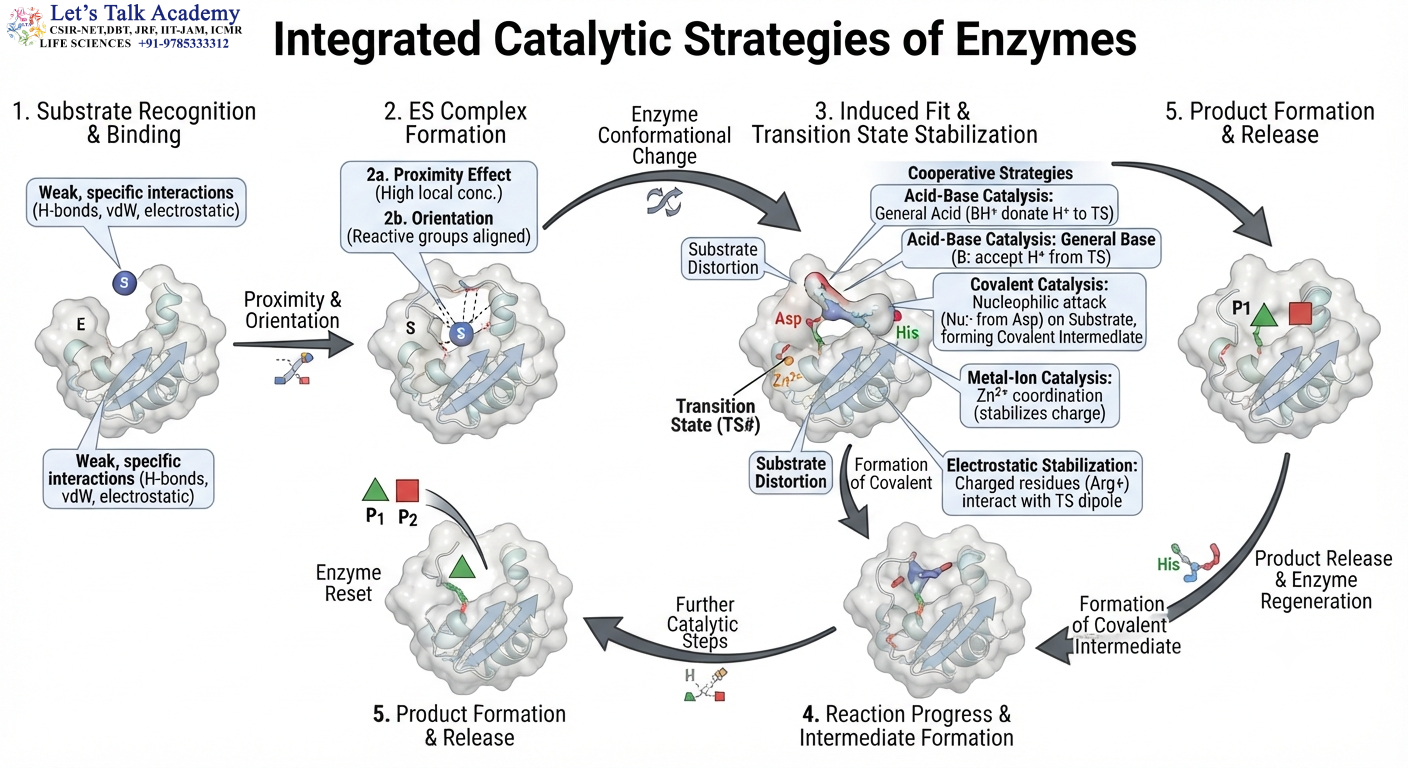
Real enzyme mechanisms usually involve several catalytic strategies operating together.
A typical catalytic sequence may be:
Substrate binding → Proximity → Orientation → Conformational change → Acid-base catalysis → Transition-state stabilization → Intermediate formation → Product formation → Product release
A metal ion may participate throughout the process.
A covalent intermediate may occur between two transition states.
Hydrogen bonds may stabilize several intermediate structures.
Electrostatic interactions may control the protonation state of catalytic residues.
The catalytic power of an enzyme therefore results from the integration of multiple interactions rather than a single mechanism.
25. Catalytic Triads
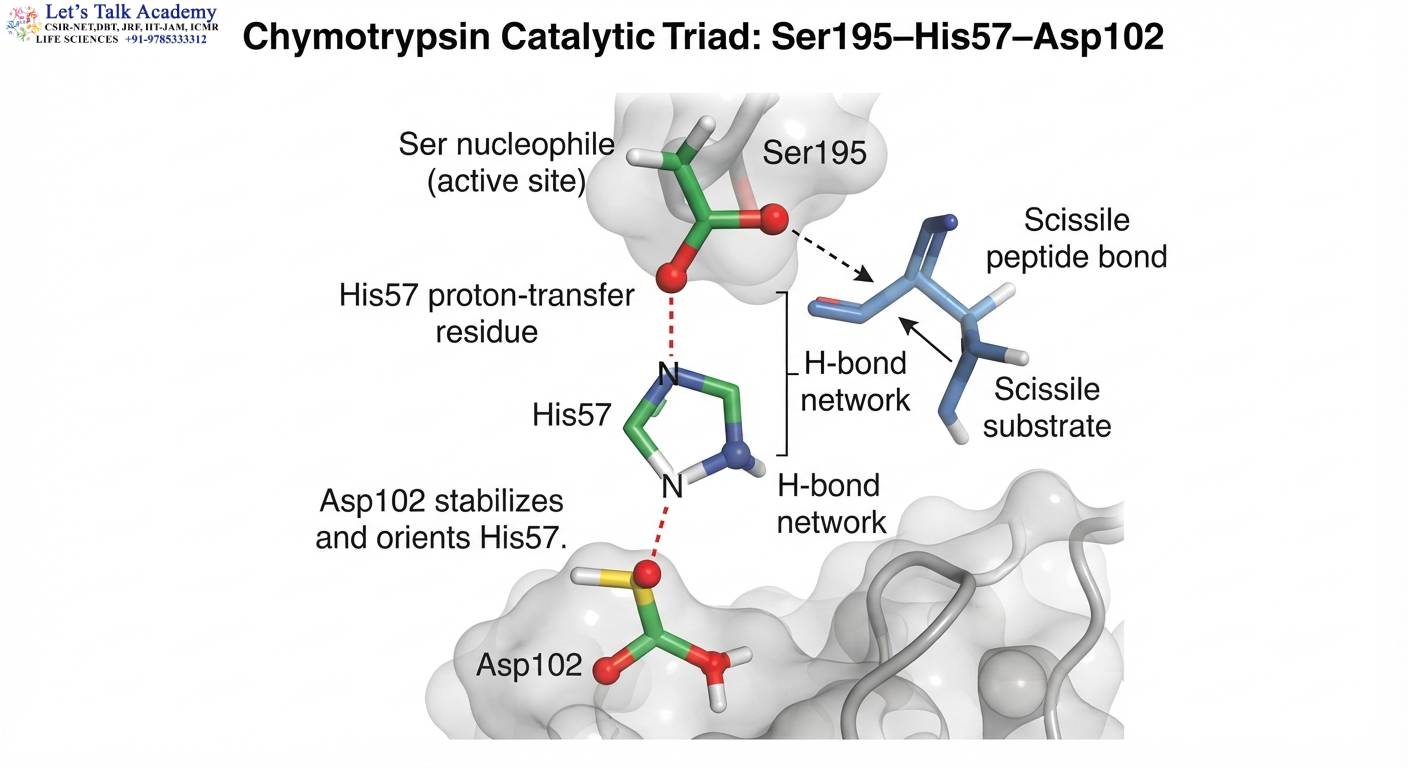
Some enzymes use groups of three amino acid residues that work together as a catalytic unit.
The classical example is the catalytic triad of serine proteases.
In chymotrypsin, the catalytic triad consists of:
Ser195 — His57 — Asp102
Each residue performs a different but coordinated function.
Ser195 acts as the nucleophile.
His57 participates in proton transfer.
Asp102 helps stabilize and orient His57 within the catalytic environment.
The three residues form a cooperative catalytic system.
This demonstrates that the catalytic properties of an enzyme cannot always be understood by examining individual amino acid residues independently.
The three-dimensional arrangement of the residues is essential.
26. Mechanism of Chymotrypsin Catalysis
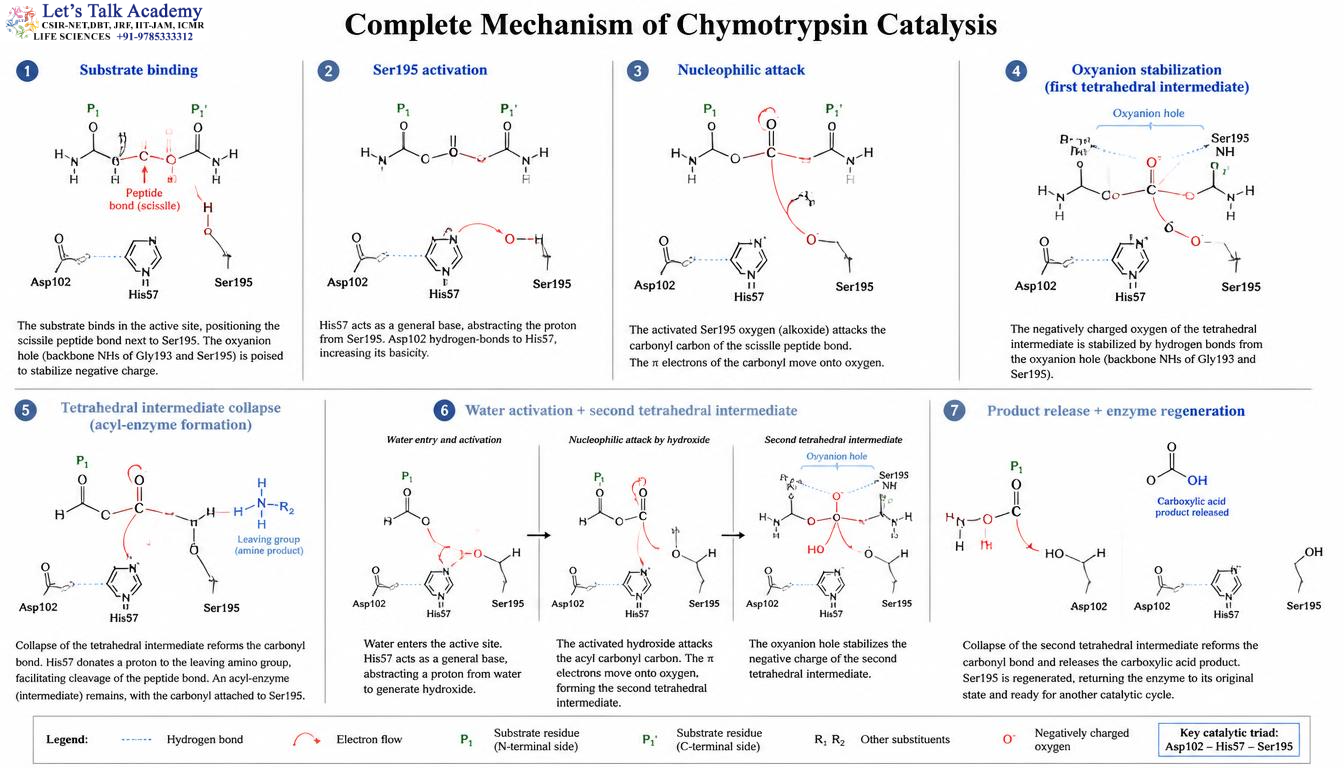
Chymotrypsin is a serine protease that hydrolyzes peptide bonds in proteins.
It is one of the most extensively studied examples of enzyme catalysis because its mechanism demonstrates several catalytic principles simultaneously.
The catalytic triad is:
Ser195 — His57 — Asp102
The substrate binds in the active site, positioning a susceptible peptide bond close to Ser195.
26.1 Substrate Binding
The substrate enters the active-site cleft and interacts with residues that determine substrate specificity.
The peptide bond that will be cleaved is positioned near the hydroxyl group of Ser195.
Correct orientation is essential because the catalytic serine must attack the carbonyl carbon from an appropriate direction.
26.2 Activation of Ser195
His57 functions as a general base.
It accepts the proton from Ser195:
Ser−OH + His → Ser−O⁻ + His−H⁺
The serine oxygen becomes a strong nucleophile.
26.3 Nucleophilic Attack
The activated serine attacks the carbonyl carbon of the peptide bond:
Ser−O⁻ + R−CO−NH−R′ → tetrahedral intermediate
The carbonyl carbon changes from a planar geometry toward a tetrahedral arrangement.
A negative charge develops on the oxygen.
26.4 Oxyanion Stabilization
The negatively charged oxygen is stabilized by hydrogen bonds in the oxyanion hole.
This is an example of transition-state stabilization.
The enzyme therefore reduces the energetic cost of forming the high-energy tetrahedral intermediate.
26.5 Collapse of the Intermediate
The tetrahedral intermediate collapses.
The peptide bond is broken.
His57 donates a proton to the leaving amino group.
An acyl-enzyme intermediate remains.
26.6 Water Activation
Water enters the active site.
His57 acts again as a general base and activates the water molecule.
The activated water molecule attacks the acyl-enzyme intermediate.
26.7 Release of Product
A second tetrahedral intermediate forms and subsequently collapses.
The carboxylic acid product is released.
Ser195 is regenerated.
The enzyme can now begin another catalytic cycle.
The complete process illustrates:
Proximity + Orientation + Acid-base catalysis + Covalent catalysis + Transition-state stabilization + Electrostatic stabilization
27. Mechanism of Lysozyme Catalysis
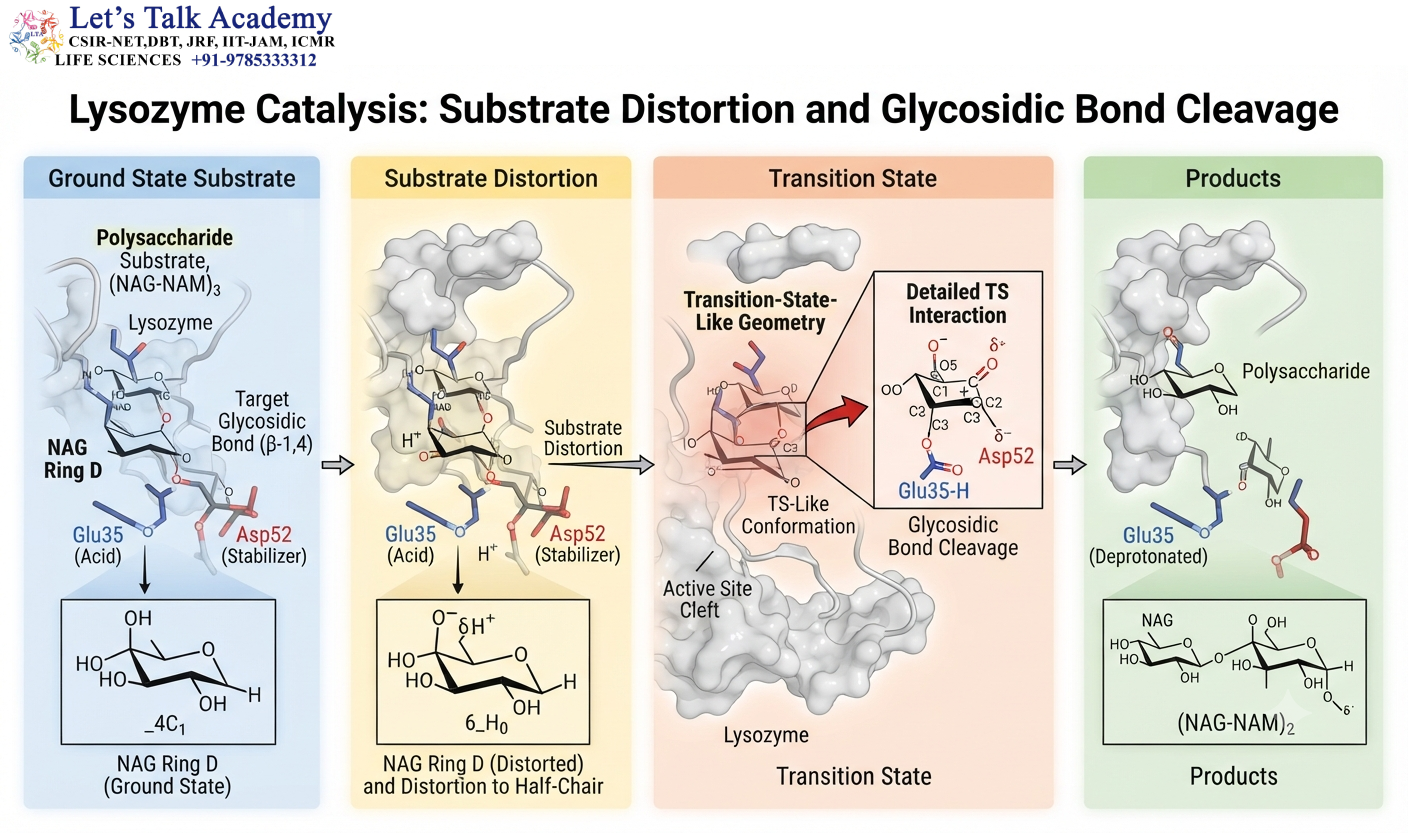
Lysozyme catalyzes the hydrolysis of specific glycosidic bonds in bacterial cell-wall polysaccharides.
The enzyme binds a carbohydrate chain in an extended active-site cleft.
The substrate is positioned so that a particular glycosidic bond is placed near catalytic residues.
An important feature of the mechanism is distortion of the sugar ring.
The enzyme favors a substrate conformation that resembles the geometry of the high-energy state required for bond cleavage.
Acid-base catalysis contributes to cleavage of the glycosidic bond.
The active site also stabilizes developing charges through hydrogen bonds and electrostatic interactions.
Lysozyme therefore demonstrates how substrate distortion, acid-base chemistry, and transition-state stabilization can operate together.
28. Transition-State Analogues
Transition-state analogues are stable molecules designed to resemble important structural and electronic properties of an enzyme reaction’s transition state.
The general relationship is:
Transition state ≈ Transition-state analogue
The analogue resembles the transition state but does not undergo the normal chemical transformation.
Because the active site can be highly complementary to the transition-state configuration, the analogue may bind very tightly.
The resulting interaction can be represented as:
E + I ⇌ EI
where I represents the inhibitor or transition-state analogue.
Transition-state analogues are therefore useful in studying enzyme mechanisms and designing enzyme inhibitors.
29. Cofactors in Enzyme Catalysis
Some enzymes require non-protein components called cofactors for catalytic activity.
Cofactors may be inorganic metal ions or organic molecules.
Metal ions include:
Mg²⁺, Zn²⁺, Fe²⁺, Fe³⁺, Mn²⁺, Cu²⁺
Organic cofactors are often called coenzymes.
Examples include:
NAD⁺
FAD
Coenzyme A
These molecules expand the chemical capabilities of enzymes.
Amino acid side chains alone cannot easily perform every type of biochemical reaction. Coenzymes can provide additional chemical groups or participate directly in electron transfer and group transfer.
30. Coenzymes and Redox Catalysis
NAD⁺ is an important coenzyme in oxidation-reduction reactions.
A simplified representation is:
NAD⁺ + 2e⁻ + H⁺ ⇌ NADH
The oxidized form, NAD⁺, accepts reducing equivalents and is converted into NADH.
NADH can subsequently transfer those reducing equivalents to another reaction.
FAD and FMN can similarly participate in electron-transfer reactions.
These cofactors allow enzymes to catalyze reactions involving changes in oxidation state that would be difficult to accomplish using amino acid side chains alone.
31. Enzyme Specificity
Enzyme specificity results from the precise structural and chemical complementarity between the active site and the substrate.
An enzyme can distinguish substrates based on:
Size
Shape
Charge
Hydrogen-bonding pattern
Hydrophobicity
Stereochemistry
Conformation
An enzyme may exhibit absolute specificity for one substrate or broader specificity for a family of related compounds.
Specificity can also be reaction-specific. An enzyme may recognize several related molecules but catalyze only one type of chemical transformation.
32. Stereospecificity
Many biological molecules are chiral.
An enzyme’s active site is itself a three-dimensional chiral environment.
Consequently, two stereoisomers may interact differently with the same enzyme.
For example, an enzyme may efficiently bind one enantiomer but poorly bind the other.
The reason is that the functional groups of one stereoisomer may align correctly with catalytic residues, whereas the corresponding groups of the other stereoisomer may be incorrectly positioned.
Stereospecificity is therefore a direct consequence of the three-dimensional architecture of the active site.
33. Regiospecificity
Regiospecificity refers to the ability of an enzyme to act at a particular position within a substrate containing several chemically similar groups.
A molecule may contain multiple potential reaction sites, but the enzyme may recognize only one of them.
This occurs because the substrate is positioned in a precise orientation within the active site.
Only one reactive group may be placed correctly relative to the catalytic residues.
Thus, enzyme specificity is determined not only by chemical reactivity but also by molecular geometry.
34. Relationship Between Catalysis and Enzyme Kinetics
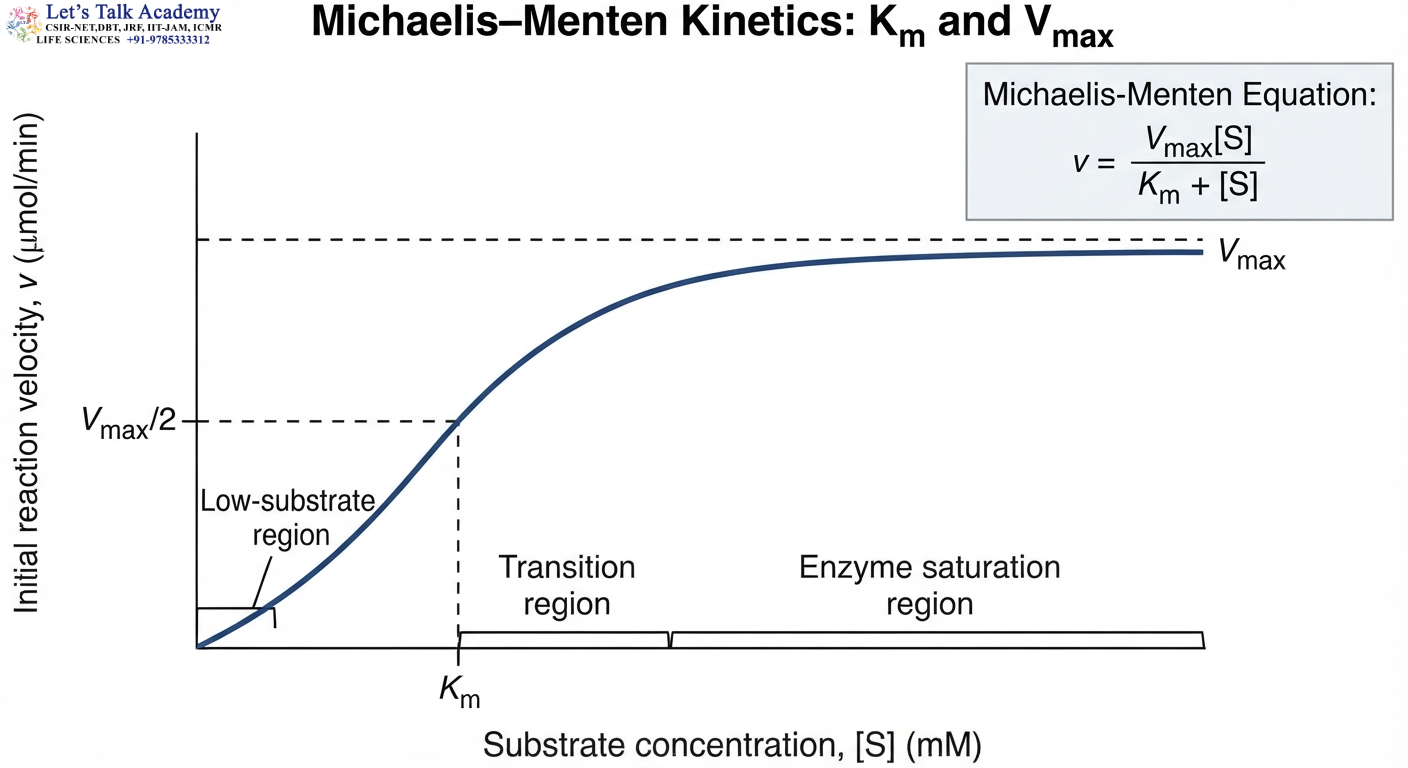
The mechanism of catalysis is closely related to enzyme kinetics.
A simplified Michaelis-Menten mechanism is:
E + S ⇌ ES → E + P
The Michaelis-Menten rate equation is:
v = Vₘₐₓ[S] ÷ (Kₘ + [S])
Here, v represents the initial reaction velocity, Vₘₐₓ represents the maximum velocity, [S] represents substrate concentration, and Kₘ represents the Michaelis constant.
The maximum velocity is related to the catalytic constant:
Vₘₐₓ = k₍cat₎[E]ₜ
Therefore:
k₍cat₎ = Vₘₐₓ ÷ [E]ₜ
The catalytic efficiency can be represented as:
k₍cat₎ ÷ Kₘ
These parameters provide kinetic descriptions of enzyme performance and can be related to the underlying catalytic mechanism.
35. Meaning of Kₘ
Kₘ is the Michaelis constant for a particular enzyme-substrate system under the assumptions of the Michaelis-Menten model.
It is defined as the substrate concentration at which:
v = Vₘₐₓ ÷ 2
Kₘ is often discussed as an indicator of apparent substrate affinity, but it should not automatically be interpreted as a direct equilibrium dissociation constant.
For the simple Michaelis-Menten mechanism:
Kₘ = (k₋₁ + k₍cat₎) ÷ k₁
where k₁ represents association of enzyme and substrate, k₋₁ represents dissociation of the enzyme-substrate complex, and k₍cat₎ represents catalytic conversion.
Therefore, Kₘ depends on both binding and catalytic steps.
36. Meaning of k₍cat₎
The catalytic constant, k₍cat₎, represents the turnover number under saturating substrate conditions.
It can be calculated as:
k₍cat₎ = Vₘₐₓ ÷ [E]ₜ
If:
k₍cat₎ = 100 s⁻¹
one enzyme molecule can, under the appropriate saturating conditions, complete approximately 100 catalytic turnovers per second.
A high k₍cat₎ indicates rapid turnover but does not by itself establish that the enzyme is highly efficient at low substrate concentration.
37. Catalytic Efficiency
Catalytic efficiency is commonly represented by:
k₍cat₎ ÷ Kₘ
This parameter combines information about substrate behavior and catalytic turnover.
At low substrate concentrations relative to Kₘ:
v ≈ (k₍cat₎ ÷ Kₘ)[E]ₜ[S]
Thus, k₍cat₎ ÷ Kₘ is particularly useful for comparing enzyme performance when substrate is present at relatively low concentration.
Some enzymes have catalytic efficiencies approaching the theoretical diffusion-controlled limit, meaning that their reactions are extremely efficient once enzyme and substrate encounter one another productively.
38. pH and Enzyme Catalysis
pH can strongly affect enzyme activity because catalytic residues must often exist in specific protonation states.
For a simple ionization equilibrium:
HA ⇌ H⁺ + A⁻
the relative amounts of HA and A⁻ depend on pH.
Suppose a catalytic residue must be protonated to function as a general acid. At excessively high pH, the residue may become predominantly deprotonated and lose its ability to donate a proton.
Conversely, if a catalytic residue must be deprotonated to act as a base, excessively low pH may reduce catalytic activity.
This produces characteristic bell-shaped or more complex pH-activity profiles.
The pH optimum of an enzyme therefore reflects the combined ionization requirements of catalytic residues and structural stability of the protein.
39. Temperature and Enzyme Catalysis
Temperature affects enzyme activity through both kinetic and structural effects.
At moderate temperatures, increasing temperature generally increases molecular motion and the frequency of productive encounters.
Reaction rates therefore commonly increase with temperature over an initial range.
However, enzymes depend on a specific three-dimensional structure maintained by noncovalent interactions.
At sufficiently high temperatures, these interactions can be disrupted.
The enzyme may partially unfold or lose the precise active-site geometry required for catalysis.
Consequently, enzyme activity often increases to an optimum and then decreases as structural stability is lost.
40. Effect of Substrate Concentration
At low substrate concentration, most enzyme molecules have unoccupied active sites.
Increasing substrate concentration therefore increases the frequency of enzyme-substrate complex formation.
As substrate concentration continues to increase, more active sites become occupied.
Eventually, nearly all enzyme molecules are present as enzyme-substrate complexes.
The enzyme approaches saturation and the reaction velocity approaches Vₘₐₓ.
At saturation:
v → Vₘₐₓ
Additional substrate cannot produce a proportional increase because the number of available catalytic sites is limited.
41. Effect of Enzyme Concentration
When substrate concentration is sufficiently high, the maximum reaction velocity depends directly on enzyme concentration.
The relationship is:
Vₘₐₓ ∝ [E]ₜ
Therefore, increasing the amount of enzyme generally increases the maximum catalytic capacity.
If the total active enzyme concentration is doubled under otherwise suitable conditions, Vₘₐₓ approximately doubles.
This principle is widely used in enzyme assays and biochemical measurements.
42. Catalysis and Enzyme Inhibition
Enzyme inhibitors interfere with one or more stages of the catalytic cycle.
An inhibitor may occupy the active site, bind to another region of the enzyme, alter enzyme conformation, react with a catalytic residue, or interfere with cofactor binding.
Competitive inhibitors generally compete with substrate for the active site.
Other inhibitors can bind outside the active site and influence catalysis through conformational changes.
Mechanism-based inhibitors are especially informative because they exploit the catalytic chemistry of the enzyme itself.
Understanding the mechanism of catalysis therefore provides the molecular basis for understanding how inhibitors affect enzyme activity.
43. Binding Energy and Catalytic Power
The binding of substrate to an enzyme is associated with favorable interactions that contribute to binding free energy.
The enzyme can use this binding energy for more than simple substrate recognition.
Binding energy can help:
Bring substrates together
Orient reactive groups
Distort the substrate
Stabilize developing charges
Exclude water
Position catalytic residues
Stabilize the transition state
The most effective catalytic interactions are those that preferentially stabilize the transition state relative to the ground-state substrate.
This is why stronger substrate binding does not automatically mean faster catalysis.
An enzyme that binds the substrate extremely tightly but fails to stabilize the transition state appropriately may actually release the substrate slowly without producing efficient catalysis.
44. Enzyme Dynamics and Conformational Changes
Enzymes are dynamic molecules.
Their atoms continuously undergo thermal motion, and different regions of the protein can move relative to one another.
These conformational changes can be important for catalysis.
A simplified catalytic cycle can be represented as:
Open enzyme → Substrate binding → Closed catalytic state → Product formation → Product release → Open enzyme
The closed state may position catalytic residues correctly.
The open state may facilitate substrate entry and product release.
Therefore, efficient catalysis requires not only appropriate chemical groups but also controlled conformational flexibility.
45. Role of Water in Catalytic Reactions
Water is an active participant in many biochemical reactions.
Hydrolysis reactions, for example, use water to break chemical bonds.
A general hydrolysis reaction is:
R−X + H₂O → R−OH + H−X
The water molecule may need to be activated by a catalytic base or metal ion.
For example:
B + H₂O → BH⁺ + OH⁻
The resulting hydroxide species is a strong nucleophile.
The enzyme can position this nucleophile precisely relative to the substrate.
At the same time, the active site can prevent unnecessary water molecules from interfering with other stages of the catalytic mechanism.
46. Role of Catalytic Residues
Catalytic residues are amino acid side chains that participate directly or indirectly in chemical transformation.
Serine can act as a nucleophile.
Cysteine can act as a powerful nucleophile after deprotonation.
Histidine can participate in proton transfer.
Aspartate and glutamate can act as acids or bases.
Lysine can participate in acid-base chemistry and temporary covalent interactions.
Arginine can stabilize negatively charged groups.
Tyrosine can participate in proton transfer and hydrogen bonding.
The function of a residue depends on its local environment.
The same amino acid can perform different catalytic roles in different enzymes because the surrounding residues determine its protonation state, orientation, accessibility, and electrostatic environment.
47. Energy Landscape of Enzyme Catalysis
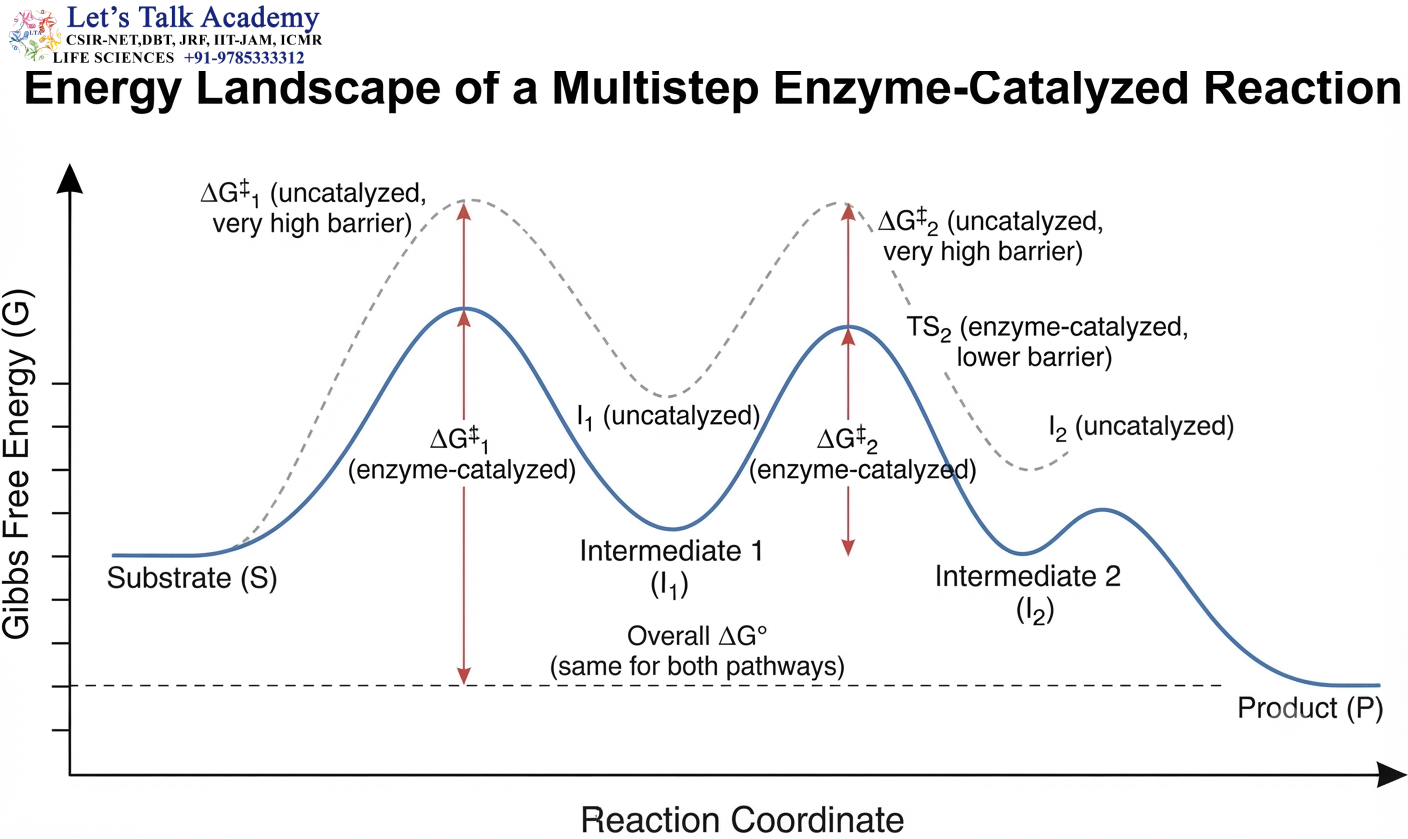
An enzyme-catalyzed reaction can be visualized as movement through an energy landscape.
A simplified multistep reaction is:
S → TS₁ → I₁ → TS₂ → I₂ → P
Here, TS₁ and TS₂ represent transition states, whereas I₁ and I₂ represent intermediates.
Each transition state represents an energetic barrier.
The enzyme can lower these barriers by stabilizing transition states and intermediates.
The enzyme may also alter the relative energies of different conformational states of the substrate and enzyme.
This energy-landscape view explains why enzyme catalysis is often a multistep process rather than a simple one-step transformation.
48. Multistep Catalytic Mechanisms
Many enzymes convert substrates into products through multiple intermediates.
A general mechanism may be represented as:
E + S ⇌ ES
ES → EI₁
EI₁ → EI₂
EI₂ → EP
EP → E + P
Each step can involve different chemical interactions.
The enzyme must stabilize appropriate intermediates without making them so stable that the next reaction becomes unfavorable or excessively slow.
Efficient enzymes therefore balance stabilization and reactivity throughout the catalytic pathway.
49. Enzyme Catalysis Does Not Require Permanent Modification
Some catalytic mechanisms involve temporary covalent modification of the enzyme.
However, the enzyme must ultimately return to its original catalytic state.
For example:
E + S → E−S → E + P*
The covalent intermediate E−S* exists only during part of the catalytic cycle.
Once the reaction is completed, the catalytic residue is restored.
This regeneration is what allows the enzyme to function repeatedly.
An enzyme can therefore participate in thousands or millions of catalytic cycles without being consumed stoichiometrically.
50. Why Substrate Binding Alone Does Not Guarantee Catalysis
A molecule may bind to an enzyme without being efficiently converted into product.
Catalysis requires productive binding.
For productive binding, the reactive group must be positioned correctly relative to catalytic residues.
The substrate must often adopt a suitable conformation.
The correct protonation state may be required.
The appropriate nucleophile and electrophile must be aligned.
The transition state must be stabilized.
If one of these requirements is missing, strong binding may still occur without efficient chemical transformation.
Therefore:
Binding ≠ Catalysis
Efficient catalysis requires productive binding combined with a favorable chemical pathway.
51. Relationship Between Enzyme Structure and Catalytic Function
The catalytic function of an enzyme is inseparable from its three-dimensional structure.
The primary amino acid sequence determines the folding pattern.
The folded structure determines the position of the active-site residues.
The active-site geometry determines substrate binding.
Substrate binding influences conformational changes.
The resulting catalytic configuration determines reaction chemistry.
Thus:
Primary structure → Three-dimensional structure → Active-site architecture → Catalytic mechanism → Biological function
A mutation that changes an active-site residue can therefore alter substrate binding, transition-state stabilization, proton transfer, or covalent catalysis.
This provides a molecular explanation for why specific amino acid substitutions can strongly influence enzyme activity.
52. Catalytic Mechanism and Mutational Analysis
The importance of individual catalytic residues can be investigated experimentally through site-directed mutagenesis.
A catalytic residue can be replaced by another amino acid.
For example:
Ser → Ala
can remove the hydroxyl group of serine.
If the original serine was essential for nucleophilic catalysis, the mutation can produce a large decrease in enzyme activity.
Similarly, replacing a catalytic histidine can interfere with proton-transfer chemistry.
Such experiments help identify which residues are directly involved in catalysis and which residues primarily contribute to substrate binding or structural stability.
53. Catalytic Mechanism and Transition-State Analogues
The strong interaction between enzymes and transition-state-like structures has important practical consequences.
Suppose an enzyme catalyzes:
S → TS → P
A stable compound that resembles TS can bind tightly:
E + TS analogue ⇌ E−TS analogue
The analogue may inhibit the enzyme because it occupies the catalytic site without undergoing the normal chemical transformation.
This principle is widely used in biochemical research and rational drug design.
The mechanism demonstrates that catalytic efficiency is closely related to transition-state recognition.
54. Overall Catalytic Cycle
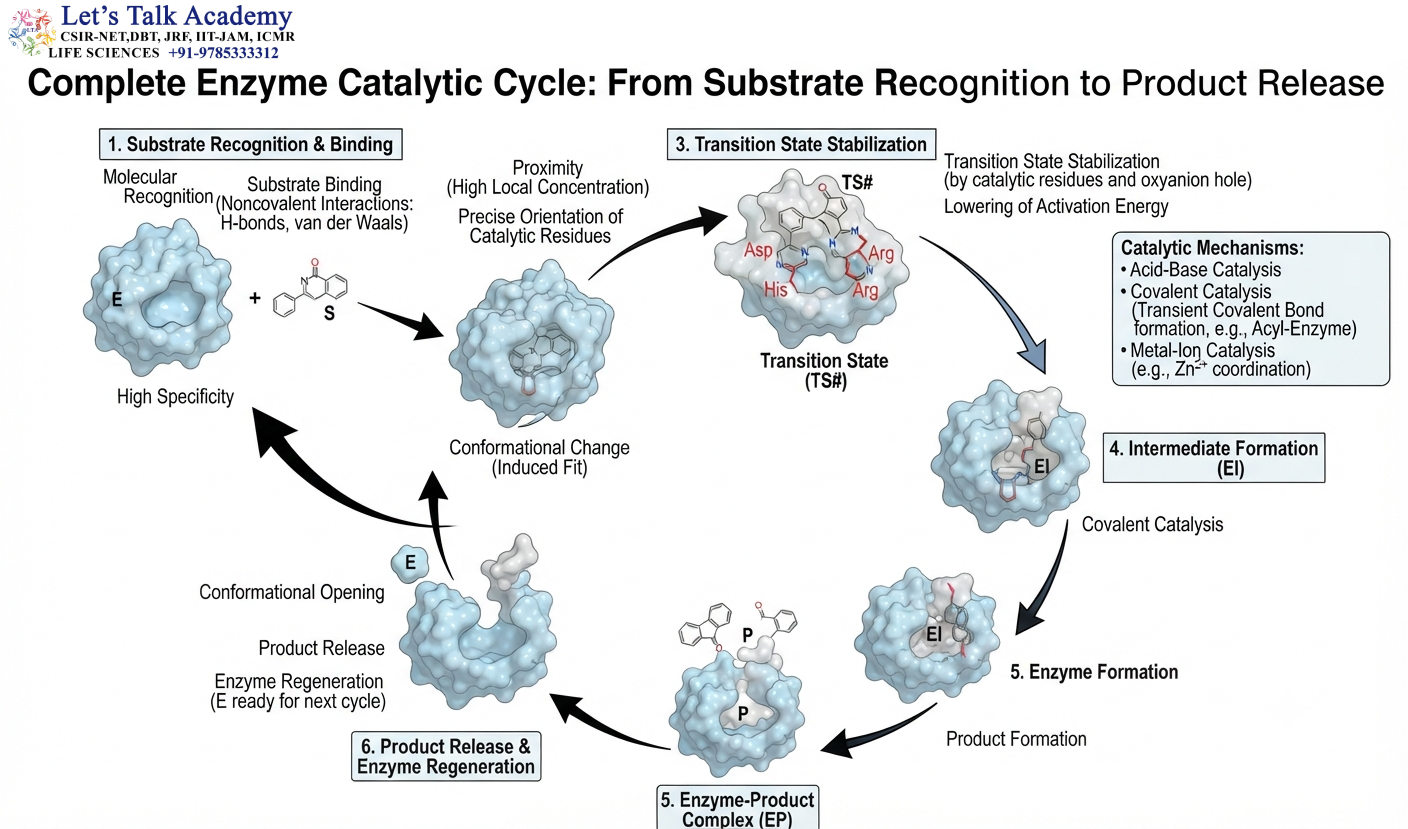
The complete catalytic cycle can be summarized as:
E + S ⇌ ES ⇌ E*S → EI → EP → E + P


