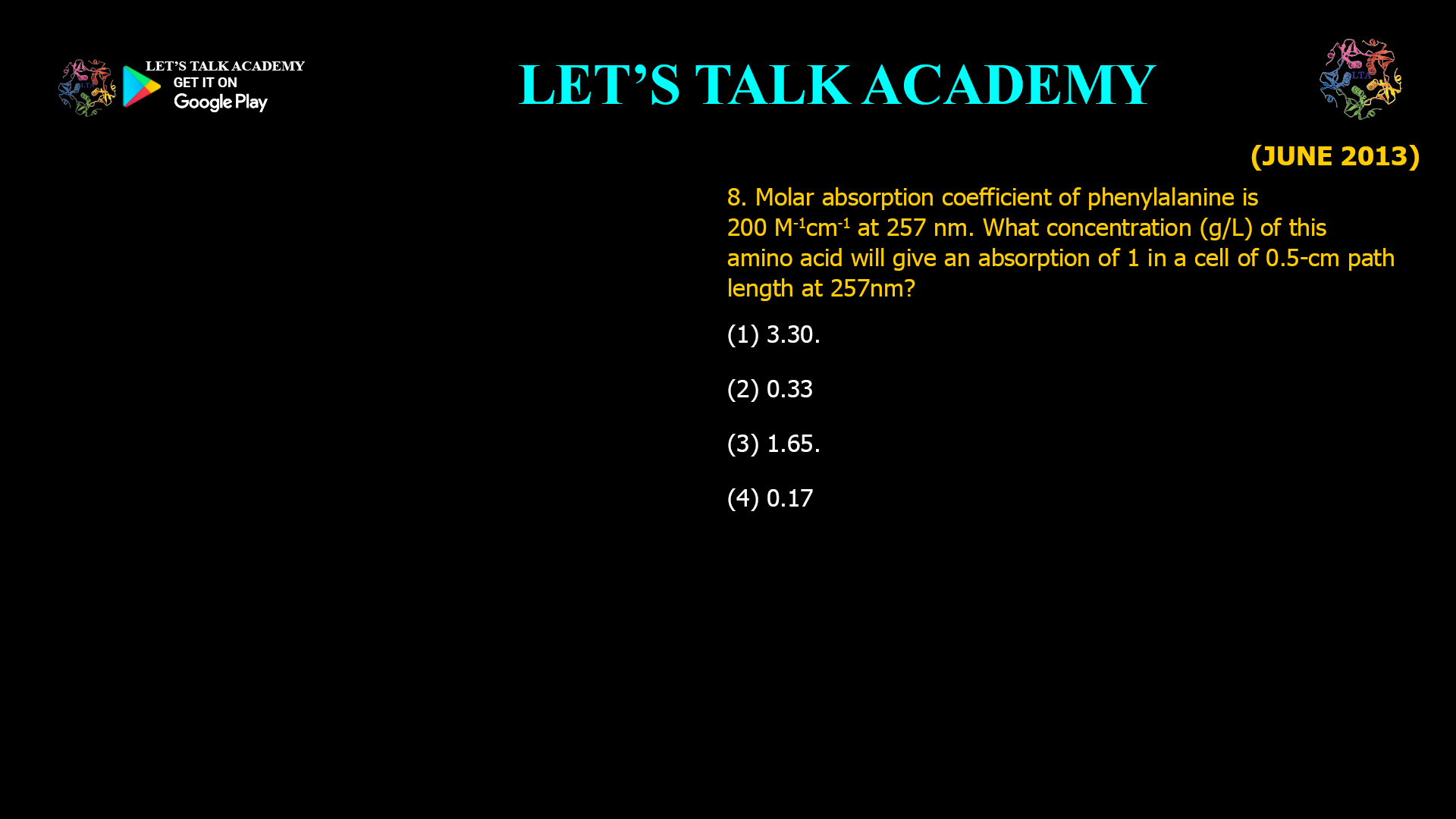
8. Molar absorption coefficient of phenylalanine is 200 M⁻¹ cm⁻¹ at 257 nm. What concentration (g/L) of this amino acid will give an absorption of 1 in a cell of 0.5-cm path length at 257 nm?
(1) 3.30
(2) 0.33
(3) 1.65
(4) 0.17
Molar Absorption Coefficient of Phenylalanine: Beer-Lambert Law Numerical
Introduction
In this question, the molar absorption coefficient, absorbance, and path length are provided. The only unknown quantity is the concentration of phenylalanine expressed in grams per litre. The solution involves first calculating the molar concentration using the Beer-Lambert equation and then converting it into g/L using the molecular weight of phenylalanine.
Concept Behind the Question
The Beer-Lambert Law is represented by the equation
A = εcl
where A is the absorbance of the solution, ε is the molar absorption coefficient (M⁻¹ cm⁻¹), c is the concentration of the solution in moles per litre (M), and l is the path length of the cuvette in centimetres.
This equation indicates that absorbance is directly proportional to both the concentration of the absorbing substance and the distance travelled by light through the sample. If either the concentration or the path length increases, the absorbance also increases proportionally.
Given Data
Absorbance (A) = 1
Molar absorption coefficient (ε) = 200 M⁻¹ cm⁻¹
Path length (l) = 0.5 cm
Molecular weight of phenylalanine = 165 g/mol
Required concentration = g/L
Step 1: Calculate the Molar Concentration
Using the Beer-Lambert equation,
A = εcl
Rearranging the equation,
c = A / εl
Substituting the given values,
c = 1 / (200 × 0.5)
c = 1 / 100
c = 0.01 M
Therefore, the concentration of phenylalanine is 0.01 mol/L.
Step 2: Convert Molarity into g/L
The question asks for concentration in grams per litre rather than molarity. Therefore, the molar concentration must be multiplied by the molecular weight of phenylalanine.
Concentration (g/L) = Molarity × Molecular Weight
= 0.01 × 165
= 1.65 g/L
Hence, the required concentration is 1.65 g/L.
Final Answer
Correct Option: (3) 1.65 g/L
Detailed Explanation of Each Option
Option (1): 3.30 g/L
This option is incorrect because it is exactly twice the correct value. Such an answer is usually obtained if the path length is incorrectly considered or if an error occurs while converting molarity into grams per litre. Since the Beer-Lambert equation clearly specifies a path length of 0.5 cm, this option cannot be correct.
Option (2): 0.33 g/L
This answer is incorrect because it is obtained by using an incorrect molecular weight or by making an arithmetic mistake during the conversion from molarity to mass concentration. Phenylalanine has a molecular weight of approximately 165 g/mol, which gives a concentration of 1.65 g/L instead of 0.33 g/L.
Option (3): 1.65 g/L
This is the correct answer because the Beer-Lambert equation gives a concentration of 0.01 M, and multiplying this value by the molecular weight of phenylalanine (165 g/mol) results in 1.65 g/L. All calculations and unit conversions are consistent with the given data.
Option (4): 0.17 g/L
This option is incorrect because it results from a decimal placement error during calculation. Such mistakes are common in competitive examinations but do not satisfy the Beer-Lambert equation. Therefore, this option is not correct.
Why Does Phenylalanine Absorb at 257 nm?
Phenylalanine is an aromatic amino acid that contains a benzene ring. The delocalized π electrons present in the aromatic ring undergo electronic transitions when ultraviolet light is absorbed. These π→π* transitions are responsible for the characteristic absorption of phenylalanine near 257 nm. Although phenylalanine absorbs UV light, its absorbance is considerably weaker than that of tyrosine and tryptophan because it lacks additional electron-donating substituents that increase the probability of electronic transitions.
Biological Significance of the Beer-Lambert Law
The Beer-Lambert Law is extensively used in biological sciences for quantitative analysis. It forms the basis of spectrophotometric estimation of DNA, RNA, proteins, enzymes, metabolites, and microbial cell density. Researchers rely on this principle to determine unknown concentrations quickly and accurately without destroying the sample. Because of its wide range of applications, questions based on this law are regularly included in competitive examinations related to life sciences and biotechnology.
Unit Analysis
The absorbance is a dimensionless quantity because it represents the logarithmic ratio of incident and transmitted light intensities. The molar absorption coefficient is expressed in M⁻¹ cm⁻¹, while the path length is measured in centimetres. The Beer-Lambert equation always produces concentration in moles per litre. If the final answer is required in grams per litre, the calculated molarity must be multiplied by the molecular weight of the compound.
Conclusion
The Beer-Lambert Law provides a simple mathematical relationship between absorbance and concentration. In this question, substituting the given values into the equation yields a molar concentration of 0.01 M. Multiplying this value by the molecular weight of phenylalanine (165 g/mol) gives the required concentration of 1.65 g/L. Therefore, Option (3) is the correct answer.


